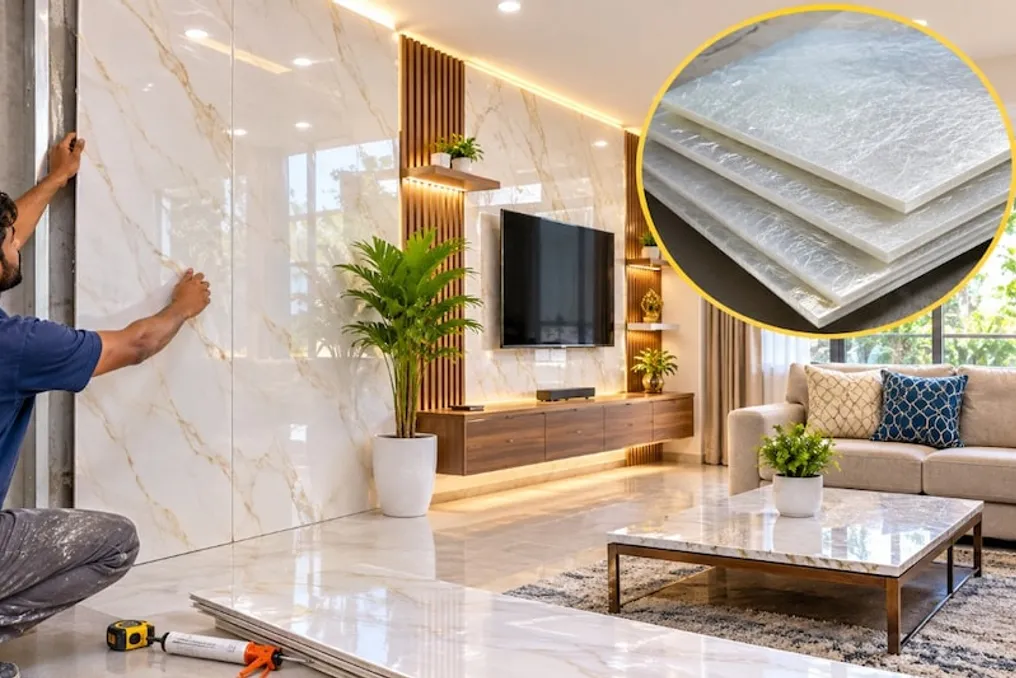
What is fiberglass and why is it becoming more popular than marble and tile
Read more
Aaj Tak
www.aajtak.in

What is fiberglass and why is it becoming more popular than marble and tile

Nowadays, people are increasingly using a special material instead of traditional marble and tile in their homes, and this material is called fiberglass. Demand for it in the market is growing, so it is important to understand what fiberglass is and what its features are.

Fiberglass is a modern and very strong material. It is made by mixing fine glass fibers with a plastic resin composition. In technical terms, it is also called 'glass-reinforced plastic' (GRP). This material is very light, yet possesses strength capable of competing with steel.

It is precisely because of these qualities that the demand for fiberglass sheets in the construction and interior design of residential and commercial buildings is rapidly increasing compared to marble and tile. Fiberglass has numerous advantages.

Marble and tile are quite heavy, which requires significant labor and time for their transportation and installation. In contrast, fiberglass is very light, allowing it to be easily installed on walls or roofs. The lightness of the material reduces the load on the building, as it does not add unnecessary weight to the overall structure.

Fiberglass is resistant to damage. While marble and tile can crack or break from falling heavy objects, fiberglass does not break as easily due to its flexibility and strength. It is not affected by sun, rain, or moisture, nor does it suffer from rust or termite infestation.

Unlike tile, where gaps can lead to water leaks and dampness, fiberglass is completely waterproof. Therefore, it is considered the best choice for bathrooms, kitchens, and roofs.

Furthermore, fiberglass is available in a wide range of designs and variations. While marble is difficult to cut and process, fiberglass can be molded into any custom shape, mold, or curved design. It can be given the appearance of marble, wood, or any other decorative tile, giving it a very modern and attractive look.

Marble can develop permanent stains from acid, tea, or oil, and its shine dulls. Fiberglass does not absorb stains and only needs to be cleaned with a damp cloth, eliminating the need for regular polishing.

Fiberglass is an excellent thermal insulator. It prevents excessive heating indoors in summer and severe cooling in winter, which contributes to energy savings. Whereas marble and tile become very cold to the touch, fiberglass does not have such properties.

Today, fiberglass is most often used to make bathtubs, roofing sheets, designer wall panels, kitchen countertops, and doors. Being economical, it provides a modern look and a long service life, which is what prompts people to abandon traditional marble and tile in favor of this material.


Similar stories

Alcohol molecules found in giant cosmic cloud capable of holding the entire Earth
Read more
www.aajtak.in

Alcohol molecules found in giant cosmic cloud capable of holding the entire Earth

Alcohol lovers on Earth might be interested to know that 'alcohol' also exists in space. A massive gas and dust cloud was discovered near the center of our Milky Way galaxy, containing various alcohol molecules. Scientists identified propanol here, which is considered the largest alcohol molecule found in space to date.

It is important to note that this is not potable alcohol, but a chemical substance. According to researchers, this discovery may help understand the processes of forming complex organic compounds necessary for life in space.

The attention of scientists is focused on a giant molecular cloud called Sagittarius B2, located near the center of the Milky Way. It is approximately 26 thousand light-years from Earth. This region is rich in gas and dust and is a site of active formation of a large number of new stars, hence it is called a stellar nursery.

Various alcohol molecules were found in this cloud, including methanol, ethanol, vinyl alcohol, ethyl formate, and propanol. According to scientists, the amount of methanol and ethanol in Sagittarius B2 is so vast that an estimated 10 trillion liters of these substances are present. However, this does not mean that the alcohol has accumulated in liquid form, like a sea or a pond; these molecules are distributed among the cosmic gas and dust.

The characteristic of the discovered propanol is that it is the largest alcohol molecule ever found. One of its types is isopropanol, which is used in hand antiseptics. Another type is common propanol. Scientists detected the presence of isopropanol in Sagittarius B2 using a radio telescope located in Chile. These discoveries were published in two studies in the scientific journal Astronomy & Astrophysics.

Researchers involved in this project emphasize the exceptional importance of discovering both forms of propanol, as their chemical structures are very similar, and they can exist under similar conditions. By comparing their quantities, scientists can understand exactly how such complex chemical compounds are formed in space.

The main question facing scientists is how such complex organic molecules form in space. To date, about 125 different molecules have been identified in space. Scientists believe that most of them are formed by the collision and combination of small molecules or atoms. However, explaining the presence of such complex substances as vinyl alcohol and propanol solely by this process is difficult.

In 2001, scientists recorded signals of vinyl alcohol in Sagittarius B2 using a 12-meter radio telescope. This was the last of three stable molecules of the C2H4O group discovered in space. At that time, a scientist from the National Radio Astronomy Observatory of the USA, Barry Turner, stated that the discovery of vinyl alcohol was an important key to understanding the process of forming complex organic substances in space.

Another interesting discovery in the Sagittarius B2 cloud is the detection of a chemical substance called ethyl formate. This is the substance that gives raspberries their distinctive taste. Notably, it has a rum aroma. Because of this, scientists once jokingly remarked that the center of our galaxy might taste like raspberry and smell like rum. Nevertheless, this does not mean that real raspberries or rum exist in space; these are simply properties of chemical molecules.

The significance of these discoveries for scientists is not limited to the fact that alcohol-related compounds are in space. In fact, these compounds can help them understand how complex organic molecules necessary for life are formed and distributed in space. This is why they continue to closely observe giant molecular clouds like Sagittarius B2. Scientists hope this will help determine whether there are chemical conditions necessary for life in the universe besides Earth.

Recipe for Crispy Green Lentil Puri for a Festive Table
Read more
www.aajtak.in

Recipe for Crispy Green Lentil Puri for a Festive Table

During the holiday season, many different dishes are inevitably prepared, and in such an atmosphere, one wants to try something special that is different from ordinary everyday puri. If you are striving to cook something tasty and crispy, green lentil puri is an excellent choice.

These puris are not only very tasty but also nutritious. They have a flavor reminiscent of kachori and will appeal to both children and adults, adding a special aroma to the festive table.

For preparation, you will need: half a cup of green lentils (soaked for 2 hours), 2 cups of wheat flour, 2 teaspoons of dry grain or legume flour (to add crispiness), half a teaspoon of ajwain, 1 teaspoon of cardamom powder, a pinch of asafoetida, turmeric, and red pepper powder to taste, salt to taste, as well as oil or ghee for kneading the dough and frying.

First, you need to prepare the lentils: completely drain the water from the soaked green lentils, and then grind them in a blender without adding water or adding just a little to form a coarse mass.

Next, in a large bowl, mix the wheat flour, dry grain or legume flour, and all the spices: ajwain, cardamom, asafoetida, turmeric, red pepper, and salt. Add the ground lentils and one tablespoon of oil, mixing thoroughly. Then, gradually adding water, knead a stiff dough, similar to puri dough. Let the dough rest for 15 minutes.

After this, divide the dough into small balls. Lightly brush each ball with oil and roll it into a round or oval shape, trying not to make them too thin. Heat oil in a deep pan to medium-high heat. Carefully drop the rolled puris into the hot oil and gently press with a spatula so that they rise like balloons. Fry on both sides until golden and crispy.

Serve the hot and crispy green lentil puris with vegetable curry, raita, or your favorite sauce.

Popular