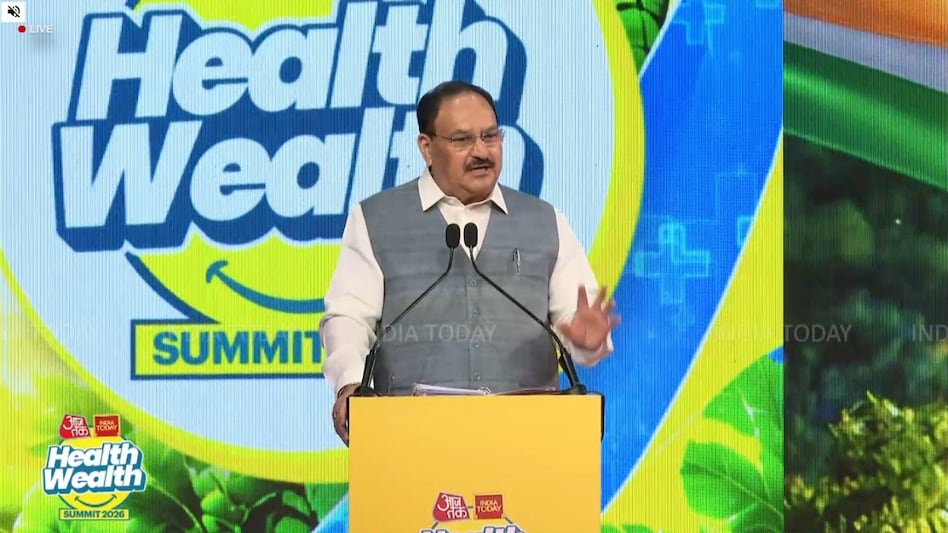
Union Minister of Health and Family Welfare J.P. Nadda presented a detailed assessment of the current state of the country's healthcare system while inaugurating India Today's 'HealthWealth Summit 2026' held at Noida Film City. He emphasized that the creation of a developed India is only possible if all 140 crore citizens of the country are healthy.
Nadda recalled the past situation when families had to sell their homes, land, and jewelry to treat serious illnesses like cancer or heart attacks, causing poor people to hesitate in visiting doctors due to the fear of jeopardizing their children's future. However, he stated that the situation has significantly changed now.
The minister explained that previously, the medical system was focused only on treatment (Cure) after illness, where doctors often advised taking antibiotics and avoiding certain things. This approach was changed by the new National Health Policy introduced in 2017. Now, the government is working on Prevention, Promotion, and a Holistic Approach, establishing a strong chain from primary to tertiary healthcare.
'Ayushman Arogya Mandir' (Health and Wellness Centers) have proven to be a decisive factor in bringing health facilities to every corner of the country. Speaking with data, the minister mentioned that 44 crore people over the age of 30 have been screened for high blood pressure and diabetes, and treatment has begun for millions of people by detecting diseases in their early stages.
Additionally, the vaccination of pregnant women (mothers) and children has been made completely digital through the 'U-WIN' portal. As a result, the institutional delivery rate in the country has increased from 70-71% to 90%.
Referring to government efforts to address the shortage of doctors, Nadda stated that the number of AIIMS in the country has increased from 1 to 23, while the number of medical colleges has risen from 387 to 1,063. The government is rapidly increasing UG and PG seats with the aim of providing excellent physicians and is investing thousands of crores in this direction.
Mentioning the Ayushman Bharat scheme, which has proven to be a boon for the poor, he said that currently, 61 crore people are receiving free health coverage up to ₹5 lakh. The biggest feature of this scheme is that senior citizens above 70 years of age receive free health insurance of ₹5 lakh until the last moments of life, regardless of their economic status or caste/religion. Citing a report from 'The Lancet', he mentioned that now, 90% of patients start treatment within one month upon detection of serious diseases like cancer.
Due to the reduction in drug prices and 'Amrit' pharmacies, the out-of-pocket expense for the common man, which was previously 63%, has decreased to about 43-44%. Millions of rupees are being saved by people because of Jan Aushadhi Kendras and 'Amrit' pharmacies (where medicines and implants are available at a 50% discount).
Concluding his speech, J.P. Nadda gave practical and strict advice to the youth. Smiling, he said, 'The solution is in not creating problems! Know your body; do not abuse your body. The younger generation needs to adopt healthy habits and lifestyle so that you and your family do not have to visit hospitals.'