Updated Free Trade Agreement Between China and Peru Enters into Force
Read more
CGTN
cgtn.com

Updated Free Trade Agreement Between China and Peru Enters into Force

The protocol modernizing the free trade agreement (FTA) between China and Peru officially came into effect on Sunday, injecting new energy into bilateral economic and trade relations.

This protocol was initially signed on November 14, 2024, and aims to optimize provisions across various areas of the original FTA.

Under the updated structure, seven existing chapters were strengthened: rules of origin, customs procedures and trade facilitation, sanitary and phytosanitary measures, intellectual property rights, trade in services, temporary entry for business persons, and investments.

Additionally, five new provisions were introduced concerning cooperation in standards and conformity assessment, competition policy, e-commerce, global supply chains, as well as environmental and trade issues.

According to a statement published on Sunday by the Chinese Ministry of Commerce, both sides also agreed on future provisions for negotiations on negative lists in the areas of trade in services and investment, striving to further expand openness in these fields.

Since the original FTA entered into force in 2010, bilateral trade has grown significantly by almost seven times, increasing from $6.4 billion in 2009 to $50.4 billion in 2025.

The Ministry noted that the updated agreement will open up new opportunities for trade and investment, optimize the business environment for companies in both countries, and give a fresh impetus to their economic and trade ties. It is worth noting that the FTA between China and Peru is the first comprehensive agreement of this kind that China has concluded with a Latin American country.

Similar stories

India-New Zealand Free Trade Agreement Enters into Force: Key Changes
Read more
business-standard.com

India-New Zealand Free Trade Agreement Enters into Force: Key Changes

The Free Trade Agreement (FTA) between India and New Zealand came into effect on Tuesday, which provides for the elimination of customs duties on goods from India exported to New Zealand, as well as tariff concessions on certain imported goods from New Zealand into India. Furthermore, this agreement opens up new opportunities for temporary work visas for qualified specialists from India.

Although Indian exports will receive duty-free access to all product lines in New Zealand, India's tariff concessions will depend on the specific product; some reductions take effect immediately, while others will be implemented gradually.

Indian Exports Gain Duty-Free Access to New Zealand

Under this agreement, India has begun providing a preferential tariff regime for a range of products from New Zealand. These concessions include duty-free entry for certain types of mutton, wool, and timber, while duties on other goods will be reduced according to the agreed schedule.

Tariffs on wine will be determined by the value of each 750ml bottle. In the first year, the rate will be 150 percent for wine valued under $5, 95 percent for wine valued between $5 and less than $15, and 70 percent for wine valued at $15 or more, based on CIF value.

The agreement also provides preferential access for selected agricultural products through tariff-based quotas. Qualified New Zealand kiwifruit valued at no less than $1.80 per kg will receive a zero-duty quota of 6,250 tonnes in the first year. Regarding apples, the quota will start in the second year, allowing 35,000 tonnes to be imported at a 25 percent rate, compared to the existing 50 percent rate.

Certified Manuka honey will receive lower tariffs under the quota agreement. For the remainder of 2026, the established quota is 40 tonnes, with a reduced rate for corresponding imports priced between $20 and less than $30 per kg. The annual quota under the agreement is 200 tonnes, with tariffs further decreasing over five years.

Dairy Products Remain Protected

India has excluded sensitive goods from its tariff concessions, including dairy products, sugar, vegetable oils, and certain agricultural commodities. Animal meat is also excluded, except for mutton, which is covered by the agreement.

New Pathways Open for Temporary Work for Indian Citizens

As of October 20, two types of temporary employment visas become available for eligible Indian citizens. The total limit is 5,000 visa holders simultaneously, and these visas are valid for three years without a direct path to permanent residency.

Applicants must meet New Zealand's immigration requirements, including having a job offer from an accredited employer and meeting relevant qualification, language, medical, and moral standards.

Further changes will follow later. Starting November 16, graduates from India holding PhDs from New Zealand can apply for post-study work visas for up to four years. Within two years, a working holiday program for Indian citizens aged 18 to 30 is planned, with the possibility of up to 1,000 participants annually.

Further Tariff Reductions and Visa Policy Changes Ahead

Several provisions of the agreement will come into effect in the coming years. New Zealand's tariff concessions will expand over time, and relevant Indian graduates will gain expanded opportunities for post-study work in accordance with the agreement's provisions.

Both countries also intend to introduce a working holiday program for Indian citizens aged 18 to 30, offering up to 1,000 spots annually and allowing stays of up to 12 months. This program is scheduled to launch within two years of the agreement's entry into force.

New Zealand has also committed to facilitating $20 billion in investment into India over 15 years. The goal of the agreement is to double bilateral trade in goods and services to NZD 7 billion by 2030.

Free Trade Agreement between India and New Zealand Enters into Force
Read more
yourstory.com

Free Trade Agreement between India and New Zealand Enters into Force

The Free Trade Agreement (FTA) between India and New Zealand, which was signed on April 27, entered into force on Tuesday. It grants Indian goods, including products from labor-intensive sectors such as textiles and leather, duty-free access.

This is the seventh trade agreement to enter into force in the last five years. Previous agreements were concluded with the UAE, Mauritius, the European Free Trade Association (EFTA), the United Kingdom, Oman, and Australia. This agreement marks India's seventeenth active FTA.

Although negotiations began in 2010, were suspended in 2015, and resumed in March 2025, its entry into force signifies a new stage of cooperation.

Experts note that sectors such as textiles and apparel, leather and footwear, engineering goods and auto components, precious stones and jewelry, agriculture and processed foods, pharmaceuticals, and other manufacturing sectors benefit from this FTA.

Gulzar Didwanya, a partner at Deloitte India, predicts that this deal should stimulate an increase in Foreign Direct Investment (FDI) in India, although the scale of such growth remains uncertain and will depend on private sector investment decisions. Meanwhile, New Zealand has already invested $20 billion over more than 15 years.

He emphasized that the FTA provisions on duty-free access to certain raw materials, bilateral cumulation, simplification of customs procedures, and investment promotion mechanisms can contribute to deepening value chain integration and improving investment conditions. Furthermore, he noted that the agreement has significance beyond trade, as it strengthens India's strategic position in the Indo-Pacific region and expands its network of FTAs with developed economies.

Against the backdrop of growing global trade uncertainty, the FTA between India and New Zealand serves as a strong affirmation of open market principles and predictable trade rules. The ambitious goal of doubling bilateral trade by 2030 sets a high benchmark for both countries.

This FTA holds particular value because it covers not only goods but also services, investments, skills, and mobility, opening up new opportunities for Indian professionals and businesses. Since 100 percent of Indian exports receive duty-free access to New Zealand from day one, the agreement gives Indian exporters a significant competitive advantage, especially SMEs in the textile, leather, footwear, and engineering goods sectors.

Shishir Priyadarshi, President of the economic analysis center Chintan Research Foundation (CRF India), also stated that in the context of global trade instability, the FTA is a powerful confirmation of market openness. He agreed that the value of the agreement lies in its coverage of services, investments, skills, and mobility, creating new opportunities for Indian professionals and businesses.

Trade expert and Chairman of Hi-Tech Gears, Deep Kapuria, noted that the introduction of the FTA with New Zealand completes India's acquisition of preferential market access in all major Asia-Pacific countries. He added that New Zealand is a very open economy, and India has brilliantly structured this deal by ensuring access to new services such as Ayurveda, yoga instructors, and student mobility, including post-study work visas.

In 2025–26, bilateral trade volume decreased by approximately 11 percent, amounting to $1.15 billion compared to $1.3 billion in the previous fiscal year. India's exports reached $566.51 million, while imports amounted to $589.1 million, resulting in a small trade deficit for India of $22.59 million.

Rani Singh, of New Zealand Indian descent, believes that this deal is an important step forward for both countries, as it aims not only at trade but also at bringing the two nations closer, creating opportunities for people and businesses, and building stronger relationships in the future. She emphasized that thanks to duty-free access to all product lines for India in New Zealand from day one, Indian businesses can become more competitive in this market. Singh also added that the benefits are not limited to goods, as there is potential for greater cooperation in education, tourism, technology, professional services, and investment, which can strengthen ties through providing greater opportunities for skilled professionals and youth.

Free Trade Agreement between India and New Zealand Enters into Force: Zero Tariffs on Indian Goods
Read more
www.aajtak.in

Free Trade Agreement between India and New Zealand Enters into Force: Zero Tariffs on Indian Goods

A new trade route has opened up between India and New Zealand. The Free Trade Agreement (FTA) between the two countries will come into effect on October 20, 2026. Under the terms of this agreement, New Zealand will abolish import duties on Indian goods. This will make items such as clothing, footwear, leather goods, medicines, and engineering products manufactured in India cheaper in New Zealand compared to the previous period.

In turn, India will also provide preferential treatment on import duties for a range of goods from New Zealand. It is expected that this agreement will promote an increase in trade turnover between the two nations. The significance of this treaty extends beyond just companies and traders; it also includes provisions on employment opportunities for Indian specialists in New Zealand, visas for skilled labor, and cooperation in the agricultural sector.

Indian exporters are expected to benefit the most from this agreement. Previously, an import duty of up to 10% was levied on some Indian goods sold in New Zealand. After the free trade agreement comes into force, products marked 'Made in India' will gain access to the New Zealand market without paying tariffs.

Thus, most goods exported from India after the agreement takes effect will be able to enter New Zealand without customs charges. This will simplify the process of selling products by Indian companies in New Zealand. Furthermore, they may gain a price advantage over exporters from other countries whose products are subject to various levies.

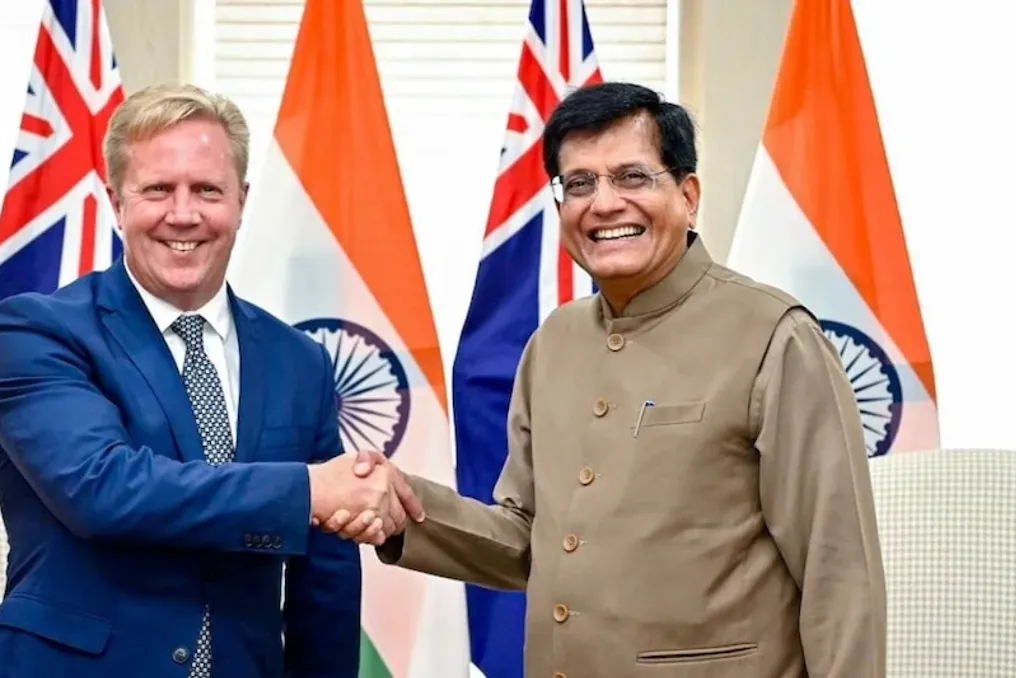
India's Minister of Commerce and Industry, Piyush Goyal, stated that thanks to the free trade agreement, zero import duty will be applied in New Zealand to products from labor-intensive industries such as leather, footwear, clothing, and textiles. He also specified that sensitive sectors, including dairy products, onions, chickpeas, peas, corn, almonds, artificial honey, and sugar, are excluded from the scope of this trade agreement.

Clothing and Textiles: Indian apparel and finished goods can be sold in New Zealand at more competitive prices.

Leather and Footwear: Tariff elimination may reduce production costs for Indian enterprises.

Medicines and Engineering Goods: Export opportunities in pharmaceuticals, mechanical engineering, and engineering products may increase.

Food Products: Products such as fruits and vegetables, tea, coffee, spices, grains, and processed foods may also gain better market access.

Seafood, Plastics, and Rubber: Exporters from these sectors are also expected to benefit from tariff-free market access.

The government aims to achieve a trade volume of approximately 7 billion New Zealand dollars, equivalent to about 35,000 crore rupees, between India and New Zealand by 2030. Currently, the trade turnover between the two countries is about 2.4 billion US dollars.

Under this agreement, India will also provide preferential treatment on import duties for a range of goods from New Zealand. This could lead to a reduction in import costs for certain goods from New Zealand in India. However, this does not mean that prices for all goods will immediately drop. New Zealand will also provide special import regimes for certain products, such as apples, kiwis, manuka honey, and albumin, for India. These goods will be subject to quota conditions based on tariffs, as well as other restrictions, including minimum import prices and protective measures.

Apples and kiwis are major products from New Zealand entering India. While tariff reductions may decrease import costs, the actual price reduction will depend on import volume, quotas, transportation costs, demand, and retailer margins.

Manuka honey from New Zealand is also included in this agreement. Tariff reductions may lower its import costs, which in turn could lead to a decrease in the price of this product in the Indian market compared to the past.

India has not fully opened its doors to all goods from New Zealand. Under the agreement, India provides tariff concessions on approximately 70% of categories, accounting for about 95% of current bilateral trade. Meanwhile, about 29.97% of tariff lines remain outside the scope of the FTA. According to New Zealand's Minister of Trade and Investment, Todd McClay, upon full entry into force of the agreement, about 95% of New Zealand's current exports could benefit from the abolition or significant reduction of tariffs. India's large consumer market could create new opportunities for New Zealand businesses.

One of the issues that arises when concluding free trade agreements with any country is the risk of harming local producers due to the cheapening of imported goods. Considering this, India has excluded its sensitive sectors from the scope of the free trade agreement with New Zealand. These sectors include dairy products such as milk, cream, whey, yogurt, and cheese. Agricultural crops such as onions, chickpeas, peas, corn, and almonds, as well as sugar, artificial honey, various animal products, fats, and oils, are also excluded from the list.

Popular