Chinese and German automotive companies explored opportunities to strengthen interaction against the backdrop of deep global transformation and intense competition in the industry on Friday.
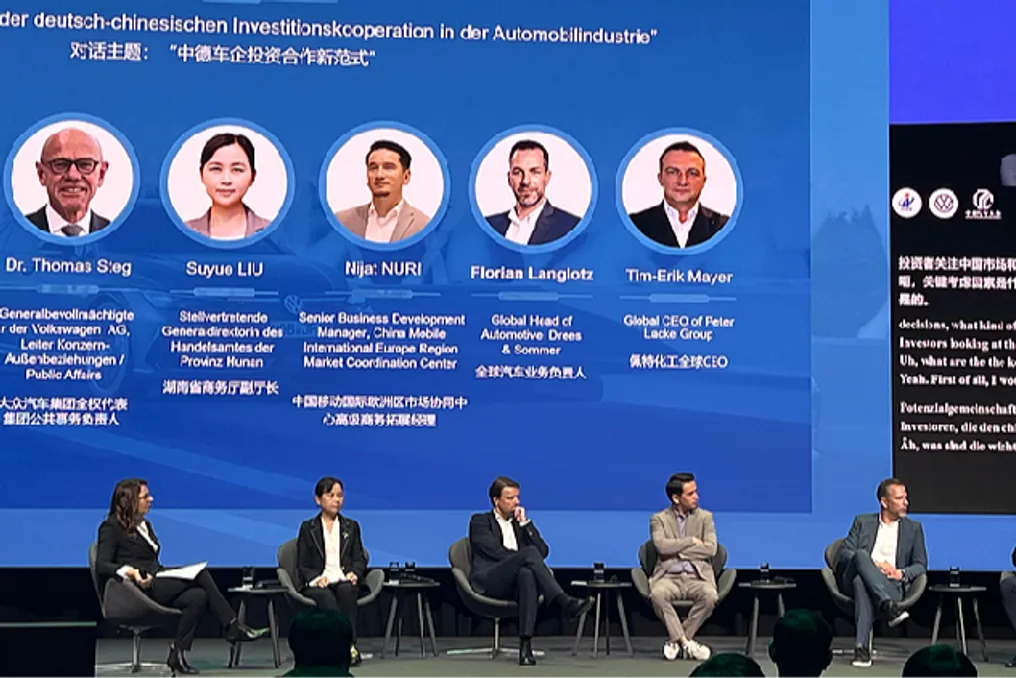
The Tenth German-Chinese Automotive Congress took place in Wolfsburg, Germany, on Friday, gathering about 600 representatives from China and Germany.
According to Olaf Lies, Minister-President of Lower Saxony, the automotive industry, including its suppliers and technology sectors, is undergoing one of the most massive and rapid transformations in its history.
Lies noted that this transformation is driven by a number of factors, such as electrification, digitalization of vehicles, the application of artificial intelligence in both production and the vehicles themselves, and autonomous driving, adding that the congress serves as a strong signal for the need to deepen cooperation between Germany and China.
Thomas Schmall, CEO of Volkswagen Group Technology, emphasized that under current conditions, it is crucial for German and Chinese companies to maintain dialogue and build reliable and solid partnerships.
Meanwhile, Liu Minqian, Director General of the Ministry of Commerce of the PRC's Investment Promotion Agency (MOFCOM), stated that the acceleration of transformation is not a negative factor for the automotive industry but rather promotes its modernization and positively affects the provision of higher quality products and services to customers. He called on companies to focus on improving their technologies, products, and services.
Lin Dong, China's Consul in Hamburg, added that cooperation between Chinese and German automakers has gone beyond traditional finished vehicle production, covering areas such as batteries, intelligent connectivity, and technological innovation.
The automotive congress followed the International Supplier Fair, which began in Wolfsburg on Tuesday. Forty-five Chinese automotive suppliers participated in this fair.
The Economic Conference on Trade Cooperation between Hunan Province of China and Germany, also held on Friday, coincided with the German-Chinese Automotive Congress.
Representatives of the German automotive industry reacted positively to delegates from Central China's Hunan Province. At the meeting, Gundula Henkel, a member of the Saxony-Anhalt German-Chinese Association board, observed the presentations with interest and was deeply impressed by China's pace of development. She noted: 'One can see how skillfully China's local strengths are combined with the necessary industries. This is a real breakthrough in understanding.'
Liu Suiyue, Deputy Director of the Hunan Provincial Department of Commerce, summarized the advantages of Hunan as a favorable destination for German investment, naming them the '5Cs': cost, consumer base, complete cluster supply, talented college base, and convenient environment. He stated: 'We are ready to work with you, and I believe our sincerity can bridge the distance from the Yangtze River to the Rhine.'
Several well-known companies from Hunan Province are located in Germany, including Sany Group. The Chinese multinational heavy equipment manufacturer Sany Group acquired Putzmeister, one of the world's leading construction equipment manufacturers, in 2012.
Michael Boese, Chairman of the Board of automotive BerlinBrandenburg e.V., also attended the meeting. He expressed satisfaction with the opportunity to interact with representatives from Hunan, and potentially with Sany Group to discuss vehicles and automotive technologies. As chairman of the German association representing companies in the special transport manufacturing sector, Boese is aware that German companies 'are currently showing great interest and actively seeking contacts in the electric vehicle industry, especially regarding heavy trucks and heavy machinery in connection with China.'
Liu Minqian, an official from MOFCOM, noted in his speech at the meeting that Hunan has a solid foundation in the automotive industry as a major manufacturing province of China. These industrial capabilities not only provide enterprises with supply chains and market expansion opportunities but also create significant room for cooperation between China and Germany in new technologies and products.
Liu Minqian also stated that the purpose of coordinating the Hunan promotional meeting with the Sino-German Automotive Congress is to deepen the understanding of Hunan Province among the German community.
Uwe Fritsch, a specialist in member relations for automotiveland.nrw, the automotive industry cluster in the German state of North Rhine-Westphalia, also emphasized the importance of closer exchange between China and Germany. He agreed with Lower Saxony Minister-President Olaf Lies, stating that more cooperation is needed—in both directions. This implies not only closer economic interaction between German and Chinese companies but also, equally important in the current situation, greater mutual understanding and dialogue.