The commercial spaceflight company InterstellOr, based in Beijing, announced the completion of a modal test of the ground test emergency escape capsule for its suborbital crewed spacecraft, InterstellOr One (CYZ1). This information was published by the company via IT Home and Jiemian on November 1.
The test allowed for the measurement of the basic dynamic characteristics of the capsule structure and provided the company with actual data to validate its models and analyze upcoming flight tests involving the activation of the escape system.
Modal testing demonstrates how the structure vibrates. For an escape capsule, it is critically important to understand how it will react when the system activates under extreme conditions, and whether such a reaction threatens the structural integrity or crew safety. This test allows for the determination of three types of parameters: natural frequencies, mode shapes describing the movement of each part, and damping coefficients indicating the rate of vibration energy decay.
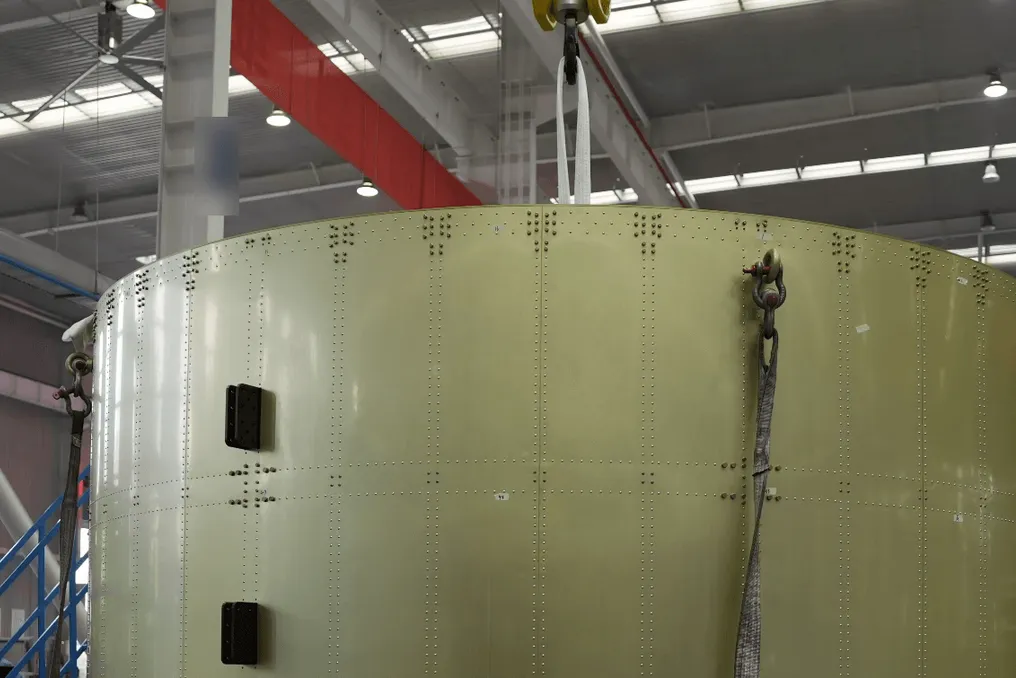
The test capsule has a diameter of about 4 meters and weighs approximately 1.1 tons. It was suspended on an elastic system to simulate free-boundary conditions, using a suspension frequency below 2 Hz, which is less than one-fifth of the capsule's lowest elastic mode. Engineers impacted the body with a hammer, while over 100 measurement points, located around the circumference and at different heights, recorded the response. These points covered key interfaces and the solid rocket motor mounting ring, paying special attention to modes related to thrust misalignment, as well as lateral and axial motion.
One of the objectives was to study the ovalization mode, where the circular cross-section of a large thin-walled shell deforms into a flatter shape. If the frequency of this mode is too close to flight vibrations, it could cause localized fatigue or instability. InterstellOr stated that the results of its finite element modeling closely matched the measured shapes, confirming the model the company will use for load prediction and safety analysis.
CYZ1 uses a 'ejection' type escape mechanism, rather than a traditional tower that pulls the capsule out. A spatial truss network converges to a central ring, distributing thrust loads along multiple trajectories. Since there is no mature dynamic data for this structure, the test also establishes a baseline: repeating the test after transport or flight will reveal changes in stiffness caused by fatigue cracks or weakened joints, supporting the reusability check required for a reusable spacecraft.