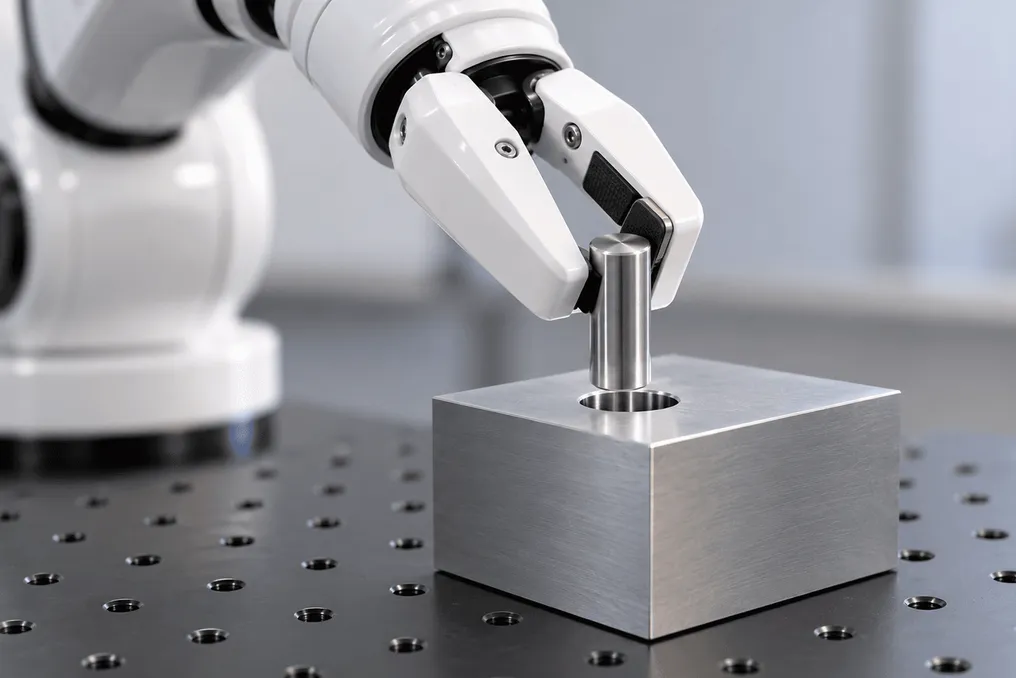
A team of researchers from the Institute of Automation of the Chinese Academy of Sciences (CASIA) demonstrated that adding tactile feedback to fingertips significantly improves a robotic arm's ability to insert parts into holes with sub-millimeter clearance.
The work, conducted by Long Chen's team with contributions from Xinpan Meng, Houcheng Li, and Zhenhua Ma, was accepted at the IROS 2026 conference and published on arXiv under the title 'From Reach to Insert: Tactile-Augmented Precision Assembly under Sub-Millimeter Tolerances.'
Precise insertion of parts into small tolerance holes is a challenging task because minor positional errors can lead to jamming or excessive contact forces, and cameras are often obstructed by the gripper and the part itself when the pin approaches the hole.
The team divided this task into two stages. First, a reaching policy trained using Imitation Learning with Diffusion Policy grasps a randomly placed pin and brings it near the hole. Then, a Reinforcement Learning policy based on Soft Actor-Critic performs the insertion process and is capable of recovering from failures during contact.
An asymmetric actor-critic architecture is used during training. The actor primarily relies on visual data, which ensures the policy's efficiency during insertion, while the critic receives tactile feedback for a more accurate assessment of actions. Since each grasp leaves a different initial reading on the sensor, the system first evaluates the tactile baseline before contact, and the critic works with the change relative to this baseline. Furthermore, the team groups training samples by torque readings and distributes samples evenly within groups so that the policy can see a wider range of contact conditions.
For the experiment, a 7-DOF Franka Emika Panda robotic arm equipped with a six-axis PaXini PX-6AX GEN3 tactile sensor on the fingertip, an Intel RealSense camera mounted on the wrist, and a second RealSense camera for general overview was used. This sensor was provided as part of research collaboration with PaXini Tech.
Testing was conducted on five different hole shapes: square, circular, hexagonal, L-shaped, and triangular, with tolerances of 1 mm, 0.25 mm, and 0.05 mm. Using pure imitation learning, the average success rate was 76% at a 1 mm clearance, but dropped to 24% at 0.25 mm and 0% at 0.05 mm. At a 0.05 mm clearance, imitation learning combined with reinforcement learning without the tactile sensor achieved 52% success. However, thanks to the tactile critic and sample grouping, success increased to 67%, while the peak interaction force decreased by 60% and the peak torque by 44%.