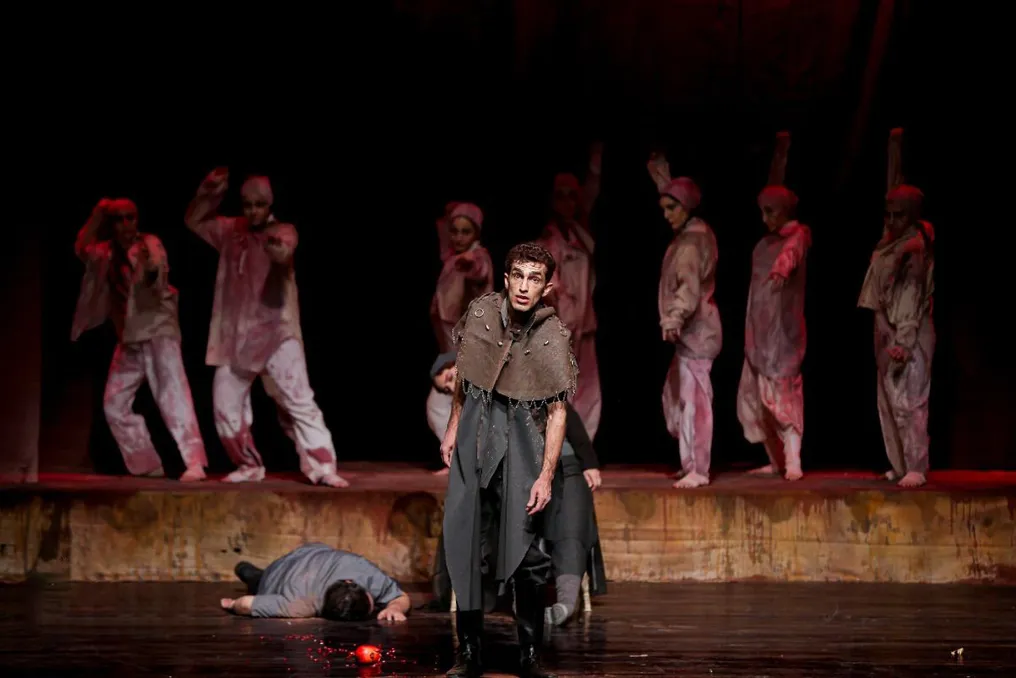
A production of Albert Camus' play 'Caligula' is taking place at the Isfahan Art Hall in Tehran. This 90-minute performance will be available to audiences until November 8th.
Rohaam Bahraei directed the play. The cast includes Radnoush Moghadam, Sam Kuravand, Mehdi Ahmadiparvar, Amirhossein Khamesipur, and Reza Mohammadian, among others.
Originally published in 1944, 'Caligula' has undergone numerous revisions. It is part of a cycle that Camus called the 'Cycle of Absurdity,' alongside the novel 'The Stranger' (1942) and the essay 'The Myth of Sisyphus' (1942).
Some critics characterize this work as existentialist, but Camus himself always denied its belonging to this philosophical school. The plot of the play centers on the historical figure Caligula, the Roman emperor known for his cruelty and seemingly insane behavior.
The play depicts Caligula experiencing grief after the death of his sister Drusilla. According to Camus' version, Caligula ultimately orchestrates his own murder intentionally. (Historically, Caligula was assassinated in 41 AD).
Albert Camus wrote about his work: 'Caligula, seemingly a kind prince, realizes after Drusilla's death that people die and they are unhappy. Obsessed with the search for the Absolute and poisoned by contempt and horror, he tries to realize freedom through murders and the systematic distortion of all values, which he eventually discovers is not true freedom. He rejects friendship and love, simple human solidarity, good and evil. He accepts the words of those around him; he forces them to obey logic; he levels everyone around him with the force of his refusal and the fury of destruction that drives his passion for life.'
Camus continued: 'But if his truth lies in rebellion against fate, then his capacity is to oppose and deny other people. One cannot destroy without destroying oneself. That is why Caligula empties the world around him and, following his logic, makes preparations to arm those who will eventually kill him. Caligula is a story of magnificent suicide. It is the story of the most human and most tragic delusion. Unfaithful to man, faithful to himself, Caligula agrees to die, realizing that no one can save himself alone, and that one cannot be free in opposition to other people.'
Albert Camus (1913–1960) was a French philosopher, author, playwright, journalist, global federalist, and political activist. He received the Nobel Prize in Literature in 1957 at the age of 44, becoming the second youngest laureate in history. Among his works are 'The Stranger,' 'The Plague,' 'The Myth of Sisyphus,' 'The Fall,' and 'The Rebel.'