Moon approaches Mars and Jupiter early in the week, causing lunar occultation in certain regions
Read more
Olhar Digital
olhardigital.com.br

Moon approaches Mars and Jupiter early in the week, causing lunar occultation in certain regions

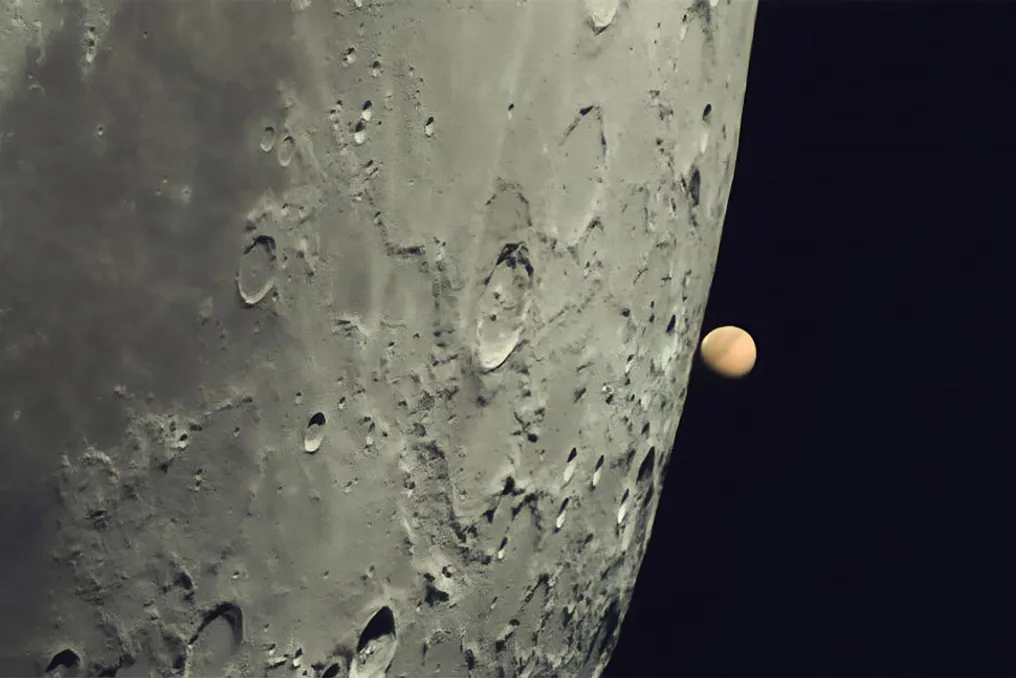
Beginning its November 'monthly tour' of the Solar System planets, the Moon is close to Mars on Monday morning (2) and to Jupiter at night. In some locations on Earth, this approach results in a phenomenon similar to an 'eclipse,' although it is technically called a lunar occultation.

This event is not visible across the entire globe. In Brazil, for example, the two celestial bodies will not overlap, but they will appear very close in the sky. This visual alignment is called astronomical conjunction, which occurs when two or more celestial bodies share the same right ascension, meaning the coordinate equivalent to terrestrial longitude.

The conjunction between the Moon and Mars begins at 11:24 AM, according to Brasília time, but it will not be observable due to daylight brightness. According to information from the InTheSky.org observation guide, they can be seen near sunrise, appearing at 1:09 AM and reaching an altitude of 40° above the northeast horizon, before disappearing shortly before 5 AM.

Later, at 8:09 PM, the Earth's natural satellite will enter conjunction with Jupiter. In Brazil, both stars will be below the horizon line at that time. However, in other areas of the planet, besides being close, they will cause a more notable phenomenon: lunar occultation, where the Moon passes in front of Jupiter, temporarily covering it.

This event can be observed during the early morning hours in islands such as Maldives, Sri Lanka, Seychelles, and Mauritius, as well as on Réunion Island, a French territory in the Indian Ocean. In parts of South and Southeast Asia and Oceania, the occultation will occur during the day, which may make observation difficult due to sunlight.

The Moon will have a magnitude of -11.8, Mars will have a magnitude of 0.9, and Jupiter -2.1, with all three in the constellation Leo. It is important to note that the brighter an object is, the lower its magnitude (an inverse relationship). The Sun, being the brightest body in the sky, has an apparent magnitude of -27.

Throughout this month, the Moon will pass by Venus (on the 7th) and Saturn (on the 20th), concluding the period near the Red Planet and Jupiter (on the 30th). This sequence of monthly lunar conjunctions is due to the fact that it orbits the Earth in a plane that is approximately the same as the plane in which the planets orbit the Sun, known as the ecliptic plane.

The characteristic reddish hue of Mars has always aroused interest, linking it to mythologies and military operations. In Greek mythology, Ares, the god of war, was associated with this color. Interestingly, the brightest star in the constellation Scorpius, Antares, received this name for its reddish tone, referencing Ares, meaning 'Anti-Ares.' Later, with Roman domination in Europe, Ares was renamed Mars, a name also given to the planet and still in use today.
Similar stories

Moon Phase on October 28, 2026: Information about the Lunar Cycle
Read more
olhardigital.com.br

Moon Phase on October 28, 2026: Information about the Lunar Cycle

On October 28, 2026, the Moon was in the full phase, showing 89% visibility. The complete calendar of lunar phases for October 2026 was released by the National Institute of Meteorology (Inmet).

The lunar phases in October 2026 began on the 3rd with the Waning Moon at 10:26 AM Brasília time. Subsequently, the New Moon occurred on the 10th at 12:50 PM. The Waxing Moon appeared on the 18th at 1:13 PM, and the Full Moon happened on the 26th at 1:13 AM.

A lunar cycle, also known as lunation, is the time interval between two new moons and has an average duration of 29.5 days. During this period, the Moon passes through the four main phases: new, waxing, full, and waning, with each phase lasting approximately seven days.

In addition to these main phases, there are so-called 'interphases,' which include the first quarter and the gibbous crescent (located between the new and full phases), and the waning gibbous and the last quarter (located between the full and waning phases).

Details about Lunar Phases

During the New Moon phase, the satellite is positioned between the Earth and the Sun. This results in only the side illuminated towards the Sun, while the dark side faces us, making the Moon invisible in the night sky. This phase signals the beginning of a new lunar cycle and is linked to renewal and new opportunities.

After the New Moon, the Waxing phase begins. Slowly, a thin illuminated band starts to be observed in the sky, and this illumination progressively increases each night. Initially, only a faint arc of light is seen, but as the days advance, the illuminated area grows until it reaches half of the Moon, a stage called First Quarter. This phase represents development, growth, and the building of new paths.

In the Full Moon phase, the Earth is located between the Sun and the Moon. This configuration allows the entire lunar face facing us to receive light, making it completely visible and bright in the firmament. This is the period of maximum luminous intensity, occurring when the Moon rises on the horizon simultaneously with sunset. The Full Moon is associated with fullness, the peak of processes, and energy at its highest point.

After the Full Moon, the lunar luminosity begins to gradually decline. Each night, a decrease in the illuminated surface is observed. When half of the Moon is visible, the Last Quarter occurs, which is the opposite of the First Quarter. The Moon continues to lose brightness until it returns to the New Moon, thus restarting the cycle. The Waning phase symbolizes reflection, closure, and preparation for subsequent beginnings.

Moon to Approach Pleiades Star Cluster, Known as the 'Seven Sisters'
Read more
olhardigital.com.br

Moon to Approach Pleiades Star Cluster, Known as the 'Seven Sisters'

Located 444 light-years from Earth, the open star cluster known as the Pleiades is also referred to as Messier 45 (M45) or the 'Seven Sisters'. On Tuesday night (the 27th), this cluster will be in close proximity to the Moon from our planet's perspective.

The Pleiades cluster consists of six prominent stars, but it received the name 'Seven Sisters' due to historical observations. The core of M45 is composed of young, hot blue stars that formed within the last hundred million years. The blue glow of these stars, reflected by the gas clouds surrounding the cluster, makes the view of this patch of the night sky particularly remarkable.

According to the astronomical observation guide In-The-Sky.org, the maximum conjunction of the Moon with the Pleiades will occur at 22:38 Brazilian time, when they will be only 58.6 arcminutes apart. It should be noted that an 'arcminute' is a unit of measurement in astronomy used to denote very small angles in the sky; a full circle is 360 degrees, and 60 arcminutes equal one degree.

From the perspective of an observer in São Paulo, the pair will become visible at 21:13, situated at an altitude of 12° above the northeast horizon. They will reach their highest point in the sky at 1:27 on Wednesday (the 28th), rising to 42° above the northern horizon, before disappearing at dusk at 4:42, at an altitude of 23° above the northwest horizon.

During this period, the Moon is on the third day of the full moon phase (technically, in the waning phase, intermediate before waning), illuminated by 93%, with a magnitude of -12.7. The magnitude of M45 will be 1.3, and both objects will be located in the constellation Taurus. The brighter an object appears, the smaller its numerical magnitude.

Although the pair will not be close enough to fit into a telescope's field of view, it can be seen with the naked eye or using binoculars. The reason why the cluster, which appears as six stars, is called the 'Seven Sisters' is related to the fact that in ancient times, when the name was given, observers could instantly see seven main stars with the naked eye. Over time, one of them disappeared from sight due to the change in the position of the variable star Pleione, which approached Atlas, and both became perceived by the naked eye as a single star.

Moon Phase on October 19, 2026: Information from the National Meteorological Institute
Read more
olhardigital.com.br

Moon Phase on October 19, 2026: Information from the National Meteorological Institute

On October 19, 2026, the Moon is in the waxing phase and has 62% visibility. According to data from the National Meteorological Institute (Inmet), a full calendar of lunar phases for this month is available.

The lunar phases in October 2026 began on the 3rd with a waning Moon at 10:26 Brazilian time. Then, the New Moon occurred on the 10th at 12:50. The Waxing Moon appeared on the 18th at 13:13, and the Full Moon is scheduled for the 26th at 1:13.

A lunation, or lunar cycle, is the period between new moons and has an average duration of 29.5 days. During this period, the Moon goes through four main phases: new, waxing, full, and waning, with each phase lasting approximately seven days.

There are also so-called 'intermediate phases': the waxing quarter and waxing gibbous, which are observed between the new and full Moons; as well as the waning gibbous and waning quarter between the full and waning Moons.

Description of Main Phases

During the New Moon, the satellite is located between the Earth and the Sun. This results in the illuminated side of the Moon facing the Sun, and the dark side facing us. Because of this, the Moon is not visible in the night sky. This phase marks the beginning of a new lunar cycle and is associated with rebirth and new opportunities.

Following the New Moon is the Waxing Moon phase. Gradually, a small illuminated strip begins to appear in the sky, which increases every night. Initially, only a thin ray of light is visible, but as the days pass, the illuminated part grows until half of the Moon becomes visible—this is called the Waxing Quarter. This phase symbolizes growth, development, and forging new paths.

During the Full Moon phase, the Earth is located between the Sun and the Moon. This allows the side of the Moon facing us to receive full light, making it completely visible and bright in the sky. This is a period of maximum light intensity, when the Moon rises exactly at sunset. The Full Moon is associated with completeness, the culmination of processes, and peak energy.

After the Full Moon, the Moon's light gradually begins to fade. Each night, we see less and less illuminated surface. When only half is visible, the Waning Quarter occurs, which is the opposite of the Waxing Quarter. The Moon continues to lose brightness until it reaches the New Moon again, restarting the cycle. The waning phase symbolizes reflection, completion, and preparation for new beginnings.

Currently, the Moon is in the waxing phase.

Popular