The month of November begins with several important astronomical events, including the end of Mercury's last retrograde motion of the year, a meteor shower, the observation of Uranus at its best time, and the arrival of a Supermoon. Concurrently, space exploration records an unprecedented feat with the Voyager 1 probe reaching a distance of one light-day from Earth.
It is important to note that all mentioned times and dates are referenced to an observer in Brasília (DF) and may vary slightly depending on the location. To ensure the accuracy of observations, it is recommended to use applications such as Star Walk, Stellarium, or SkySafari, which indicate the exact position of celestial bodies according to the observer's location.
On November 9th, Carl Sagan's birthday will be celebrated, a date dedicated to honoring the contributions of the astrophysicist and the legacy of scientific outreach he left behind.
On November 13th, Mercury's retrograde motion ends. Due to its relatively short orbit, completing one trip around the Sun every 88 days, the planet often appears to move backward in the sky for about three weeks as it overtakes Earth.
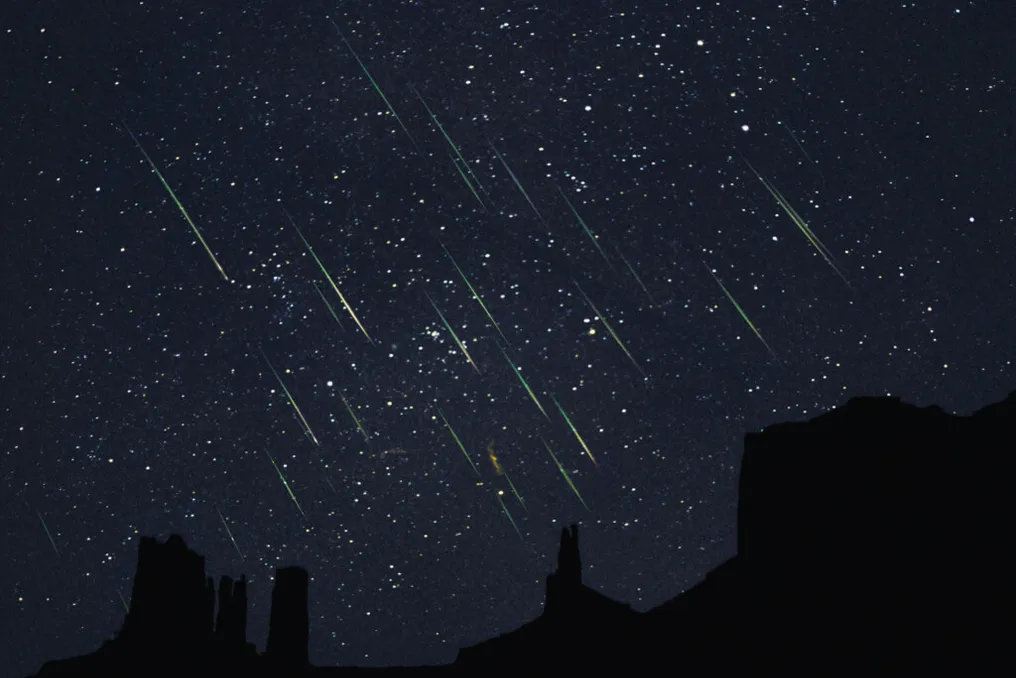
The peak of the Leonids meteor shower is expected on November 18th. On this day, with the Moon showing 61% illumination in the early evening, but setting before the ideal visibility time, the phenomenon can be seen in both the Southern and Northern Hemispheres.
Additionally, on November 25th, the Castor Supermoon will occur. This event happens when the Full Moon coincides with perigee, the orbital point closest to Earth, causing the lunar disk to appear slightly larger and up to 14% brighter than a common full moon. The name refers to periods when animals accumulated reserves for winter.
During this month, the Hera probe will arrive at the Didymos-Dimorphos asteroid binary system for the first encounter. This European Space Agency (ESA) spacecraft will study the consequences of the DART mission, conducted by NASA, assisting in improving planetary defense methods, and will release two cubesats before beginning its scientific activities in 2027.
Another milestone is the insertion of BepiColombo into Mercury's orbit. This collaborative mission between the ESA and the Japan Aerospace Exploration Agency (JAXA) will use the Mercury Planetary Orbiter (MPO) and the Mercury Magnetospheric Orbiter (MIO) to investigate the planet's magnetic field, interior, and surface.
Finally, around the 15th, the NASA's Voyager 1 probe will reach the mark of one light-day from Earth. Nearly fifty years after its launch in 1977, the spacecraft will be 25.9 billion kilometers from our planet, the time required for light to travel that distance.