Practical seminar on heritage preservation held at Sasanian palace ruins
Read more
Tehran Times
www.tehrantimes.com

Practical seminar on heritage preservation held at Sasanian palace ruins

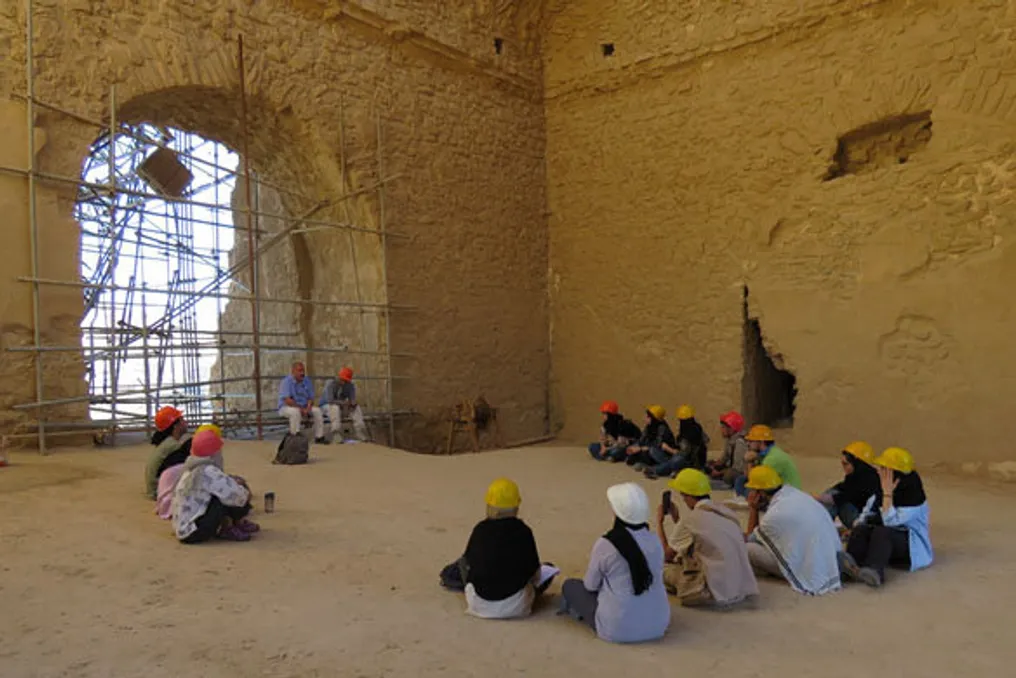
A practical training seminar on emergency preservation and restoration was held in Tehran at the Ardashir Palace and Kaleh Dokhtar Fortress, located near Firuzabad in southern Iran. The event gathered heritage preservation specialists and university students to gain practical experience in protecting historical structures.

Afshin Ebrahimi, director of the Sasanian Archaeological Landscape of Fars World Heritage site, reported that the seminar took place on Friday, October 30, with the participation of the World Heritage site management team, curators from Isfahan University of Arts, and twelve students.

The program aimed to familiarize students with practical methods of heritage conservation, monitoring, documentation, and emergency restoration, thereby bridging the gap between academic knowledge and hands-on experience at historical sites.

During the seminar, participants studied specialized measures for site preservation and periodic monitoring procedures. They also took part in practical exercises that included topographic surveying, preparation of detailed sketches, mapping, and damage assessment of selected wall surfaces at Kaleh Dokhtar, as well as filling out conservation monitoring records.

Ebrahimi emphasized that learning the correct identification and documentation of structural damage is critical for effective monument preservation. Participants were also presented with monitoring forms and technical information necessary for assessing and recording the conditions of historic buildings.

Another part of the program was dedicated to emergency preservation work at the Ardashir Palace. Students, under the guidance of specialists, participated in re-tamping sections of the palace walls and preparing gypsum models to track changes in the structure.

According to Ebrahimi, holding such seminars can strengthen the technical capabilities of the next generation of preservation specialists, promote the transfer of practical experience, and advance scientifically based approaches to protecting Sasanian heritage.

The Ardashir Palace, also known as Ardashir Papakan Palace, dates back to the beginning of the third century and was built by Ardashir I, the founder of the Sasanian Empire. Located near Firuzabad, this monument is distinguished by its vaulted halls, monumental iwan, and construction using stone and mortar.

Kaleh Dokhtar, another major Sasanian monument in the Firuzabad area, is a fortified structure traditionally attributed to Ardashir I. Its architectural features include vaulted halls, arches, domes, and staircases.

Both monuments are part of the Sasanian Archaeological Landscape of Fars region, which was inscribed on the UNESCO World Heritage List in 2018. This site encompasses archaeological remains in Firuzabad, Bishapur, and Sarvestan, illustrating the development of Sasanian architecture and the early history of the empire.
Similar stories

Sasanian rock carvings of human hands discovered in Marvdasht
Read more
www.tehrantimes.com

Sasanian rock carvings of human hands discovered in Marvdasht

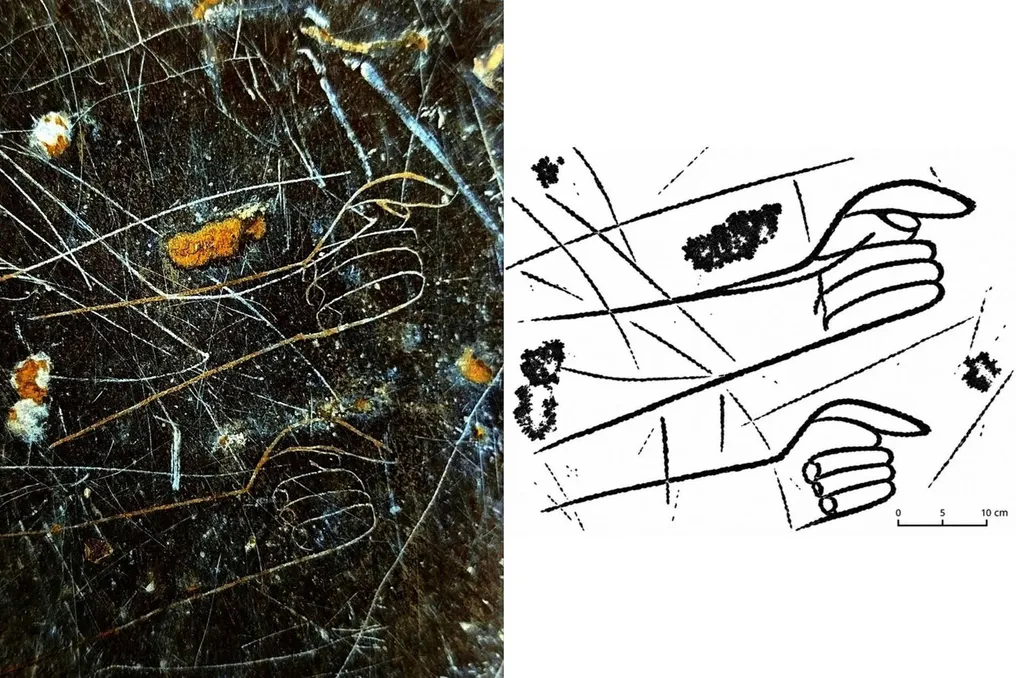
Archaeologists have discovered previously undocumented rock carvings from the Sasanian era depicting human hands without any accompanying figures on the historical plain of Marvdasht in Fars province, southern Iran.

These unusual engravings were found near an inscription in Persian (Pahlavi) from the Sasanian period. They may shed light on ancient practices of prayer, oaths, and religious rituals.

Archaeologist and historian Abolhassan Atabaki reported this finding during current archaeological surveys and documentation on the Marvdasht plain, as reported by the Ana agency on Sunday.

He specified that the newly identified images are human hands along with parts of forearms, engraved directly onto the stone surface, without any other human figures. Their artistic style and visual features indicate that they belong to the Sasanian period (224–651 AD).

Atabaki noted that while hands often appear in Sasanian rock reliefs as symbols of respect and reverence, their isolated depiction also has precedents in seals and seal impressions from that period.

Examples held in the collections of the British Museum, Bandar Abbas, Takht-e Soleyman, Tell Abu Shaaf in Iraq, and the University of California, Berkeley, demonstrate that Sasanian artists sometimes depicted hands independently of other parts of the human body.

Studies of Sasanian art suggest that the motif of the hand was associated with concepts such as greeting, benevolence, and kindness. In some cases, researchers have also hypothesized a connection to treaties, the deity Mithra, and religious ceremonies.

One notable example is a seal impression found at Takht-e Soleyman, which depicts a hand with the Pahlavi inscription 'abestan o yazdan', meaning 'appeal to the help of the gods.'

In this regard, historian Najmeh Ebrahimi stated that the available evidence suggests that the independent depiction of hands could have served as a symbolic way of expressing prayer, oaths, treaties, and good wishes.

She explained that since the hand plays a central role in performing such actions, its separate depiction could convey the intended meaning without the need to show the entire human figure.

Ebrahimi added that the rock drawings from Marvdasht might also have had a cultic character, possibly representing prayers or appeals for divine help. This interpretation is supported by the discovery of an inscription from the Sasanian period containing a prayer next to one of the hand images.

The depiction of a forearm section ending in a straight line, combined with the characteristic arrangement of fingers, gives the recently documented drawings particular archaeological and artistic significance. Researchers believe that further study and documentation will be required to more accurately determine the meaning and function of these unusual motifs.

Exhibition 'Levitation' held in Tashkent dedicated to the memory of sculptor Bayat Mukhtarov
Read more
gazeta.uz

Exhibition 'Levitation' held in Tashkent dedicated to the memory of sculptor Bayat Mukhtarov

The exhibition titled 'Levitation' was held at the Uzbekistan National Museum of Fine Arts (NBU) in memory of the Uzbek sculptor Bayat Mukhtarov, who lived from 1946 to 2015. The exposition showcases works created by the artist in the final years of his life, during which he sought to move away from traditional concepts of sculpture.

The exhibition features works from the collection of the National Bank of Uzbekistan, as well as from the artist's private collection, provided by his relatives. Bayat Mukhtarov was born in Andijan, but his personality developed in Tashkent. In 1979, he studied at the Tashkent Theatre and Art Institute, specializing in monumental and decorative plasticity.

Nevertheless, in his creative process, the sculptor consciously refused to adhere to academic standards. He was interested in non-standard forms and avant-garde approaches. As recalled by his classmate Ludvig Nesterovich, Bayat always possessed a spirit of freedom and disliked naturalistic copying, preferring to find new methods of expressing thoughts through composition, combining various materials, and using symbolic imagery.

After graduating from the institute, when the demands for realistic portraits lessened, Mukhtarov began working in his own unique style. Ludvig Nesterovich notes that the value of his work lies precisely in this individuality, in being unlike others.

One of the significant influences on Bayat Mukhtarov was the British sculptor Henry Moore, known for his monumental semi-abstract figures. Mukhtarov was attracted to the expressiveness of unusual forms, and according to Nesterovich, he saw energy and monumentality in Moore's works even where proportions might seem incorrect or the solution quite simple. However, Mukhtarov never copied others' methods, striving to create his own artistic language.

Literature and philosophy also played an important role in Mukhtarov's life. Among his favorite authors were Kant, Hegel, Hemingway, Vonnegut, Bradbury, Lao Tzu, and Confucius. Marina Borodina, a sculptor, emphasizes that, like many members of his generation, the artist was fascinated by science fiction, and this interest was reflected in his works. Fantastic and mythological plots served as a tool for discussing the real world and its potential.

Marina Borodina notes that in Mukhtarov's works, Eastern Islamic art, classical American literature, and philosophy are uniquely combined. Islamic art often features the fragmentation of large surfaces into numerous small details, which removes weight from the volume and creates a sense of dissolution in space. The artist achieved a similar effect by using details to impart a light feeling. He avoided precise anatomical depiction, allowing figures to be guessed at through silhouettes and motifs, which attests to the artist's broad scope in culture and history.

Mukhtarov worked with diverse materials, including metal, stone, ceramics, glass, enamel, and sand. In his layered compositions, rough textures are placed next to shiny metallic elements and colored inserts. Individual components retain their independence and are not mixed into a single mass.

Borodina explains that, unlike academic sculpture, which is based on power and monumentality, Mukhtarov dismantled these canons, striving to give the sculpture an almost weightless appearance. Even heavy metal in his works seems to 'float' in space due to his unconventional approach to materials, allowing him to create a multilayered synthesis that is relevant today.

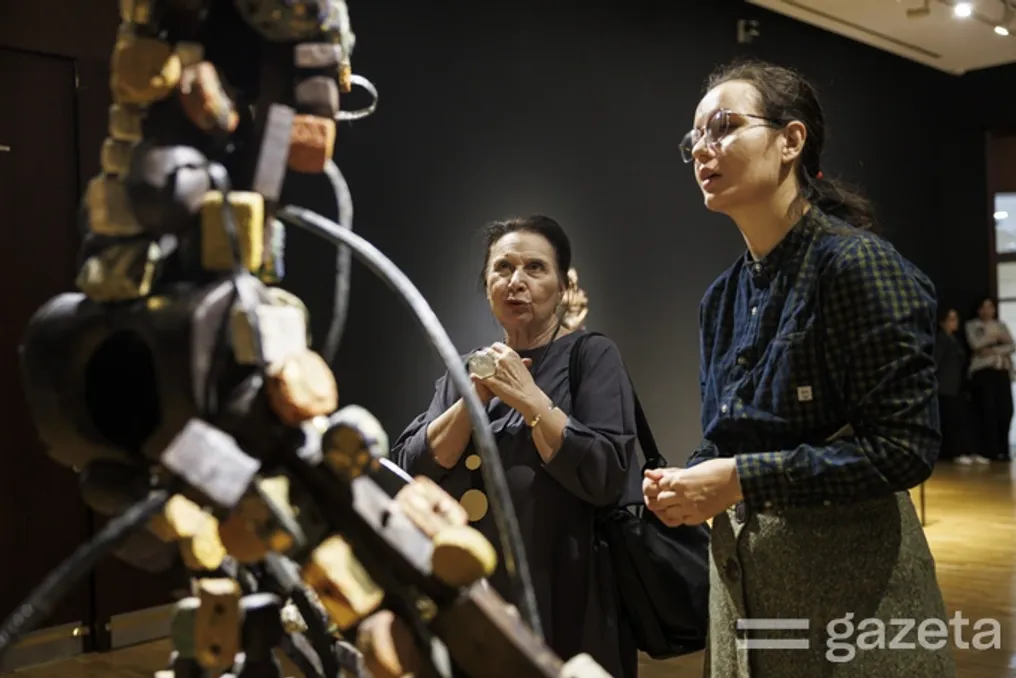
The name of the exhibition is directly related to the central work—a sculpture from 2009 made of wood, metal, and enamel. This sculpture lacks a single solid volume. Its core consists of wooden beams and plates, metal details, and blue-and-white enamel fragments. The composition is framed by metal arches that freely curve around it and extend beyond its boundaries. The space between the elements allows the viewer to see through the sculpture, and the open structure creates a sense of movement and lightness.

Ludvig Nesterovich believes that the title reflects not only the visual impression of the work but also the inner state of the artist during its creation, comparing it to a state of 'floating.' He asserts that Mukhtarov's works evoke such otherworldly sensations.

In addition to sculptures, the exhibition also features relief canvases. Marina Borodina shares that the artist initially found the image in graphic works and only later transferred it to three-dimensional space. Over time, the drawing acquired independent value.

Borodina concludes that Mukhtarov's works require careful study. Initially, the viewer's attention is drawn to individual details—be it the curve of metal, a fragment of wood, a colored insert, or an image on a panel. Then, these details come together to form an image that can transform when viewed from different angles. Mukhtarov's example demonstrates that there is no need to follow established rules in art; one can find their own path and create something original.

The 'Levitation' exhibition will be available until November 14th. The gallery operates from Tuesday to Saturday from ten in the morning to six in the evening, and entry to the exhibition is paid.

Discovery of Bronze Helmet at Lysa-Gura Monument Indicates Settlement Contact with Celts
Read more
nplus1.ru

Discovery of Bronze Helmet at Lysa-Gura Monument Indicates Settlement Contact with Celts

Archaeologists presented the results of work conducted at the Lysa-Gura archaeological site, located in northeastern modern Poland. During excavations at this fortified settlement, which was founded around the middle of the first millennium BCE, various items were found.

Among the discovered artifacts were objects whose origin is linked to territories inhabited by Celtic tribes. Of particular significance is the finding of remains of a bronze helmet from the La Tène culture, suggesting that representatives of this culture may have been present directly at this settlement.

Information about these discoveries was published in the scientific journal Antiquity.

Popular