Sasanian rock carvings of human hands discovered in Marvdasht
Read more
Tehran Times
www.tehrantimes.com

Sasanian rock carvings of human hands discovered in Marvdasht

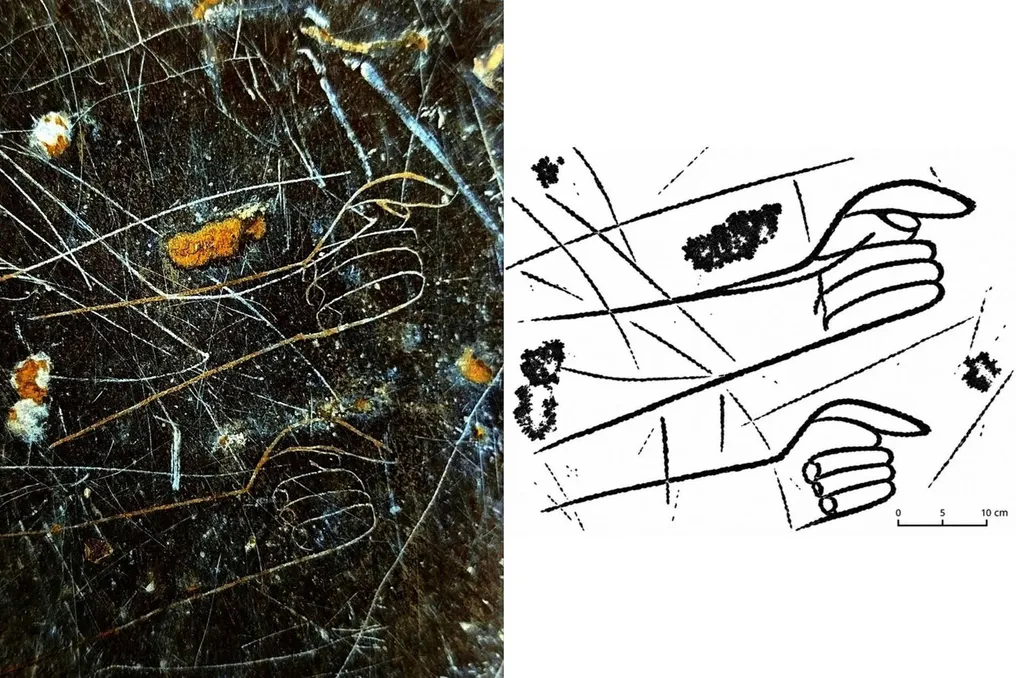
Archaeologists have discovered previously undocumented rock carvings from the Sasanian era depicting human hands without any accompanying figures on the historical plain of Marvdasht in Fars province, southern Iran.

These unusual engravings were found near an inscription in Persian (Pahlavi) from the Sasanian period. They may shed light on ancient practices of prayer, oaths, and religious rituals.

Archaeologist and historian Abolhassan Atabaki reported this finding during current archaeological surveys and documentation on the Marvdasht plain, as reported by the Ana agency on Sunday.

He specified that the newly identified images are human hands along with parts of forearms, engraved directly onto the stone surface, without any other human figures. Their artistic style and visual features indicate that they belong to the Sasanian period (224–651 AD).

Atabaki noted that while hands often appear in Sasanian rock reliefs as symbols of respect and reverence, their isolated depiction also has precedents in seals and seal impressions from that period.

Examples held in the collections of the British Museum, Bandar Abbas, Takht-e Soleyman, Tell Abu Shaaf in Iraq, and the University of California, Berkeley, demonstrate that Sasanian artists sometimes depicted hands independently of other parts of the human body.

Studies of Sasanian art suggest that the motif of the hand was associated with concepts such as greeting, benevolence, and kindness. In some cases, researchers have also hypothesized a connection to treaties, the deity Mithra, and religious ceremonies.

One notable example is a seal impression found at Takht-e Soleyman, which depicts a hand with the Pahlavi inscription 'abestan o yazdan', meaning 'appeal to the help of the gods.'

In this regard, historian Najmeh Ebrahimi stated that the available evidence suggests that the independent depiction of hands could have served as a symbolic way of expressing prayer, oaths, treaties, and good wishes.

She explained that since the hand plays a central role in performing such actions, its separate depiction could convey the intended meaning without the need to show the entire human figure.

Ebrahimi added that the rock drawings from Marvdasht might also have had a cultic character, possibly representing prayers or appeals for divine help. This interpretation is supported by the discovery of an inscription from the Sasanian period containing a prayer next to one of the hand images.

The depiction of a forearm section ending in a straight line, combined with the characteristic arrangement of fingers, gives the recently documented drawings particular archaeological and artistic significance. Researchers believe that further study and documentation will be required to more accurately determine the meaning and function of these unusual motifs.
Similar stories

Petroglyphs and Bronze Age Settlement Traces Discovered in Nurata Mountains
Read more
podrobno.uz

Petroglyphs and Bronze Age Settlement Traces Discovered in Nurata Mountains

Archaeologists have discovered petroglyphs, presumably created during the Mesolithic and Neolithic periods, as well as traces of a Bronze Age settlement in the Nurata mountain range. These findings were made during fieldwork in the Koshrabad district of the Samarkand region and will allow for a deeper study of how ancient people settled this region and their contacts with neighboring tribes.

In October, researchers from the Yakhye Gulomov Samarkand Archaeological Institute conducted surveys of the mountainous and foothill areas of this district. On the walls and ceilings of stone shelters in the locations of Egrizarsay, Khodzhasay (Badimin), Galajinsay, and Sumbulsay, which are part of the Akchabsay mahalla, investigators identified images executed with natural ochre. According to preliminary data, these drawings date back to the Mesolithic and Neolithic eras.

Furthermore, another significant discovery was made in the Pangat mahalla area. Archaeologists found and studied fragments of Bronze Age pottery in three different locations. At one site, located approximately 700–800 meters east of the village Kumolokli, specialists began trial excavations measuring 2 by 1 meter.

A cultural layer about sixty centimeters thick was revealed beneath the ground surface, serving as evidence of a Bronze Age settlement. During the excavations, a large number of pottery shards and bone remains were found. The discovered artifacts require further excavation work, as they may provide new information about the lifestyle, occupations, and daily life of the ancient inhabitants of the Nurata mountains.

The scientists intend to compare these findings with archaeological data obtained from other regions to gain a more complete understanding of the history of Nurata's settlement. It is worth noting that traces of a presumed palace of 8th-century rulers have previously been discovered in the Samarkand region.

Discovery of Bronze Helmet at Lysa-Gura Monument Indicates Settlement Contact with Celts
Read more
nplus1.ru

Discovery of Bronze Helmet at Lysa-Gura Monument Indicates Settlement Contact with Celts

Archaeologists presented the results of work conducted at the Lysa-Gura archaeological site, located in northeastern modern Poland. During excavations at this fortified settlement, which was founded around the middle of the first millennium BCE, various items were found.

Among the discovered artifacts were objects whose origin is linked to territories inhabited by Celtic tribes. Of particular significance is the finding of remains of a bronze helmet from the La Tène culture, suggesting that representatives of this culture may have been present directly at this settlement.

Information about these discoveries was published in the scientific journal Antiquity.

Ancient faience workshop discovered by archaeologists near Nubian temple in Napata
Read more
nplus1.ru

Ancient faience workshop discovered by archaeologists near Nubian temple in Napata

Archaeologists conducted excavations near the Nubian temple in Sanna, which was located in the ancient city of Napata. During the work, the remains of a faience workshop were discovered, where various items were produced.

This workshop manufactured beads, vessels, as well as magical figurines and other valuable objects. These artifacts are presumed to date back to the 7th century BCE.

This period coincides with the reign of the Kushite dynasty, which governed both Nubia and Egypt. Information about this find was presented in a publication in the scientific journal Antiquity.

Popular