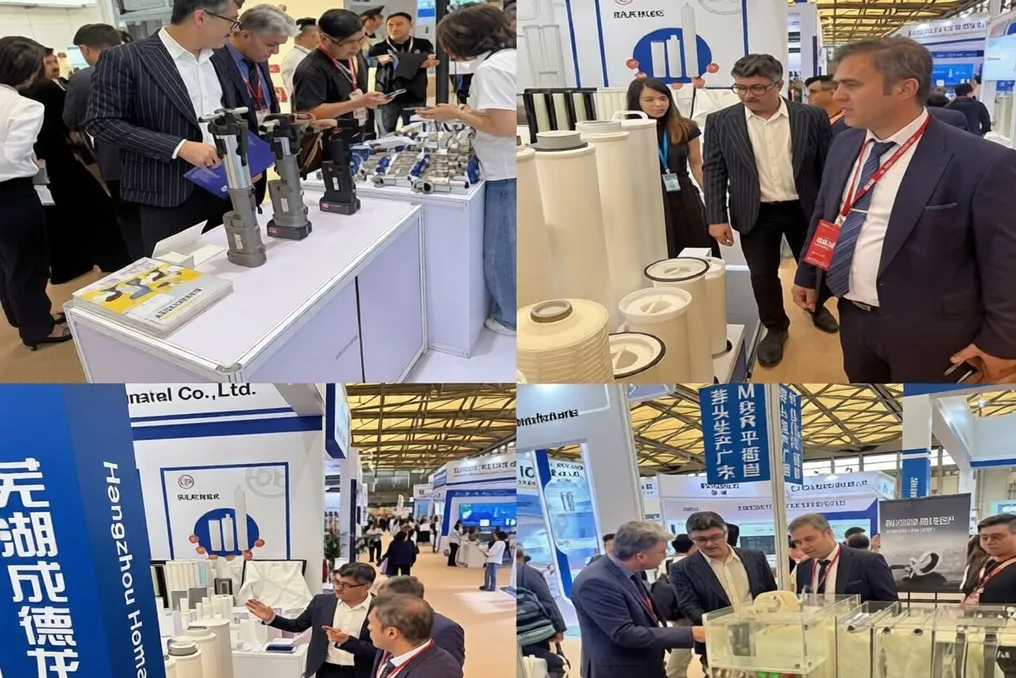
Knowledge-based Iranian companies participated in two major international exhibitions: Kazan Digital Week in Russia and Aquatech China in China. The purpose of participation was to demonstrate their technological capabilities and seek opportunities for expanding international cooperation and business ties.
Representatives from nine Iranian companies, supported by the Fund for Innovation and Prosperity, attended the Kazan Digital Week Expo, which took place from October 29 to 31. During the event, they held meetings with representatives of the Tatarstan Investment Development Agency and employees of Russian technology firms.
The delegation's plans included studying joint investment opportunities, conducting business meetings with companies located in IT parks, and visiting the urban settlement of Innoplace. The main focus of the exposition was on creating a sustainable ecosystem of trusted digital technologies and applying these technologies in industry, business, and public administration.
The exhibition featured scientific conferences, expert sessions, business meetings, startup events, training seminars, and initiatives for developing international interaction. This provided an excellent opportunity to showcase the latest innovative developments, search for export markets, attract investments, and establish strategic partnerships.
In October, leading Iranian and Russian companies explored ways to expand bilateral cooperation in advanced technologies at the Third Russian-Iranian Forum on Information and Communication Technologies (ICT). This forum gathered officials, diplomats, as well as representatives of the private and public sectors of both countries. Participants met during the sidelines of the Second Global Digital Forum, which took place in Moscow from October 8 to 10.
During the meeting, Alexander Shoytov, Deputy Minister of Digital Development, Communications, and Mass Media of Russia, noted that the participation of Iranian companies in the Global Digital Forum was a valuable opportunity for information exchange and establishing new partnerships. He emphasized the significant potential of Iran and Russia for deepening bilateral cooperation, especially in the fields of artificial intelligence and cybersecurity.
Shoytov also confirmed Russia's readiness to strengthen bilateral ties and develop joint infrastructure in the ICT sector. For his part, the Iranian Ambassador to Russia, Kazem Jalali, highlighted the importance of developing a strategic partnership between Iran and Russia to expand digital exchange within the state structure. Strengthening these ties contributes to enhancing the country's ability to participate in regional and global markets.
Highlighting the experience and knowledge of Iranian technology companies in localizing IT infrastructure equipment, Russian firms can create joint ventures with reliable partners in Iran, gaining access to the country's IT services and artificial intelligence services market.
Furthermore, representatives of high-tech companies from Iran and Russia demonstrated their latest achievements and presented comprehensive plans and operational proposals for promoting cooperation in advanced technologies. The exchange of best practices and technological solutions, holding B2B meetings, expanding business networks, and studying opportunities for joint projects were among the other key aspects of the Forum. Special attention was paid to practical mechanisms for Russian and Iranian companies to enter new markets and develop cooperation with partners from third countries.
Aquatech China
A trade and technology delegation, consisting of approximately 16 knowledge-based companies, also visited the Aquatech China exhibition with the aim of accelerating domestic integration and exporting knowledge-based products. The exhibition took place in Shanghai from October 28 to 30. The delegation toured various sections of the exhibition and held meetings with participating companies.
Aquatech China is a leading trade exhibition in the field of water supply in China, covering all aspects of water: drinking water, industrial water, wastewater treatment, sludge treatment, smart water solutions, and water resource management. The growing demand for clean water, combined with the promotion of environmental protection and strict adherence to new standards, creates enormous opportunities for international companies specializing in wastewater treatment technologies in China.
In August, the Iranian National Science Foundation (INSF) and the Chinese National Natural Science Foundation (NSFC) announced support for the second joint specialized seminar to develop scientific diplomacy, strengthen research networks, and exchange technical knowledge. A grant of 7 billion rials (approximately 2.6 million US dollars) per research project for one year will be allocated to the following areas:
- Advanced Materials: Research and processing of rare earth elements; Nanocomposites for sustainable building materials in seismic zones; Green synthesis of nanomaterials using biological resources.
- New Sensors: Smart nanomaterials for biosensors: early detection of diseases and pathogens; Nanostructured gas sensors for monitoring environmental and industrial pollution.
In July, INSF and NSFC announced support for the implementation of 15 faculty research projects. A grant of 50 billion rials (approximately 26,595 US dollars) per research project for a term of at least three years will be distributed across the following fields: Water and Energy: AI-based intelligent irrigation systems for arid and saline environments; Integrated water resource management under drought and climate variability; Energy-efficient advanced technologies for water purification and desalination of seawater/brackish water. Energy Storage and Hydrogen Technologies: Integration of renewable energy sources into national and distribution grids; Agricultural and medical biotechnology; Genetic improvement of strategic crops for resistance to drought, salinity, and heat using molecular breeding methods; Microbial biotechnology for food security: biofertilizers, single-cell proteins, probiotics, biopesticides, and biological control; Recombinant drugs and biologics: development processes, purification, and quality control; Novel drug delivery systems based on biological sources (nanocarriers, liposomes).