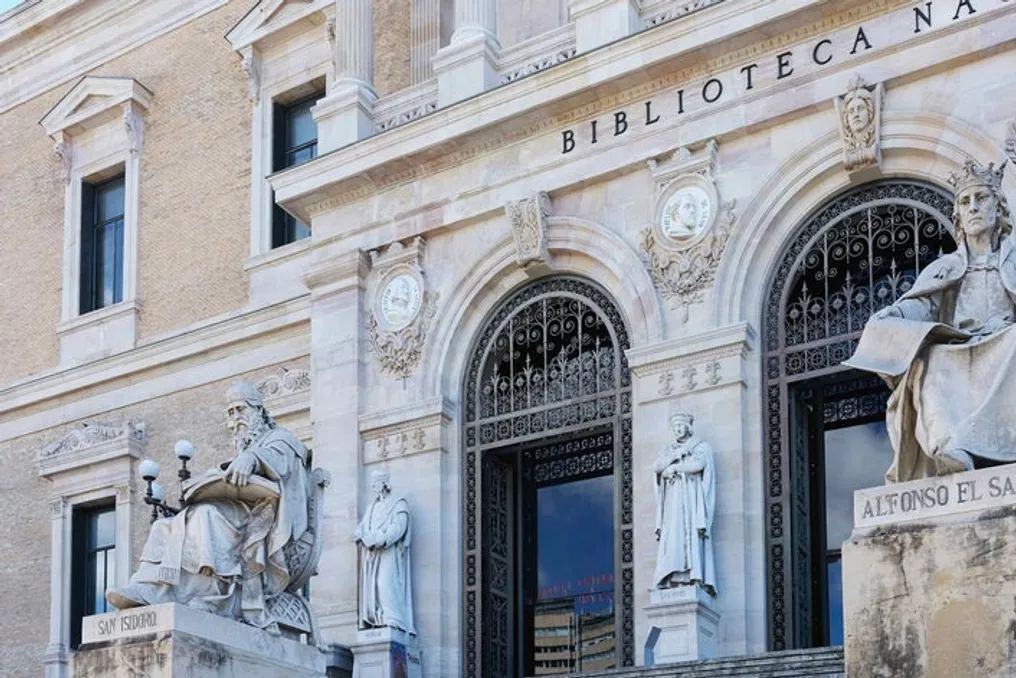
The National Library of Spain (BNE) is organizing an exhibition titled 'Camões. Life, Work, and Presence in Hispanic Culture,' which will be inaugurated by the heads of state of Portugal and Spain—President António José Seguro and King Felipe VI. The exhibition will be open to the public until February 14, 2027, with free admission.
During this period, visitors can explore the exhibition, which is based on works and collections held at the BNE. The institution described this exhibit as a 'fantastic and unique selection striving to honor the memory of one of the greatest writers of world literature.'
Among the exhibits are some of the first editions and first translations of 'Os Lusíadas' into Castilian, with most of the material belonging to the BNE itself. Additionally, items brought from various Portuguese institutions specifically for this exhibition will be displayed in Madrid, including the sole complete edition of 'Saudades da Terra' (written between 1586 and 1590) by Gaspar Frutuoso.
This copy, which arrived in Madrid from the Public Library and Regional Archive of Ponta Delgada in the Azores, was presented by Manuel de Morais Sarmiento Pizarro, a member of the exhibition's supervisory committee working at the Portuguese Embassy in Madrid. Works from Portugal donated by the Lisbon War Museum (works by José Malhoa) and the Lisbon Museum (the painting 'Death of Camões' by Francisco Augusto Metrassa) will also be shown at the BNE.
The BNE emphasizes that it 'preserves an important heritage about Portugal and its literary history' and invites the public to 'discover the culture and richness of the Portuguese people.' According to the BNE, through the presented artifacts and collections, Luís Vaz de Camões 'is presented as a product of the Iberian historical and cultural context and simultaneously as a source of inspiration for authors from both sides of the Atlantic.'
The exhibition is divided into four main sections. The curator, Professor and Doctor of Romance Philology Aurelio Vargas Dias-Toledo from Complutense University in Madrid, selected the works available at the BNE that are 'of the greatest significance for each core,' according to Manuel de Morais Sarmiento Pizarro.
The first section is dedicated to 'precursors and the historical-literary contextualization of Portugal.' The second section aims to demonstrate Camões' cultural environment, particularly 'classical, peninsular, and Italian works and authors who had some decisive influence' on Camões.
The third section focuses on 'Camões' literary world.' This is where visitors can see a selection of works by the Portuguese author held at the BNE, such as first editions or translations of 'Os Lusíadas' into Castilian. This section also includes other works by Camões, as well as the edited edition of 'Os Lusíadas' by Manuel de Faria and Sousa, published in Madrid in 1639, which highlighted the BNE as a 'significant moment in the canonization process of Camões in Castilian literature.'
The fourth section of the exhibition is dedicated to 'the projection of Luís de Camões in Hispanic culture' and includes a selection of works from the 'Hispanic literary world' by authors such as Rosalía de Castro, Francisco Villaspas, and Jorge Luis Borges.
According to the BNE, the exhibition concludes with the Spanish writer Antonio Muñoz Molina, author of the book 'A Solitary Walk Among People,' whose title is taken from the poem 'É um andar solitário entre a gente' from the sonnet 'Love is a fire that burns without being seen' by Camões.
The exhibition 'Camões. Life, Work, and Presence in Hispanic Culture' is the result of cooperation between the Government of Portugal and the BNE (which is under the supervision of the Spanish Ministry of Culture). It is part of the program developed within the framework of the Mission Structure for the centenary of the birth of Luís de Camões, scheduled for the period 2024–2026. The involved bodies consider this exhibition a 'culmination' and hope to 'complete with a golden key' the international program of these celebrations.