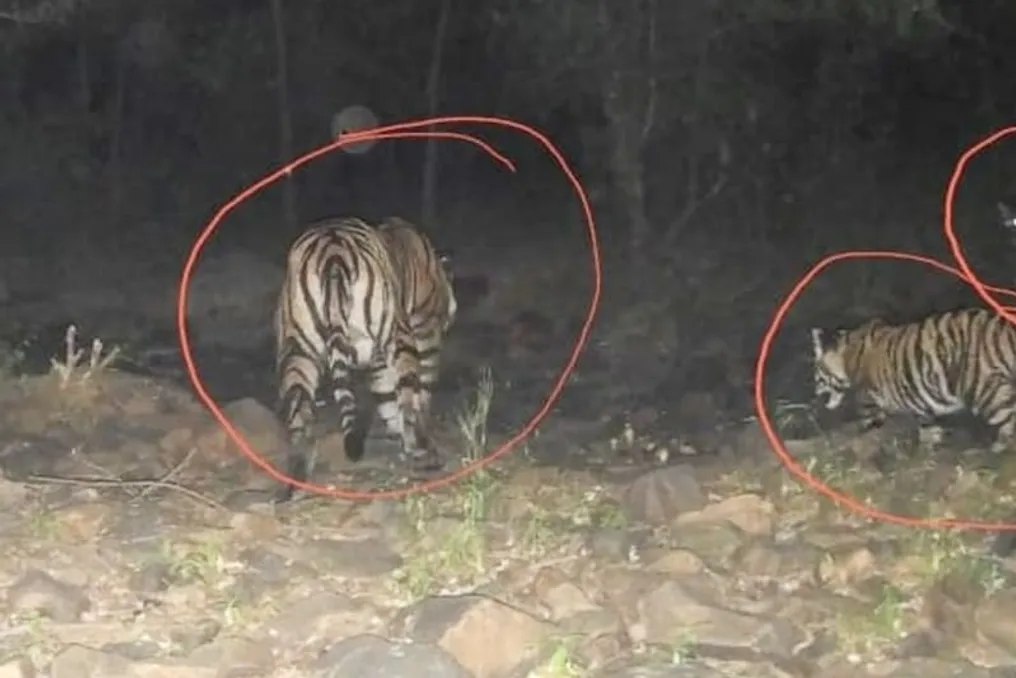
A tiger cub born in one forest left it and ended up in another. This cub independently traversed the forests and reached Pench Tiger Reserve in Maharashtra without any assistance or guidance. On October 29, the cub was spotted near the Chorbahuli gates. It was identified as the offspring of tigress F2, who was born in the Gotkhangao area of the Umred-Karhandla reserve.
This news gave hope to forest department officials, who believe that a natural corridor may exist for tigers to move between the two forests. However, there is uncertainty: it is not yet known whether the cub has made Pench its new home or is simply passing through.
In a tiger's life, there are periods when it needs to find its own territory. It does not always stay with its mother. As it grows, a young tiger requires a new place for living, hunting, and roaming. In such cases, young tigers may leave their native territory and venture into other forests. This phenomenon is called tiger dispersal.
This cub, spotted in Maharashtra, likely also set out in search of its territory. According to Akshay Gadge, Deputy Director of Pench Tiger Reserve, the tiger might be looking for a suitable territory. Officials continue to monitor its activity, and Gadge noted that it would be premature to assert whether the tiger will stay in Pench or just pass through.
The question arises as to how this cub managed to cover the distance from one forest to another. The Forest Department hypothesized a possible route: the tiger might have passed through Kukhi, Bhandara, Ramtek, Pawni, Pawni Buffer, and then to Chorbahuli via NH-44. Currently, this is only a hypothetical path requiring confirmation through monitoring the tiger's activity and scientific research.
Imagine two large forests where tigers live, but fields, roads, villages, and other obstacles are located between them. If a young tiger needs to cross from one forest to another, what path will it take? A natural passage among forests that allows tigers and other wild animals to move from one place to another is called an ecological corridor. These paths are critically important for tigers because each needs its own territory. When a young tiger matures, it may look for a new place. If there is no safe passage between forests, its journey can become difficult and dangerous. Roads, settlements, and deforestation can disrupt these paths, leading to tiger isolation.
Akshay Gadge, Deputy Director of Pench Tiger Reserve, called this event a positive sign for Pench. He stated that the department's priority is forest conservation and ensuring conditions for tigers to live. The Forest Department reports that patrols are constantly conducted in the Chorbahuli forest area. In addition to protecting the forest, efforts are being made to conserve water, build small dams in forest zones, and involve local residents in conservation activities. The goal of these efforts is to create a better environment for wildlife so that tigers have enough food, water, and space to live.
Will this tiger stay in Pench? There is currently no answer. Forest department officials are monitoring the tiger's presence. It may establish its territory in Pench or continue searching elsewhere. However, its appearance indicates an important trend. Conserving tigers means not only counting their numbers within the forest but also ensuring their safe movement between different forests. The tiger cub, born in Umred-Karhandla, raised hope by appearing in Pench. The Forest Department's monitoring will show whether this was just the journey of one tiger or a story of a natural passage between two large forests of Maharashtra.