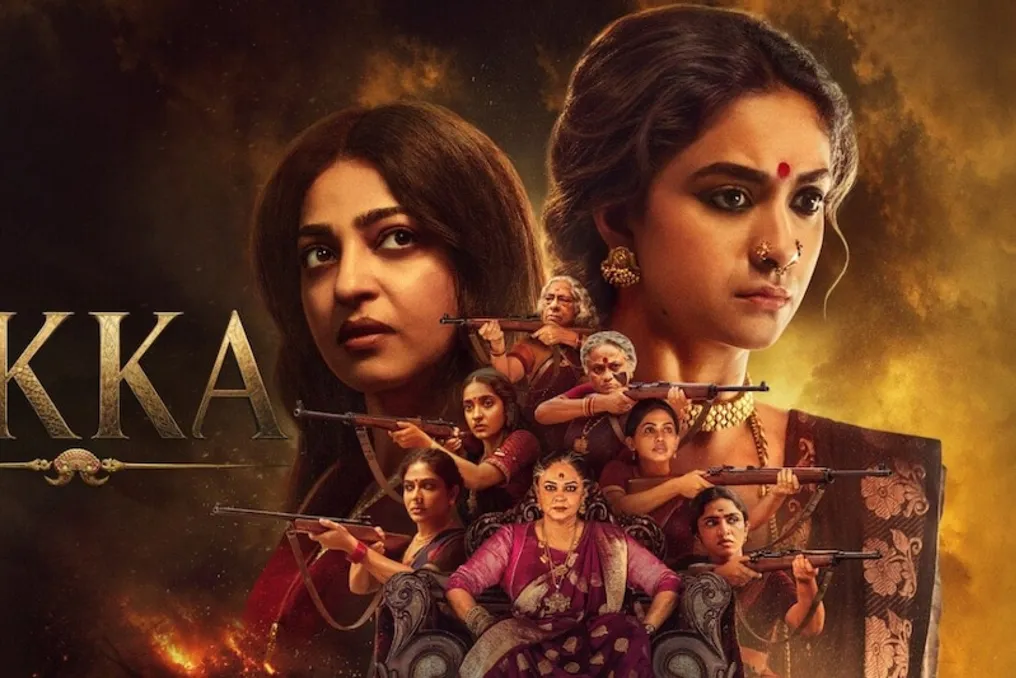
The series 'Akka', released on Netflix under the aegis of Yash Raj Films, generated high expectations due to its concept: a world where command and weaponry are in the hands of women, set against a beautifully recreated ancient backdrop and dominated by formidable female gangsters. However, as is often the case, the brilliance and luxurious production could not compensate for the weak script, causing the show's entire potential to be lost.
The plot spans the period between 800 BCE and the 1980s. The action takes place in the fictional city of Pernaru in South India, where power belongs exclusively to women. The supreme leader of this city is called 'Akka.'
Pernaru has specific and strict rules: women are allowed to have lovers, but they are forbidden from having husbands. Girls are revered as goddesses protecting forests and lakes, and inheritance is passed down only to daughters. There is an 'eye for an eye' principle, and any insult to a woman can provoke a great calamity. Furthermore, literacy is highly valued in this system.
The main conflict begins when Rudra (Radhika Apte) arrives from Mumbai and openly challenges the existing system, striving to seize power through men. This direct challenge poses a serious threat to strong women such as the tribe leader Bhavani (Kriti Suresh), Tanvi Azmi, and the young warrior Anjali Patil, which forms the core narrative line.
The first two episodes look very convincing: women make decisions fearlessly, and sword fights occur. But as soon as Radhika Apte appears, the story starts resembling a worn-out 'woman versus woman' race.
Radhika's appearance in a tight dress and large glasses seems strange and reminiscent of a loud villain from old Bollywood films. In contrast, the other women of Pernaru always look elegantly dressed, as if preparing for a grand wedding or religious ritual, even when in prison. Actors like Anshuman Pushkar (as Amar) and Nanda (Vishak Nair) play only minor roles.
Although the author does not object to the violence shown in the series—since blood is constantly shed in the male world—one moment deeply shocked the viewer: why show the burnt body of a child on the seashore? Even though a bloody struggle between various factions begins after this horrific sight, the plot could have moved forward without this scene.
Upon deeper analysis, the series presents a disappointing idea: when all power falls into the hands of women, they ultimately begin to behave as cruelly and greedily for power as men do. This may shock those who believe that simply granting women power will automatically lead to a fairer and better world.
The series attributes the same old and traditional patriarchal lexicon to its female rulers. This clearly shows that changing the gender of the leader does not change the principles of social structure functioning. As always, the bitter truth might be hidden somewhere between these two poles, but it is crucial to contemplate this serious argument.
Radhika Apte receives significant screen time, yet her character seems quite predictable and one-dimensional, as nothing new is felt in her dialogues. On the contrary, Kriti Suresh, dressed in traditional sarees and heavy jewelry, looks incredibly powerful, striking, and dominates the screen. As 'Akka', she single-handedly carries the entire show, being so captivating that it is hard to look away.
It would have been ideal if all other elements were equally strong. Instead of an old gangster plot about a father and son, 'matriarchy' should have replaced 'patriarchy'. I criticize the script the most—how a man wrote such a profound story about women. My only advice to him: their own ideas and vision would be much more effective than just giving them a gun.
It is necessary to acknowledge the talent of the actors and costume designers, who gave uniqueness to the characters and presented this fictional global culture of Pernaru. Nevertheless, despite the magnificent costumes, grand setting, and excellent concept, 'Akka' ultimately remains a typical revenge drama.
Nevertheless, my hopes for a second season remain alive; perhaps next time the creators will make some improvements and be able to beautifully fill these gaps.