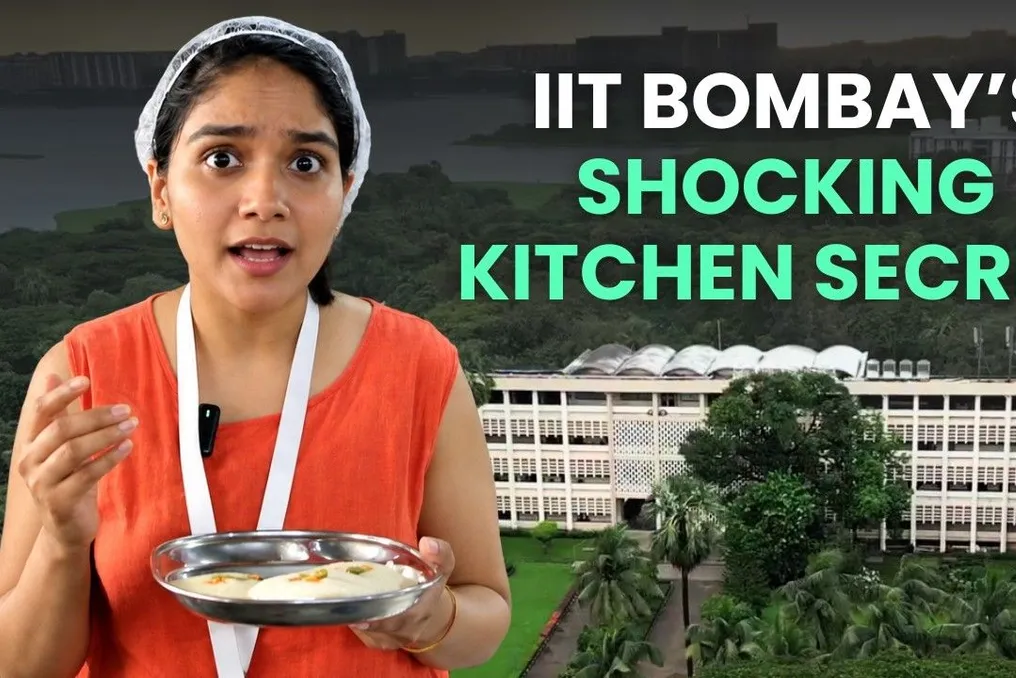
IIT Bombay uses garden waste to cook meals for over 1200 students
Read more
The Better India
thebetterindia.com

IIT Bombay uses garden waste to cook meals for over 1200 students

The Indian Institute of Technology (IIT Bombay) is transforming garden leaves into fuel for cooking, providing breakfast, lunch, and dinner for 2000 people and reducing liquefied petroleum gas (LPG) consumption by 60%.

India imports about 60% of its LPG, much of which passes through the Strait of Hormuz—one of the world's most unstable choke points. If supplies are disrupted, millions of kitchens could be left without gas. This raises the question of how Hostel 16 cafeteria at IIT Bombay prepares lunches for 1200 students using leaf granules instead of gas cylinders.

The company Infixen, funded by IIT Bombay, converts two tons of garden waste collected on campus daily into clean cooking fuel. Previously, the institute spent 50 lakh rupees annually just on the removal of this waste; now, this waste is used to feed students and staff.

The process of the plant and the cafeteria is detailed in the 'Solved in India' program from The Better India, demonstrating how this transformation occurs.

Similar stories

Village in Maharashtra uses technology to obtain 500 liters of drinking water daily from the air
Read more
thebetterindia.com

Village in Maharashtra uses technology to obtain 500 liters of drinking water daily from the air

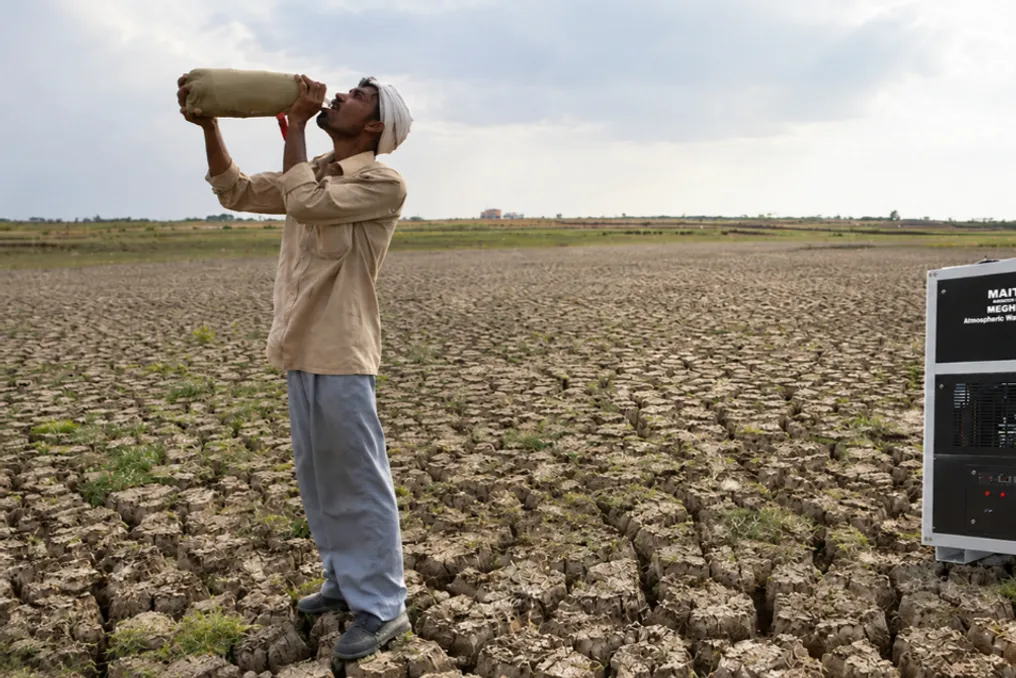
In the village of Vadji, located in the Washim district of Maharashtra state, residents have long faced the problem of water scarcity. They had to travel up to one and a half kilometers to bring water home, which became especially exhausting during hot summer months when water sources dried up.

The solution to this problem was found in the air itself. A machine called Meghdoot was introduced in the village, capable of extracting moisture from the atmosphere and converting it into drinking water. This unit can produce up to 500 liters of purified water per day, providing the village with a new water source that does not depend solely on wells or groundwater.

Even a single jug of water required a long walk

Vadji, home to about 2000 people, is part of the communities in the Vidarbha region suffering from water shortages. The problem extends beyond the village itself: according to reports from the Central Ground Water Board, nearly 40 villages in the Risod taluka are classified as having semi-critical groundwater levels.

For local residents, difficulties intensify in the summer due to rising temperatures and increased difficulty accessing reliable drinking water. To address this issue, the Gram Panchayat of Vadji adopted a technology that utilizes a resource that people rarely consider a source of drinking water—moisture contained in the air. This village is the first and only one in Maharashtra to implement this technology.

How does the technology turn air into water?

The Meghdoot system uses atmospheric water generation technology to extract moisture from the air and convert it into a liquid state. The process begins with fans drawing moist air into the machine. Filters then remove suspended particles, such as dust and pollen, before a cooling-based mechanism lowers the air temperature to the dew point.

As the air cools, water vapor condenses into droplets, similar to condensation on a cold glass surface. The collected water undergoes further purification: activated carbon, ultraviolet (UV) disinfection, and other treatment methods make it potable. The purified water is stored until it is dispensed for consumption.

The installed unit has a stated capacity of about 500 liters per day. However, the actual volume obtained by the atmospheric water generators depends on factors such as temperature and humidity, as well as the operating mode of the machine. Unlike traditional sources that draw water directly from groundwater or surface water, this method collects moisture from the atmosphere, allowing for an additional source of drinking water where existing supplies are under pressure.

The water supply innovation in Vadji was developed by scientists from the Council of Scientific and Industrial Research—Indian Institute of Chemical Technology (CSIR-IICT) in Hyderabad in collaboration with the company Maithri Aquatech. Key participants in the project include Dr. Sridhar, Dr. Nivedita Sahu, and their team. The system was acquired with support from CSIR-IICT under the leadership of the then Director, Dr. Chandrashekhar.

At the village level, the initiative was taken up by the Gram Panchayat of Vadji. The unit was placed in the Zilla Parishad primary school and in the Anganwadi, ensuring access to drinking water in places frequented by children and local residents. This placement allows students and Anganwadi visitors to utilize a source of clean water near their location.

Despite the advantages, it should be noted that atmospheric water generation does not replace the need for groundwater conservation, rainwater harvesting, or the presence of reliable public water infrastructure. The technology also requires electricity, and its efficiency depends on local atmospheric conditions. Long-term viability will be determined by operational costs, maintenance, and operational stability.

For Vadji, the promise of Meghdoot lies in a simple principle: bringing drinking water closer to those in need. What once required a journey of a kilometer or more can now be partially provided by a machine extracting moisture from the air. Although this technology cannot replace long-term solutions such as groundwater conservation and rainwater harvesting, it offers an alternative way to combat water scarcity. With proper maintenance and adaptation to local conditions, such innovations can help more communities find alternative sources of drinking water.

Young Scientists Returning from Abroad to IIT-IIM for Professorship Careers: A New Trend
Read more
www.aajtak.in

Young Scientists Returning from Abroad to IIT-IIM for Professorship Careers: A New Trend

The return of young scientists from abroad to IIT-IIM has become a new phenomenon. For instance, Shilpa Satish, an assistant professor at IIM Kozhikode, decided to return to India to raise her child in the same educational environment that shaped her academic journey. She stated that she does not regret her decision, wishing for her child to grow up in Kerala, near the Vembanad Lake, in an atmosphere of family support. Furthermore, she aimed to contribute to the Indian public education system.

Shilpa received her PhD in Sociology from the University of South Florida, and much of her research focuses on the social and ecological landscape of Kerala. For her, returning to India did not mean abandoning a global career but rather having the opportunity to develop her research on ground she understands very well. However, she acknowledges existing issues within Indian institutions related to bureaucracy and the socio-cultural system.

Like Shilpa, many young Indian scientists who studied abroad are now building their academic careers in their home country.

Dominance of Youth in IIM Bangalore

IIM Bangalore is a prime example of this trend. This IIM, which has over 100 faculty members, is characterized by a high proportion of young talent. Of the total 150 faculty members, about 30% of professors are under 35 years old, whereas several years ago this figure was less than 10%. Many of these researchers completed their studies abroad but chose India over international opportunities.

Professor Saurav Mukhi, Dean of Human Resources and Organizational Behavior at IIM Bangalore, notes that this change reflects the evolution of the older IIMs. Previously, these institutions were primarily focused on teaching, but now their focus has shifted to publishing high-quality research to improve global rankings.

Professor Mukhi emphasizes that 'this change has increased the significance of the young faculty group. One cannot expect top-quality publications from a suddenly appointed senior professor who spent years in administrative duties.' Thanks to these changes, IIM Bangalore has risen seven places in the FT 2025 Masters in Management ranking, securing 21st place, which is attributed to improved research and growing international integration.

The influx of professors educated abroad benefits Indian institutions through international research collaboration, exposure to global methodologies, and strong scientific publications. However, Professor Mukhi clarifies that holding a foreign degree is not the sole selection criterion; priority is given to young specialists who are research-oriented and can advance the institute's research agenda.

From 'Brain Drain' to 'Brain Circulation'

The return of scientists from abroad to India is a new trend, although it cannot be considered a complete cessation of the long-standing 'brain drain' trend. Professor Anubha Agrawal from IIM-B believes that the research environment in India has significantly improved, even if the country lags behind Western nations in terms of funding and infrastructure. Western countries have invested enormous sums in research and infrastructure for decades, while most of the budget in India was spent exclusively on the education system.

Nevertheless, in institutions like IIM-B, young faculty members are now provided with significant academic freedom, reduced teaching loads, research grants, and funding to attend international conferences.

Impact of Visa Policy and Uncertainty

Kadar Nath Thakur, an assistant professor at MDI Gurgaon, highlights another aspect of this shift. He points out that the return to India is driven not only by the attractiveness of the country itself but also by external circumstances. Reduced research funding in the US and visa uncertainty in 2025 have left many Indian postdocs and PhD students in a dilemma regarding career building there. As a result, many scientists have chosen to return to India.

Moreover, India's rapidly growing consumer market, digital infrastructure (such as UPI), the gig economy, and the field of Artificial Intelligence (AI) offer researchers new and practical topics for study.

The Challenge of Understanding the Indian Context in Teaching

While the arrival of young faculty contributes to research development, they also face a practical challenge: 'understanding the Indian context.' Professor Saurav Mukhi explains that a significant portion of IIM's revenue comes from executive education (courses for senior executives). These executives require not only theory but also practical understanding relevant to the Indian market and conditions. Young professors who returned after obtaining their PhDs abroad sometimes lack this local understanding, which is compensated for by specialized training centers established by the institutes.

Sebastian M.P., Director of IIM Kozhikode.

India produces 454 million tons of sugarcane: the diversity of its production applications
Read more
thebetterindia.com

India produces 454 million tons of sugarcane: the diversity of its production applications

The concept of 'one plant, 100 uses' explores numerous ways to utilize familiar Indian plants, leaves, fruits, and trees in daily life—from nutrition and agriculture to traditions and natural remedies. Each story focuses on a single plant and reveals the surprising ways people have found it useful, often over several generations.

Sugarcane is a familiar element of India's agricultural landscape. Its sweet juice is popular as a summer drink; the stalks are crushed to produce sugar and jaggery, and the leaves can be used as fodder for livestock. However, the utility of this plant is not limited to juice extraction.

According to data from the Ministry of Agriculture and Farmers' Welfare in the 'Agricultural Statistics Review 2024-25' section, India produced 454.61 million tons of sugarcane in 2024-25. In addition to sugar production, this harvest serves as raw material for industries that use its fibrous residue and other by-products.

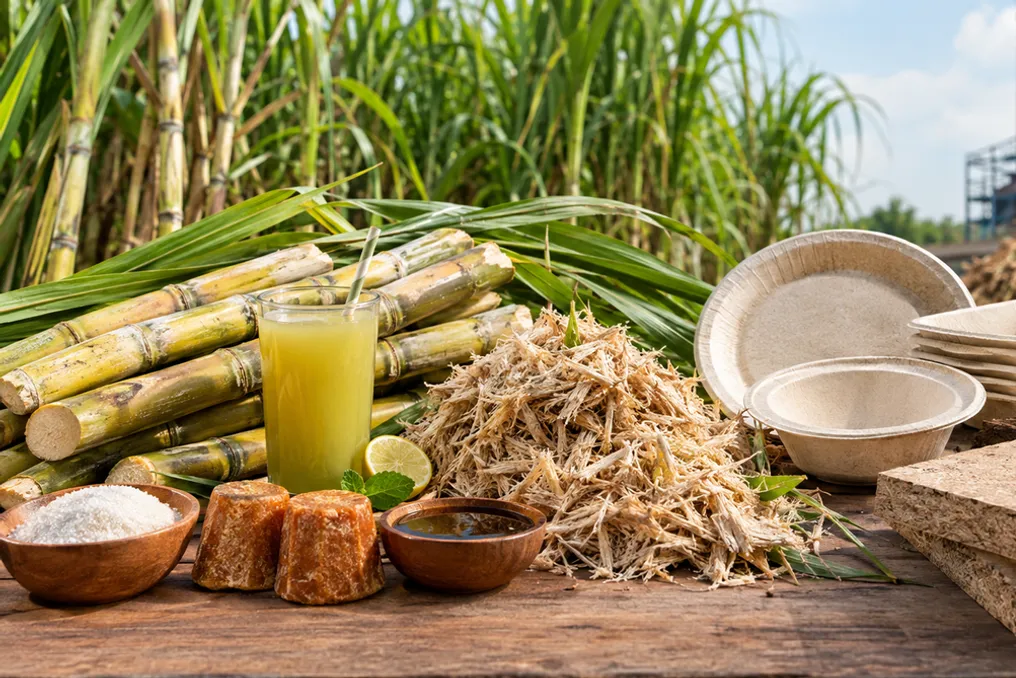
Sugarcane offers a range of applications beyond culinary uses, including electricity generation, paper production, creation of compostable tableware, and soil enrichment. Even the fibrous residue after crushing the stalks can become valuable industrial raw material.

Studies conducted by Indian agricultural institutions highlight how different parts of the crop can be utilized. Below are examples of how this everyday plant finds application far beyond the sugar mill.

Sweetening everyday products

Sugar is the most well-known product derived from sugarcane. Its juice is processed to extract sucrose, which is then crystallized into sugar used in homes, restaurants, and the food industry. The plant also provides traditional Indian sweeteners such as gur (jaggery) and khandsari sugar. Jaggery is made by boiling concentrated sugarcane juice until it solidifies and is widely used in regional sweets like laddus, halwas, and traditional dishes.

The Government of India's 'One District One Product' portal provides additional information on sugarcane-based products, such as molasses and jaggery.

Making a refreshing drink

Fresh sugarcane juice is a popular street drink across India, especially in the summer. Vendors crush the stalks to extract the juice, often serving it with lemon, ginger, or mint. This juice can also be evaporated to produce jaggery. In traditional production, the fibrous residue left after extraction can be burned to provide heat during juice boiling, allowing one part of the plant to aid in processing another.

Creating compostable disposable tableware

The fibrous residue left after extracting juice from sugarcane is called bagasse. Its fibers can be recycled into plates and other disposable tableware, offering an alternative to conventional plastic items. The Central Institute for Cotton Research of the Indian Council of Agricultural Research developed a technology for producing disposable paper plates using sugarcane bagasse and banana heart fibers. According to an ICAR technical note on creating wealth from agricultural waste, the production unit can manufacture between 10,000 and 30,000 paper plates per day, depending on its size. The process uses pressure molding to transform the fibers into usable products. This gives sugarcane processing industries another way to utilize the residue left after stalk crushing.

Electricity generation

Bagasse can also serve as fuel. Sugar mills burn this fibrous residue in boilers to generate steam, which drives turbines to produce electricity. The electricity helps meet the mill's own energy needs, and facilities with suitable infrastructure can supply surplus power to the grid. According to a release from the Press Information Bureau of the Ministry of Power and New and Renewable Energy, sugar mills use bagasse-based cogeneration units to produce steam and electricity for their operations and generate additional energy for sale.

Turning waste into paper

Bagasse contains cellulose, a component of plant fibers used in paper manufacturing. After appropriate processing, it can be converted into paper and other fibrous products. The Institute of Forestry Science and Technology under the Indian Council of Forestry Research and Education explains how bagasse can be used to produce particleboard. It also identifies this material as a potential source of cellulose for paper production. Utilizing this residue can create another source of raw material for industries dependent on plant fibers.

Fodder for livestock

Sugarcane can also support animal husbandry. Green tops and leaves remaining after harvesting can be used as dry fodder for cattle, especially when regular feed is scarce. A study by the Indian Council of Agricultural Research on sugarcane waste as feed explains how the material can be chopped and mixed with green fodder and concentrates. Due to its nutritional limitations, it must be used as part of a balanced diet, not as a complete feed on its own.

Soil enrichment

Fine dirt, also known as filter cake, is a byproduct separated during the clarification of sugarcane juice. It contains organic matter and plant nutrients that can be beneficial in agriculture. After proper treatment, it can be incorporated into compost and soil amendments, helping to return organic matter to agricultural lands. Its composition should be checked before application to ensure it is suitable for the intended use. This opens another path for the productive use of sugar industry waste instead of viewing it solely as refuse.

Particleboard production

Sugarcane bagasse can be used to produce particleboard, which is made by treating plant fibers or particles and binding them into sheets. These boards can be used in certain furniture and interior design solutions. A study by the Institute of Forestry Science and Technology on bagasse particleboards describes the fiber content of the material and its potential in board production. This application transforms the residue from sugar production into a material that can serve the construction and furniture industries.

One plant, many possibilities

The value of sugarcane lies not only in its sweet juice but also in the multitude of products that can be derived from its various parts. More efficient utilization of these materials can reduce waste and create added value for sugar mills and farmers. The key to success is selecting appropriate processing methods so that the majority of the harvest can be used productively.
Popular