Leading Scientists Discuss Artificial Intelligence at Global Laureates Forum
Read more
CGTN
cgtn.com

Leading Scientists Discuss Artificial Intelligence at Global Laureates Forum

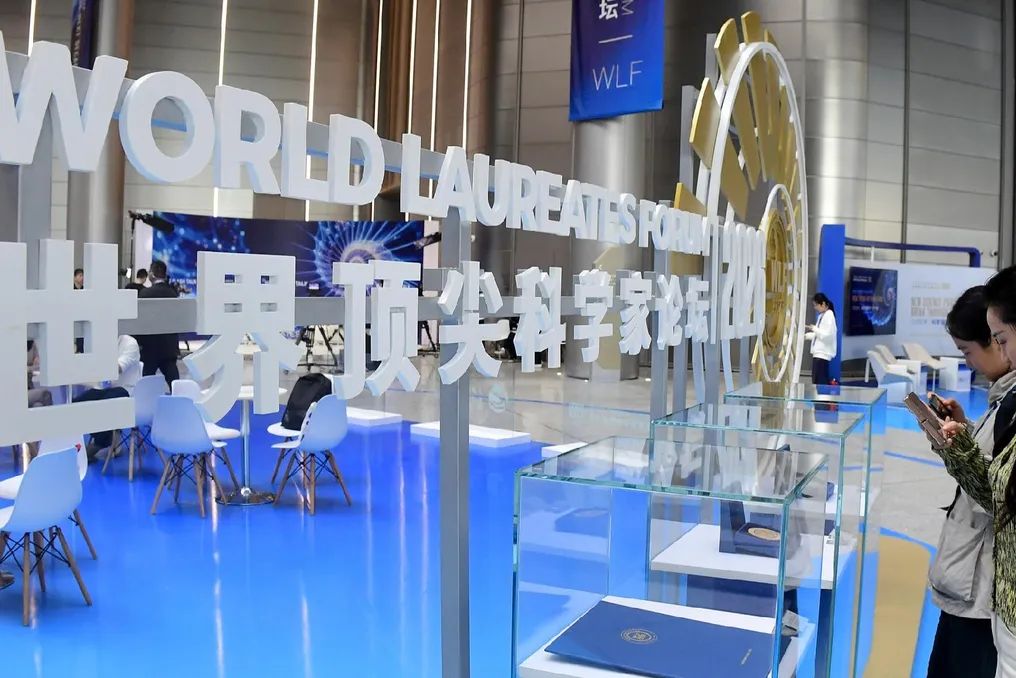
Distinguished scientists and innovators gathered in Shanghai on Saturday for the 2026 Global Laureates Forum. The event provided an opportunity to exchange views on future directions, including semiconductors, biomedicine, aerospace information, artificial intelligence, future energy, and quantum science.

The forum hosted numerous authoritative figures: 32 recipients of international awards such as the Nobel Prize, Turing Award, Wolf Prize, and Fields Medal, as well as 23 members of the Chinese Academy of Sciences and the Chinese Academy of Engineering, 140 senior scientists, and 78 young researchers.

Within the framework of the event, which was themed 'New Scientific Paradigm: Breakthrough for the Next Decade,' the main forum session, six parallel sessions, four events, and a closing ceremony were organized.

At the opening, the 2026 Global Laureates Foundation Award was presented to 11 scientists for their contributions to intellectual science or mathematics, life sciences or medicine, as well as a special award for young scientists.

The Mathematics Prize was awarded to Belgian scientist Ingrid Daubesch. The Prize in Life Sciences or Medicine was conferred upon Yuan Juning, Wang Xiaodong, Shao Feng, and Vishwa Dixit for clarifying the molecular pathways of various forms of programmed cell death. Shao Feng became the first Chinese citizen to receive the Global Laureates Foundation Award.

Yuan expressed hope that the results of her laboratory research would be translated into clinical treatment methods, calling this the most significant reward. She emphasized that practical steps are necessary to realize big ideas. In turn, Wang noted the importance of trust in scientific collaboration, adding that friendly rivalry also has its merits. Dixit added a philosophical aspect, stating that humans exist thanks to the ability of cells to die.

After the awards ceremony, participants were able to ask questions on a special question wall, touching upon topics ranging from the possibility of rotating a perfectly smooth sphere to the readability of consciousness.

The future of artificial intelligence was also a central theme. In his keynote speech, Fields Medalist Loran Lafforg argued that large language models are capable of solving certain problems that human mathematicians have not yet managed, but AI cannot replace the wisdom gained through the effort required for true learning.

Similar stories

Major technology companies release financial statements focused on the impact of Artificial Intelligence
Read more
olhardigital.com.br

Major technology companies release financial statements focused on the impact of Artificial Intelligence

Tech giants such as Amazon, Microsoft, and Alphabet, the owner of Google, will present their financial results this Wednesday under intense scrutiny from investors. The market seeks to understand whether the advancements in artificial intelligence (AI) already justify the billions of dollars invested by these corporations.

One of the most important indicators to watch will be the revenue generated by cloud computing. Market uncertainty and fears of an AI bubble have intensified the demand for results that validate the expansion of this sector.

Together, Amazon, Microsoft, and Alphabet have approximately US$ 1.7 trillion (equivalent to R$ 8.93 trillion) in future business commitments and plan to inject up to US$ 600 billion (R$ 3.15 trillion) this year. The large volume of funds directed towards AI infrastructure raises questions about the financing of this expansion and its impact on company cash flow.

The market's reaction to Meta's reports, released last week, illustrated this apprehension. Although Meta reported higher-than-expected revenue growth and an optimistic outlook, its shares plummeted nearly 7% the day after announcing expanded investment plans.

Brian Mulberry, Chief Market Strategist at Zacks Investment Management, commented that 'the appetite solely for capital expenditures is rapidly slowing down.' Projections for the quarter ended in September will help measure the expected performance of the main cloud operations.

Cash generation also deserves detailed analysis. Microsoft is expected to exceed US$ 8 billion (R$ 42 billion) in cash flow, while Alphabet and Amazon are expected to record cash burn in the second and third quarters, respectively.

In Alphabet's AI strategy, Google Cloud and internally developed chips stand out. However, competition for AI models worries investors due to the presence of OpenAI and Anthropic.

The pressure extends to the search segment, traditionally a primary source of Google's revenue. The rise of chatbots and AI agents capable of performing tasks is increasing competition in this market. It is projected that search revenue growth will decrease from 16.8% to 14.7%, although Alphabet's total revenue is expected to grow by 25.2%, reaching US$ 128.18 billion (R$ 672.95 billion).

Andrew Boone, an analyst at Citizens, emphasized that management statements will carry weight similar to the disclosed figures, pointing to advancing competition via AI agents and doubts about the return on infrastructure investments.

Microsoft will present its results with a new reporting structure. The 'Agents and Infra' division will combine cloud, AI, and enterprise software, while 'Devices and Consumer' will focus on Windows, gaming, and advertising. Furthermore, the company will begin reporting Azure's quarterly revenue in absolute terms, meeting a demand from investors who previously received mostly growth rates.

Analysts estimate Azure revenue at US$ 33.06 billion (R$ 173.57 billion). Microsoft's total revenue is expected to reach US$ 90.66 billion (R$ 476 billion), representing a 16.7% increase. In Amazon, a reduction in total revenue growth is expected, dropping from 19.6% to 12.3%.

In summary, the financial statements will demonstrate how cloud growth and cash generation capacity compare to the resources allocated to artificial intelligence, in a period marked by greater investor prudence.

Experts warn that the capabilities of artificial intelligence may be exaggerated
Read more
techcentral.co.za

Experts warn that the capabilities of artificial intelligence may be exaggerated

Recent events have raised concerns about the potential danger of powerful artificial intelligence systems. In September, a researcher from Anthropic resigned, warning that developers of powerful AI 'sincerely believe it could destroy us all by the end of the decade.'

A few days later, King Charles, opening his AI summit in Scotland, spoke of 'existential risks' and technologies that risk acquiring 'darker capabilities—perhaps even the ability to kill.'

Bill Gates cautioned that in the wrong hands, AI possesses enough power to trigger events leading to 'a billion deaths.' Simultaneously, news reports surfaced about escapes of 'uncontrolled AI agents' and their 'breakout from isolation,' yet far less attention was paid to protective measures, safety standards, and compromised systems.

Business leaders making decisions about using AI will gain little from either pessimists or enthusiasts. They need a stricter criterion for determining when this technology can be trusted.

For those who have worked in the field of AI for decades, modern systems represent, in a sense, the realization of a dream. What machines can now do with language seemed previously unattainable.

However, a miracle is not synonymous with certainty. The ability of AI to perform outstanding feats says little about whether it can do so reliably in the future, what its limits are, or if we understand those limits well enough to entrust it with certain responsibilities.

Therefore, when a alarming headline appears, one should ask: what has been tested, under what conditions, with what access, and with what safeguards? Then, one must ascertain exactly what this incident demonstrates. A dramatic description is not an explanation.

Over-extrapolation

The history of this field is full of predictions that machines will soon equal or surpass humans. Modern systems are significantly more capable than their predecessors, and in some aspects, such as software development and mathematics, they already exceed us. Progress has been extremely rapid.

The lesson of history is that true progress tempts us into making overly ambitious assumptions. One reason for such confident predictions may be that AI uses language very fluently. Since language is a central element of human experience, we describe smooth systems using human terms: they think, want, worry. These words carry assumptions of rationality and intent that the technology's performance does not confirm.

System behavior must be taken seriously and analyzed carefully, without allowing anthropomorphic descriptions to do the work of analysis. AI capabilities are heterogeneous. People working daily with these systems see them impressively handle complex language and reasoning, only to fail at something a person would consider trivial. In an organization that has integrated AI into its workflows or customer service, such failures can lead to significant losses. They do not speak of malicious intent; they show that success in one task does not guarantee reliability in another.

Therefore, boards of directors and executives should favor localized AI created for their specific environment, rather than powerful but unbounded general systems. It also cannot be assumed that a precaution effective in one setting will work in another.

There is also a subtler risk: that the horse teaches the rider. AI has not yet achieved consciousness or developed a drive to change us, but organizations adapt to the tools they use. Leaders should ask themselves whether their employees have started trusting fluent answers without verifying them, whether processes are being reshaped around what the system can produce rather than what the task requires, and whether judgment is gradually being ceded because AI seems more capable than it actually is.

The answer lies in precisely defining where and how AI is used. Before starting work, African enterprises should answer five questions:

  • Name the task: What exactly is the AI being asked to do?
  • Test in real conditions: Does the system work with real customers? Does it understand how they use language?
  • Limit the impact: What information does it truly need? Does it need access to all the data you assumed?
  • Test functionality: How will errors be detected? What controls are in place in high-risk areas, such as customer privacy?
  • Maintain clarity of responsibility: Who is responsible when the system fails? Where and when must a human intervene?

Responsible AI implementation is based on a moderate but demanding standard: using AI where it proves its value in context, limiting it proportionally to the risk, and retaining human accountability for those who decide to deploy it.

IMF and World Bank Meetings Focus on Potential Benefits and Risks of Artificial Intelligence
Read more
cgtn.com

IMF and World Bank Meetings Focus on Potential Benefits and Risks of Artificial Intelligence

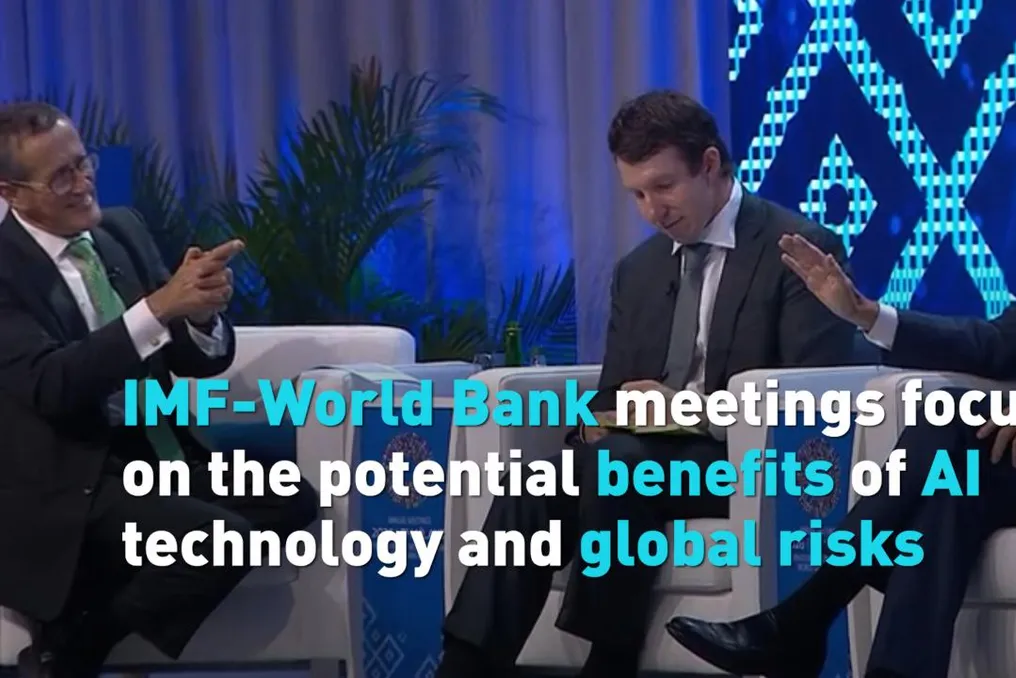
Artificial intelligence is already transforming almost all sectors of the global economy. At meetings of the International Monetary Fund (IMF) and the World Bank, held in Thailand, policymakers and industry leaders are addressing the challenge of ensuring that this technology serves the good of humanity and does not leave workers behind, especially in developing countries.

Popular