DeepSeek Harness Team Unveils Prototype of Super Agent Capable of Self-Finding and Fixing Errors
Read more
Pandaily
pandaily.com

DeepSeek Harness Team Unveils Prototype of Super Agent Capable of Self-Finding and Fixing Errors

The DeepSeek Harness team has published a description of their project, which they named the Super Agent. This agent is designed as a continuously operating system that simultaneously advances multiple tasks, independently seeks work, and recovers from failures. The corresponding research prototype was released on GitHub under the MIT license, according to Chinese tech media.

The dsh-superagent-prototype repository is a package of a proactive coding agent intended to work with a single GitHub repository within the DeepSeek Harness ecosystem. The agent monitors activity on GitHub, and optionally on Feishu. When an authorized user requests a task execution, the agent creates a work item, processes it in its session and catalog, and then responds in the original dialogue, for example, by creating a pull request.

The accompanying documentation emphasizes that this code is for research purposes and is not an official DeepSeek product, and some concepts described in the document have not yet been implemented.

System Architecture

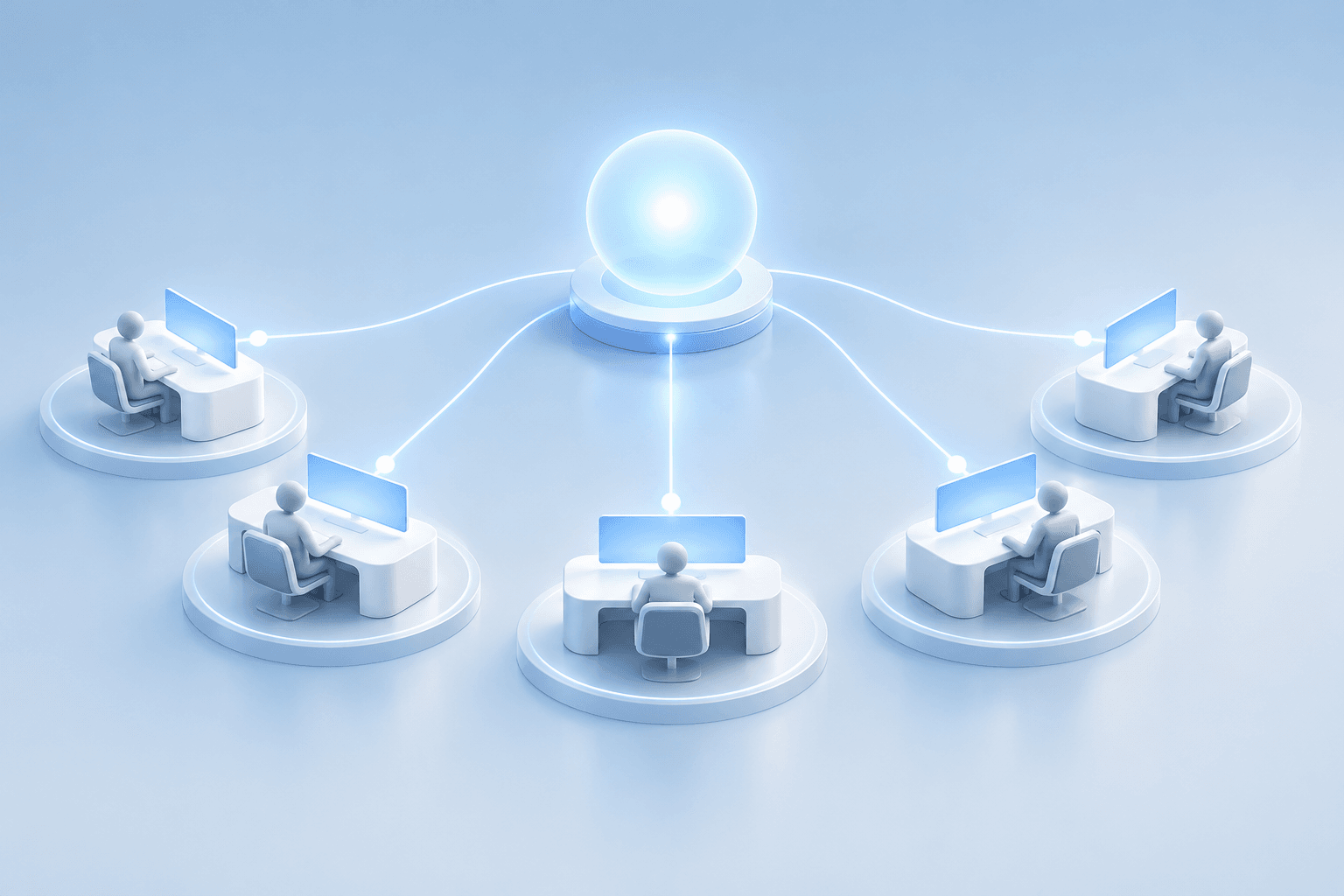
The core concept is built upon a two-layer architecture. The Router session receives all human activity from different channels but does not perform the work and may not even have a Bash tool. Tasks are delegated to isolated Worker agent sessions, which execute work in parallel using a full set of tools, and send reports back to the Router, bypassing communication with users.

Each Worker agent subscribes to branches of interest, such as chat discussions or pull requests, allowing subsequent events to go directly to it without passing through the Router. The system functions based on events: triggers include messages in chats, emails, review comments, and Continuous Integration (CI) results, which are first filtered by deterministic code and then by the model.

The team also separated the agent's state and the execution environment so that the agent can remain active in the cloud while interacting with the user's local machines. An external Watchdog session is also used to monitor whether the Worker agents are making real progress. Within the internal user group, the team established a rule: the instance must silently reproduce reported errors and only report them after finding a simple solution, sometimes opening a pull request before anyone flags the issue.

During preliminary tests on synthetic loads, including about 300 messages and approximately 20 work requests, the Super Agent completed half of the tasks in 12.4 minutes and 95% in 15.7 minutes. These figures surpassed the results achieved by a single session with a sub-agent tool, although they required more cached tokens. Without direct routing of subsequent events to the Worker agents, the Router's solutions increased by approximately 30%, and batch processing under high load reduced the time to output one Router solution from 6.4 seconds to 1.6 seconds. The team called these results a preliminary benchmark.

Among the unresolved issues listed by the team are scaling the Router, long-term memory, inter-agent communication, and the risk of prompt injection if the cloud agent gains access to credentials on local devices.

Similar stories

DeepSeek Harness v0.2.2-alpha.2 allows the main agent to delegate tasks to local Codex and Claude Code tools
Read more
pandaily.com

DeepSeek Harness v0.2.2-alpha.2 allows the main agent to delegate tasks to local Codex and Claude Code tools

DeepSeek has released a pre-release version of DeepSeek Harness, its open-source agent software, version v0.2.2-alpha.2, which was posted on GitHub on October 28. The main innovation is an experimental plugin called subagent_oar, which enables the main agent to assign an autonomous task to install Codex CLI or Claude Code on the same machine.

Previously, Harness supported Claude Code and Codex; the v0.1.0-rc.8 update in August allowed users to install them as profile packages within their subagent system. However, the new tool functions differently. It provides the main agent with a single entry point for distributing work: when calling subagent_oar, the agent selects either codex or claude, then sends the task description, the full prompt, and an optional working directory. The tool immediately returns a task ID, and upon completion, a notification of execution brings back the final answer or an error message to the main session.

External tools operate independently. Codex CLI and Claude Code maintain their own configurations, models, tools, and login process, so users must install and authorize each one, and ensure that the Harness host can find them. Provider parameters can pass the model, reasoning level, launch arguments, environment variables, and timeout, depending on each runtime's support.

The documentation sets clear limitations: the main conversation is not redirected, so the request must explicitly state which files are important and what should be returned. Tasks are one-off, without the possibility of subsequent questions, session resumption, or real-time progress streaming. Only the final answer or failure is returned, not the internal reasoning of the external agent or its tool history. Official examples allow for a writable workspace and disable permission requests, and canceling a task does not undo file changes already made by the external agent.

Other add-ons help users track delegated work. An experimental change request feature can display the status and differences of a related merge request for a session running in its own Git working tree. The developer statistics plugin details the usage of context, cache, as well as the time spent on models and tools for each step and turn. Output from small background tasks now comes through the completion notification, and the subagent waiting guide reduces the need for repeated polling.

The release also allows users to update third-party plugin packages, with the option to roll back in case of a hot update failure, and adds interface text in Japanese, Spanish, French, German, Russian, and Brazilian Portuguese. Earlier community materials, including multi-agent setup tests from Bilibili creators, were created by users themselves and are not DeepSeek products.

DeepSeek V5 identifiers found in Harness code; V4.1-Flash leads among open models on FrontierCode
Read more
pandaily.com

DeepSeek V5 identifiers found in Harness code; V4.1-Flash leads among open models on FrontierCode

Developers discovered three new model identifiers in DeepSeek's official Harness repository on GitHub: deepseek-v5, deepseek-v5-open, and deepseek-v5-next. Currently, DeepSeek has not announced the V5 model, and these entries are test placeholders in the code, not available models.

Upon checking the repository, it was determined that these identifiers are located in a test file for the DeepSeek account provider, specifically in the file packages/llm/llm-deepseek-account/tests/provider.spec.ts, on lines 154–156, next to the existing deepseek-v4-pro entry. The repository history shows they were added in a commit from September 24th, which moved the DeepSeek account model directory into the official list of models.

The test scenario checks how the client filters models by required version: the v5-open entry requires a minimum client version of 0.0.1, while v5-next requires 99.0.0-alpha.1, and the test expects only the flash and v5-open models to appear in the list. This indicates the possibility of switching to a new model from the Harness server side, either for all clients or only for those who have updated, without needing a new release. However, this does not confirm the existence of the V5 model or its release timeline, and some developers consider these names merely test placeholders. As of October 28th, DeepSeek has made no announcements, model cards, or API identifiers for the V5 series.

The current model lineup includes V4-Pro and V4.1-Flash; the latter was released in September with a new architecture while retaining the V4 name.

In the same week, a new benchmarking result was presented for the current model. Artificial Analysis released Intelligence Index v5, which is the largest update since the V4 release in January, with 60% of the weight now based on closed test datasets or hidden answers. Coding accounts for 25% of the index, and of these 15 points, FrontierCode 2.0 from Cognition accounts for the evaluation of code changes in 132 real open-source tasks to see if they would approve a pull request merge.

On the FrontierCode 2.0 platform, the DeepSeek V4.1-Flash-1017 model scored 28% at maximum effort, which is the highest score among models with released weights. Kimi K3.1 Pro achieved 25.5%, but its full weights are not yet available. Gemini 4 Argon reached 25.7%, and GPT-6 Luna scored 25.2%.

The overall index was less favorable. DeepSeek V4.1-Flash scored 32 points, tying with GLM-5.3, while the leader, Claude Opus 5.5, received 58 points. Artificial Analysis notes that the gap between the best open model with released weights and the leaderboard leader has increased from 3 points under v4.3 to 12 points under v5.

DeepSeek raises $15 billion to intensify competition against OpenAI and Anthropic
Read more
ventureburn.com

DeepSeek raises $15 billion to intensify competition against OpenAI and Anthropic

DeepSeek, which garnered Wall Street's attention in 2025 for its accessible and highly capable AI model, has completed a major funding round to challenge the growing dominance of OpenAI and Anthropic.

In the latest round, DeepSeek raised $15 billion, equivalent to approximately 100 billion yuan. The funding came from battery giant CATL, Tencent (the company behind WeChat), and several other leading technology firms.

Initially, the Hangzhou-based company planned to raise 50 billion yuan. However, demand increased this target to 80 billion, and subsequently to approximately 100 billion.

New participants in the list include automaker Geely, Legend Capital, Stony Creek Capital, China Fortune-Tech Capital, and CPE Asset Management. Among existing investors, IDG Capital, Lux Capital, and Silicon 100 also joined CATL and Tencent. It is reported that only CATL contributes about $1.38 billion, which is roughly double their check from the first round.

Dealroom estimates DeepSeek's preliminary valuation at approximately $68.8 billion. It is reported that the funds are distributed almost evenly between new and existing shareholders, indicating that early investors maintain faith even at a significantly higher price.

Previously, DeepSeek closed its first round worth over $6.88 billion in June, and opened a second round in July. In total over six months, this amounts to about $20.6 billion, which Dealroom calls the largest primary market financing in China this year.

The majority of the raised funds will be directed towards model research and computing power. There are also reports of increased spending on data centers and open-source models. Corporate restructuring is planned, and, according to reports, an Initial Public Offering (IPO) on the Shanghai Star Market is being prepared.

Despite $15 billion being a huge sum, it does not equalize the odds. OpenAI and Anthropic have each raised over $100 billion, and DeepSeek still has significantly fewer resources. Nevertheless, it has never had to measure up to American labs in dollar terms, as its reputation is based on efficiency, proving that strong models do not require infinite budgets.

This combination of discipline with much greater financial capacity should concern competitors. Furthermore, DeepSeek is not alone; Moonshot AI is reportedly approaching a $50 billion valuation and plans its own IPO in Hong Kong. Chinese AI is attracting capital at an unprecedented speed.

Perhaps more significant funding will lead to faster product releases, and DeepSeek's open models may become stronger and cheaper, creating price pressure on everyone, including American providers. The investment composition is also important: since CATL deals with batteries and Geely with automobiles, their investments indicate a deepening of AI into hardware and industry, not just chatbots. It should be noted that this report has not been officially confirmed by DeepSeek.

In any case, the message is clear: DeepSeek has ceased to be a modest underdog and has transformed into a well-funded contender, making the AI race much more competitive.

Popular