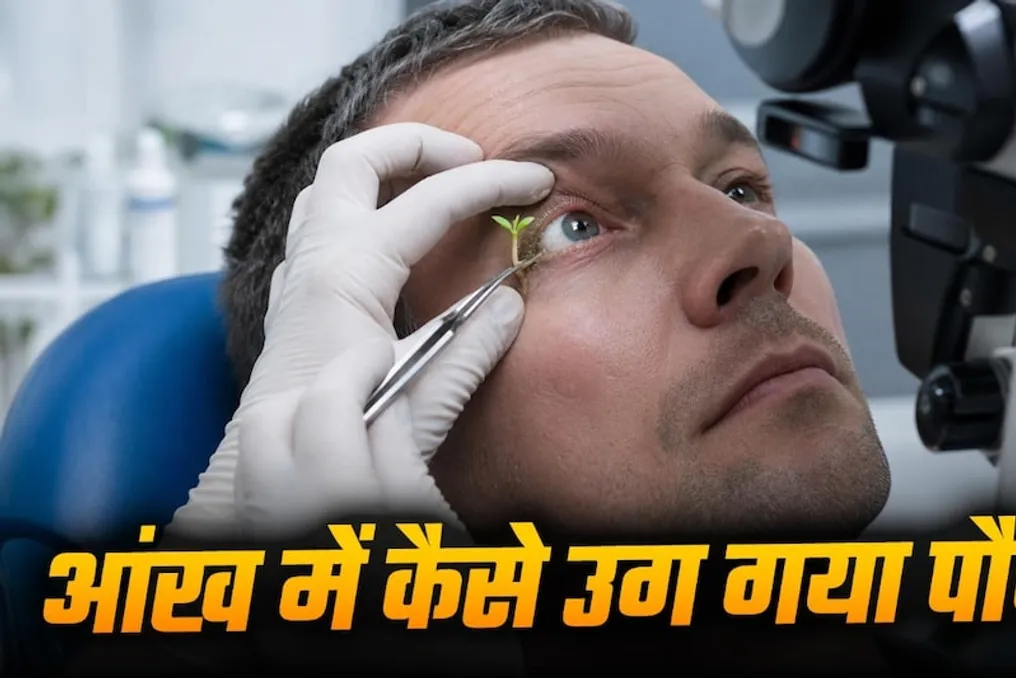
A striking case occurred in Russia where a man suffered for a long time from severe headaches and vision problems. Examinations revealed that a plant seed was inside his eye, which began to sprout and form a small shoot whose roots penetrated the delicate tissue of the eye.
This incident took place in the Siberian region of Russia. A man named Maxim Sleptsov, who was 42 years old at the time of discovery, had been experiencing headaches, eye swelling, and worsening vision for several months. Initially, he assumed it was due to a minor eye injury but was unaware of the seed rooting inside the organ of sight.
Maxim, whose profession is a welder and plumber, had previously visited a friend in the remote area of Abiuski in Siberia. They were planning to go fishing and gather wild berries. During this visit, an accident occurred: a tree branch suddenly hit him in the face and entered his eye. After that, his eye started to hurt, itch, and become red, and tears flowed from it. He rinsed his eye with water, thinking he had removed a small piece of wood, and did not give the incident much importance.
However, the real problems started later. A very small seed, detached from the tree, remained inside his eye. Over time, it began to sprout in his eye, which he did not know about.
Initially, Maxim expected the eye injury to heal on its own. Nevertheless, his condition gradually worsened: his eye constantly swelled, and his vision began to suffer. Simultaneously, he developed severe headaches, resembling migraines, which persisted even after waking up in the morning. He struggled with these unpleasant symptoms for about four months. Due to the remoteness of his residence, it was difficult for him to quickly reach a specialist ophthalmologist.
Finally, when he managed to get to the city of Yakutsk, he went to the emergency department. During the examination, doctors saw something completely unexpected.
The examination established that the seed, having entered the eye, had sprouted. Its root reached a length of about 3 millimeters and penetrated the conjunctiva—the thin membrane covering the white part of the eye. The chief physician of the hospital, Ivan Lutskan, noted that the most surprising thing was that the seed had not just gotten stuck, but had released roots that reached the delicate tissues of the eye.
After the diagnosis, the doctors decided to remove the seed. This procedure was performed by ophthalmologist Elizaveta Karpova using local anesthesia. Local anesthesia ensured numbness in the treatment area so that the patient would not feel pain during the intervention. The doctor carefully extracted the seed from the eye using a syringe. The doctor emphasized that he had never encountered such a case before. According to the medics, if the seed had remained inside and continued to grow, it could have led to serious complications, including loss of vision.
After the seed was removed, Maxim felt immediate relief. He expressed joy that the doctors had timely determined the true cause of his discomfort. This case is surprising because the seed, which entered the eye after a minor branch injury, slowly sprouted and caused problems for many months. The article concludes with a warning: if pain, redness, or blurred vision persists after an eye injury, it should not be ignored, and one should consult an ophthalmologist.