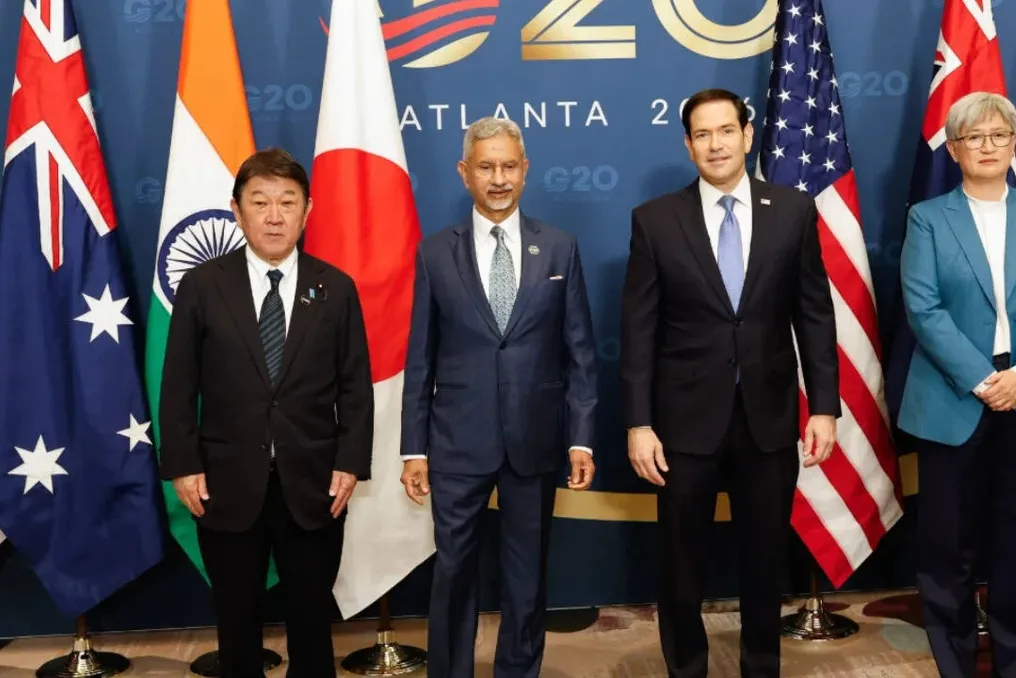
Quad countries condemn economic coercion and announce $85 million allocation for AI development
Read more
The times of India
timesofindia.indiatimes.com

Quad countries condemn economic coercion and announce $85 million allocation for AI development

Foreign ministers of the Quad nations expressed serious concern regarding economic coercion, including arbitrary export restrictions and non-market practices that lead to overproduction and disrupt global supply chains in critical sectors. These actions are directed against China's military and economic practices in the Indo-Pacific region.

During the meeting in Atlanta, the Quad countries also announced the provision of over $85 million in technical and financial assistance to expand access to 'Trusted Superintelligence SI' (referring to artificial intelligence) in the Indo-Pacific region. It should be noted that Trump recently signed an executive order changing the name of AI to SI.

The ministers supported continued cooperation in the supply chains of critical minerals and the need to reduce dependence on any single supplier. The Foreign Ministers of Australia, India, Japan, and the US—Penny Wong, S. Jaishankar, Toshimitsu Motegi, and Marco Rubio, respectively—held the fourth Quad foreign ministers' meeting after President Donald Trump's return to the White House last year, on the sidelines of the G20 summit in Atlanta on Saturday.

At this meeting, Motegi voiced strong protest against any unilateral attempts to change the status quo by force or coercion, although the joint Quad statement, unlike the May meeting, refrained from mentioning the South China or East China Sea.

Quad ministers continue to meet despite the leaders' summit remaining frozen, leading to speculation that the Trump administration has effectively downgraded the group's status by not allowing India to participate as planned.

In the joint statement, the ministers reaffirmed their commitment to promoting peace, stability, and prosperity in the Indo-Pacific region, as well as holding the Quad Leaders' Summit. Rubio stated after the meeting that Quad will soon announce a leaders' summit in Manila on the sidelines of ASEAN meetings. President Donald Trump is scheduled to travel to China from Manila to attend the APEC summit.

Leaders also focused on the situation in West Asia, including the Strait of Hormuz. The joint statement emphasized the absolute necessity of protecting and preserving navigation rights and freedoms in the Strait of Hormuz, the Red Sea, and the Bab el-Mandeb Strait in accordance with international law reflected in UNCLOS, recognizing the importance of critical sea routes, uninterrupted trade, energy security, as well as unimpeded passage and safety of maritime crews and vessels without customs duties.

Jaishankar noted that the meeting highlighted the importance of maintaining stability, stimulating prosperity, and ensuring freedom of choice, as well as deepening cooperation to strengthen supply chain resilience and ensure the security of critical minerals and energy technologies. He also mentioned the importance of continuing agreements on counter-terrorism, maritime security, and capacity building to enhance resilience and promote peace and stability.

According to the joint statement, the ministers also announced the first-ever Quad Business Leaders Forum, which will bring together industry leaders, government, and policy experts from Quad countries to strengthen public-private sector ties, including promoting commercial deals in key areas. The statement indicated that the Quad countries reinforced the need to create secure, resilient, and reliable supply chains for advanced semiconductors and SI (AI) equipment.

Similar stories

Fractile raises £577 million to challenge NVIDIA's monopoly on AI chips
Read more
ventureburn.com

Fractile raises £577 million to challenge NVIDIA's monopoly on AI chips

Despite market reactions to the massive expenditures in artificial intelligence, investments in AI hardware continue to grow. In a Series C round, the British chip manufacturer Fractile raised £577 million, causing significant resonance in the European tech scene.

Fractile's latest funding round is aimed at challenging NVIDIA's absolute dominance in the semiconductor sector. Attracting such a large amount of capital in such a short period demonstrates the huge investor demand for AI infrastructure. These funds will be used to actively expand the company's engineering centers in London and Bristol, where leading robotics and silicon design specialists are being hired.

For end-users, this means that the bottleneck in AI computing power may begin to ease. Increased competition, in turn, contributes to lower costs for running advanced AI systems, which will positively affect software accessibility and the improvement of consumer tools.

Fractile is not just opposing NVIDIA; the company is using a completely different technical approach. While NVIDIA built its empire based on Graphics Processing Units (GPUs), Fractile is developing AI inference chips based on Static Random-Access Memory (SRAM). This is highly significant because the inference phase requires fast and massive computations. SRAM provides extremely fast data access, significantly reducing the time taken to generate AI responses.

Instead of competing where NVIDIA already dominates, Fractile aims to change the principles of AI memory operation. Success in this area could lead to AI energy efficiency and speed surpassing current market standards.

Raising over half a billion pounds is only possible with serious buyers, and Fractile has secured a major initial supply agreement with Anthropic, the research lab behind Claude. This serves as strong endorsement, as Anthropic is essentially betting that Fractile's architecture will surpass the industry standard by 2027, when the chips enter data centers.

This partnership confirms the viability of the European chip market, showing that major AI labs are actively seeking alternatives to the NVIDIA monopoly, needing efficiently scalable hardware. Although NVIDIA maintains significant influence in the market, Fractile's large Series C round proves that the industry is tired of depending on a single supplier. This is a major sign of confidence in British deep technology, demonstrating that European startups can compete at the highest global level with sufficient capital, radical engineering solutions, and strategic partners.

Foundry Robotics raises $100 million to build America's first AI-powered assembly factory
Read more
ventureburn.com

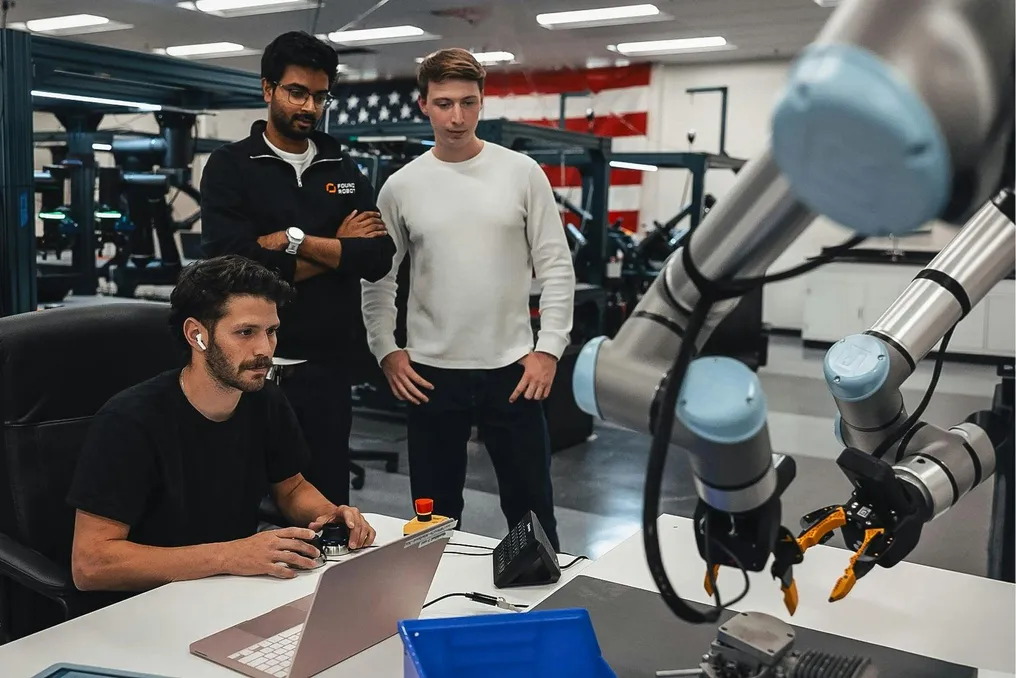
Foundry Robotics raises $100 million to build America's first AI-powered assembly factory

Foundry Robotics, based in Emeryville, California, announced on Wednesday that it has raised a Series A round of $100 million. These funds are intended for the construction of what the company calls America's first autonomous assembly factory. Additionally, the capital will be directed towards expanding its robotics, engineering, and operations teams, as well as implementing additional artificial intelligence models.

Founded only this year, Foundry is demonstrating a rapid pace of development. Founder and CEO Adarsh Kulkarni has experience with robotics; previously, he was a fourth employee at Ghost Robotics, working on bipedal robots for the US armed forces, and later became the first head of the robotics department at Scale AI.

Co-founder Emmanuel Lamakkiya possesses deep knowledge of manufacturing, having led the Model Y program at Tesla, overseeing the production of approximately 1.5 million vehicles annually. Anup Karmakar, a former software lead at Tesla, also joined the team. The team also includes veterans from the military who have experience working at Raytheon and Northrop Grumman, highlighting their ability to scale production.

Unlike most robotics startups that sell the robots or software themselves, Foundry owns and operates factories independently, offering a manufacturing-as-a-service model. The company installs AI-supported robotic cells at its sites. The FoundryOS system connects these robots, the factory, and cloud services. Each production cycle feeds data back into the models, allowing the system to continuously improve.

For clients, this means faster and more consistent production. Foundry claims it can take a product from design to release in a matter of weeks, eliminating the need to create a new production line or costly equipment retooling. For defense contractors awaiting components, this could shorten program timelines by months.

The company's main specialization is complex electromechanical assemblies such as drones, satellites, wire harnesses, and underwater vehicles. The list also includes components for autonomous vehicles, ground robots, and data center equipment. The new 130,000 square foot facility in Emeryville increases the company's production capacity twentyfold.

In addition to Marlinspike, early investors in the round returned, including Khosla Ventures and Red Glass Ventures. New participants include SE Ventures, Wing VC, and Axiom Ventures. Existing investors Hanabi and Zero Shot Fund maintained their positions. This funding round ranks among the top 3% of registered Series A rounds in US deep tech, a rare achievement for such a young company. Earlier reports indicated initial funding of about $14 million, making the current round a significant leap.

Marlinspike's Managing Director, Mislav Tolusik, noted that manufacturers urgently need in-house production capacity. He also believes that Foundry quickly secures contracts with clients. Duane Fortingham, President of HII Unmanned Systems, stated directly that 'production capacity is a national bottleneck for deploying unmanned systems.' This is where Foundry fits in.

Kulkarni insists that factories capable of reviving American manufacturing must be designed from scratch, not merely repaired. The company's mission is to revitalize US industry. Foundry is not alone in this endeavor; Arda Industries launched this month with $232 million in funding. Maven Robotics also raised $100 million in a Series A round in September. Investors clearly see a shift, but big claims require proof. An 'autonomous factory' is only valid if it delivers reproducible results at scale, and Foundry now has the funds to demonstrate this.

Simplismart raises $14 million in Series B round to expand AI inference platform
Read more
business-standard.com

Simplismart raises $14 million in Series B round to expand AI inference platform

Simplismart, a company specializing in artificial intelligence inference infrastructure, announced that it has raised $14 million in a Series B funding round. The round was led by Dallas Venture Capital, with participation from NVIDIA, Accel, Shastra VC, and Micromax.

The funds raised will be used for the further development of the Simplismart inference platform. This will enable enterprises to launch AI-based applications more efficiently, and cloud providers to transform their Graphics Processing Unit (GPU) infrastructure into managed AI services. Furthermore, the funding will support the expansion of partnerships with cloud providers and sovereign AI, as well as growth in North American and other global markets.

Simplismart creates a software layer situated between AI models and GPU infrastructure. Its modular inference engine allows companies to customize AI model operation according to their needs for speed, cost, and performance. The company's orchestration platform manages deployment and scaling in both cloud and on-premise infrastructure.

Over the last six months, the company's annual revenue growth rate has increased 14fold. Companies such as HeyGen, Higgsfield, InVideo, Shiprocket, Apna, and Ema run production workloads on the Simplismart platform, covering video, voice, multimodal, and enterprise AI applications.

Amritaanshu Jain, Co-founder and CEO of Simplismart, noted that while the industry has spent many years improving AI model capabilities, the advantage is determined by how these models are utilized: the cost per interaction, application response speed, and reliability under increasing demand. He added that the team spent four years creating the software layer between the model and the GPU, helping clients optimize workload deployment and operation.

An example of usage is the Exotel communications platform. After Exotel found that the economics of closed API models were unsuitable for its voice agents, the company fine-tuned an open model on its own data and migrated the inference to Simplismart. By sharding GPUs, Simplismart reduced the cost per minute for Exotel by 57% compared to closed API models. Additionally, it lowered costs below that of self-hosting the same open model and reduced response time from 1.1 seconds to less than 300 milliseconds.

As part of its offering to cloud providers, Simplismart collaborates with NVIDIA to simplify the deployment and operation of AI infrastructure at scale. Unlike inference providers who buy or reserve GPU capacity and resell it, Simplismart itself does not own computing power. Instead, it provides a software layer that transforms third-party GPU clusters into ready-to-use AI production infrastructure. Cloud providers can use this platform to offer managed AI services under their own brands without building their own software stack from scratch. This approach is already used by Yotta, where the Simplismart platform forms the basis of the Shakti Studio server inference layer.

Dayakar Puskoor, Managing Partner at Dallas Venture Capital, stated that inference is becoming one of the most significant drivers of change in the AI economic model. He emphasized that Simplismart is rapidly becoming a global player, helping enterprises execute AI workloads more efficiently and enabling cloud providers to convert GPU power into scalable services.

Devansh Ghatak, Co-founder and CTO of Simplismart, reported that the company's modular inference engine allows configurations to be adapted to the requirements of individual workloads, and the orchestration platform manages deployment across various infrastructure environments. Ghatak also mentioned that the new funding will support the development of a dynamic GPU scheduling layer, which can align AI workloads with available computing power across different regions and time zones, helping cloud providers better utilize their GPU infrastructure.

Popular