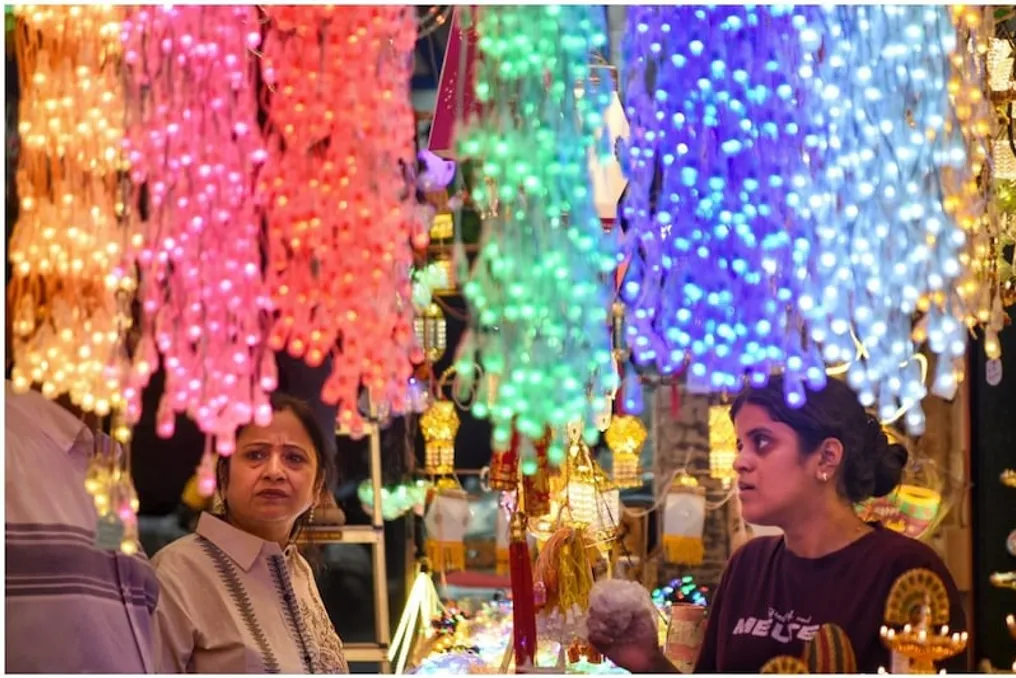
Prices for Decorative Light Garlands for Diwali in Delhi Wholesale Markets
Read more
Aaj Tak
www.aajtak.in

Prices for Decorative Light Garlands for Diwali in Delhi Wholesale Markets

As the festival of Diwali approaches, markets have been decorated with numerous twinkling lights, and shops and homes are beginning to be adorned with lighting fixtures. With Diwali drawing near, the question of choosing and where to buy lighting always arises. If you plan to purchase garlands for your home, we will tell you about their prices at Sadar Bazaar in Delhi and how cheaply they can be found wholesale. At this time, videos from sellers reporting current prices for these luminaries are circulating on social media.

According to traders, many types of lamps and garlands are available for Diwali decoration, with prices varying depending on length, design, and quality. They indicate that the starting price for single-color lamps is 18 rupees for a 10-meter set. Additionally, a 15-meter lamp costs 30 rupees, while a high-quality 'High Glow' 15-meter lamp will cost 36 rupees. 20-meter lamps are also available for 46 rupees, and 30-meter ones for 65 rupees. Sellers also offer a second-quality 15-meter lamp for 65 rupees, a 20-meter one for 80 rupees, and a 30-meter one for 100 rupees.

Regarding multi-colored lamps, the starting price is 28 rupees for 10 meters. The initial price for a 15-meter multi-colored lamp is set at 40 rupees. Traders note that these lamps come in many color options. A 30-meter garland is also available for 70 rupees, and a second-quality 30-meter garland costs 75 rupees. The price for a 40-meter lamp is 120 rupees. Furthermore, a 90-meter yellow garland sells for 230 rupees, and the second-quality option is 250 rupees.

In the opinion of the sellers, their assortment includes many long garlands, including models ranging from 75 to 100 meters. One 90-meter garland can cost 300 rupees. A seller claims to have garlands from 10 to 120 meters, with the cost depending on the number of bulbs and quality.

In the crystal lamp category, there is a 50-meter model priced at 100 rupees. A 40-meter crystal lamp is offered in various quality options for 300 and 400 rupees. The trader reported that among them there are various designs, including patterns resembling diamonds.

Besides lamps, the store has various decorative items. According to the seller, the starting price for lamps featuring Lakshmi and Ganesha is 45 rupees, and various designs are available in the price range of 75 to 140 rupees. Prices for chandeliers start from 60 rupees, followed by chandeliers costing 80, 100, 120, 150, 180, and 250 rupees. The largest and most elaborately decorated chandeliers can reach a price of 450 rupees.

Decorative lanterns and torches are also available, with a starting price of 65 rupees. One lantern costs 100 rupees, and a torch of another design costs 180 rupees. Lamps with a 'crackers and bell' design are also available for 120 rupees, a 'Ghasri' lamp for 130 rupees, and a crystal-design lamp for 250 rupees. The cost of a tactile light fixture ranges from 6 to 8 rupees, while a standard bulb starts from 20 rupees. The store also features other bulbs priced from 40 to 80 rupees, as well as lamps with folding fans.
Similar stories

Candle procession is part of the Natal Luz festival program in Gramado
Read more
viagemeturismo.abril.com.br

Candle procession is part of the Natal Luz festival program in Gramado

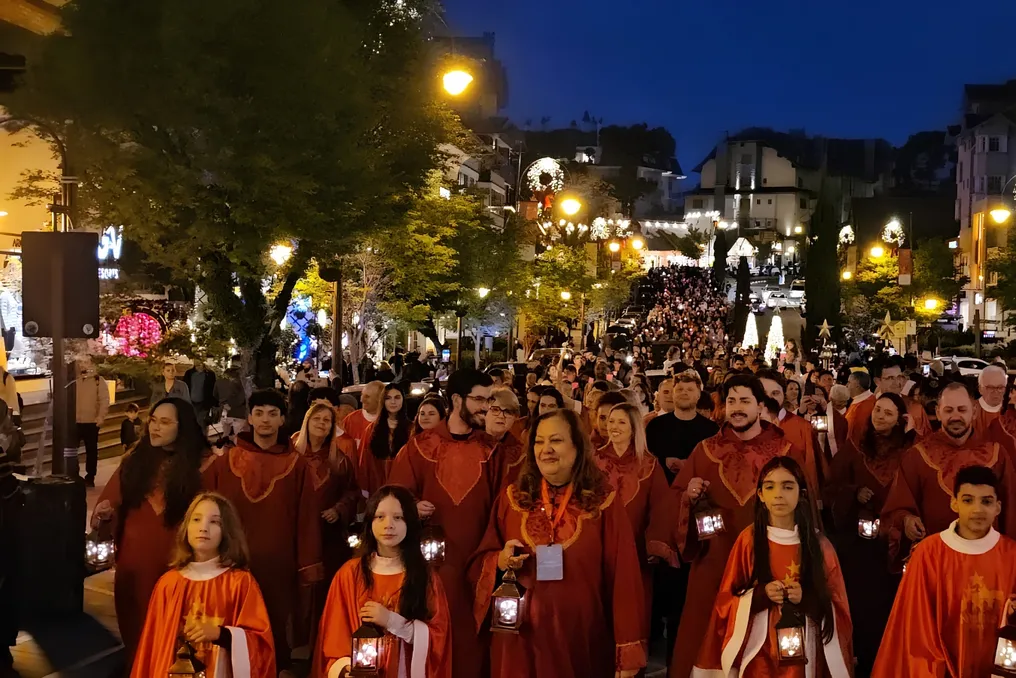
Residents and tourists visited the illuminated 'Caminho das Luzes' parade in Gramado last Tuesday (the 27th). This public procession moved through the city center with lit candles and was accompanied by a religious blessing, thereby reviving the origins of Natal Luz, which was created in 1986.

The participants gathered at Praça das Etnias, where they received candles and heard words from Father Neymar Pires, a parishioner of the São Pedro parish. From there, the group proceeded along Avenida Borges de Medeiros to Rua Coberta.

'Caminho das Luzes' is part of the 41st Natal Luz of Gramado program and takes place every Wednesday at 6:30 PM. This event is free and will continue until January 17, 2027, along with the rest of the festival.

The history of Natal Luz began as a public celebration. Inspired by Christmas festivities from rural Germany, the mayor's office and residents of Gramado organized a special program in 1986 to illuminate the city and celebrate the end of the year.

On December 26 of that year, about 700 singers from 35 Gaucho choirs left Lake Joaquim Rita Bier towards the center, carrying lit candles and Christmas carols. The procession was also accompanied by 20 Noel Fathers.

Upon arrival at Praça Matriz São Pedro, about nine thousand people were waiting for the group. In front of the church, the choirs performed under the direction of the Porto Alegre Sinfonicon Orchestra, conducted by Maestro Eleazar de Carvalho. This concert entered history as one of the landmark moments of the first edition of the event. The format of the illuminated parade was restored at the 40th edition of Natal Luz in 2025, in honor of the festival's 40th anniversary.

The Natal Luz celebration began on October 22 and continues until January 17, 2027. The official opening took place on Avenida Borges de Medeiros, opposite the Palácio dos Festivais, featuring performances by the Christmas Group and the Keeper of the Stories of Gramado.

The ceremony provided an overview of the main shows taking place in the city during the season. The Grand Christmas Parade brings characters and allegories to the streets, while Nativitaten focuses on music and visual effects. Additionally, Brilho do Natal, Natal Luz in Concert, and the Christmas Parade complement the artistic program. The opening also included a symbolic moment when Mayor Nestor Tissot handed over the city key and the Book of Stories of Gramado to Santa Claus, officially marking the start of the celebrations.

Thanks to paid and free attractions, the event covers various points of the municipality over almost three months. The full program can be found on the official website.

Underground passage worth 92 crore rupees to open before Diwali to solve traffic jams at Gur Chowk
Read more
www.aajtak.in

Underground passage worth 92 crore rupees to open before Diwali to solve traffic jams at Gur Chowk

Residents of West Greater Noida have good news: the daily traffic jams at Gur Chowk are expected to be soon eliminated. The six-lane underground passage, the construction of which cost approximately 92 crore rupees, is in its final stages. The main construction work has been completed; final works such as road marking, installation of street lighting, and wall painting are currently underway.

The Greater Noida Development Authority plans to launch this facility for traffic movement before the Diwali festival, although the official opening date has not yet been confirmed. For a long time, residents have awaited the opening of this passage because long queues of vehicles form here during morning and evening rush hours. This negatively affects the daily commutes of residents of Gur City, West Greater Noida, and neighboring residential complexes, so the opening of the passage should bring them relief.

A.K. Singh, General Manager of the Greater Noida Development Authority, stated that the priority is to launch the underground passage by Diwali to ease the traffic situation for residents of Greater Noida Extension. He emphasized that 'our priority is to launch this underground passage by Diwali. It will reduce the load on road traffic and be a big gift for the residents of Greater Noida Extension.'

Initially, the Gur Chowk underground passage project was estimated at approximately 60 crore rupees. However, due to construction work and other necessary measures, the total cost increased to nearly 92 crore rupees. As part of the project, besides constructing the passage itself, utility relocation work was carried out. The total length of the entire project is about 730 meters, and it provides for six lanes of traffic. According to A.K. Singh, the main part of the underground passage is about 160 meters long, while the entire project covers an area of about 730 square meters. The main goal of this initiative is to reduce pressure on traffic flows at Gur Chowk and ensure smooth movement.

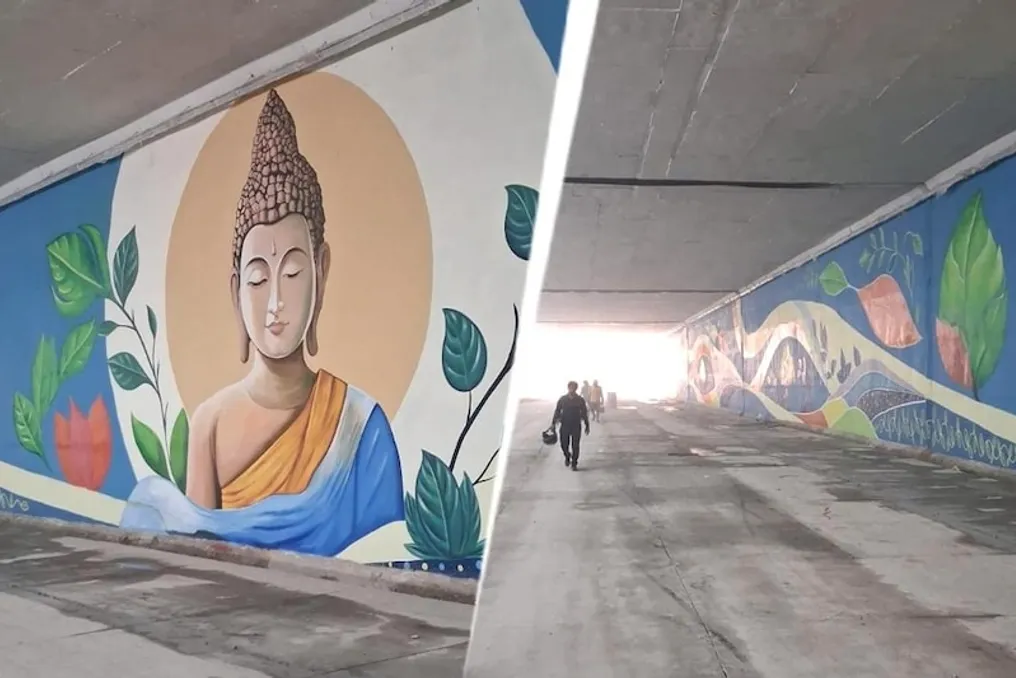
The six-lane system is expected to improve transport accessibility. After commissioning, the underground passage may reduce traffic at the intersection, helping people avoid constant congestion. Although the main construction is complete, additional work is being done before opening to the public, including road marking, installation of street lighting, and wall painting. According to A.K. Singh, various painting has been done on the sides of the underground passage walls, giving the facility an attractive appearance. The remaining tasks for preparation for operation are now being finalized, but the final opening date has not yet been announced, although the priority remains launching before Diwali.

Construction of the Gur Chowk underground passage started in July 2024. The initial plan assumed completion of work in about 18 months. However, several difficulties arose during construction that slowed down the work and led to exceeding the original deadlines. The process was affected by mushroom collection restrictions imposed due to air pollution, as well as rains, the need to relocate utilities, and work related to ramps. These factors required more time to complete the project. Now that the main construction work is finished, attention is focused on finalizing the project, including marking, lighting, and painting, after which it will be ready for public use.

Gur Chowk is a key transport hub in West Greater Noida. A large number of people travel from here daily to work, school, and other errands. During peak hours, the number of vehicles increases, leading to traffic jams at the intersection. This affects the commutes of residents of Gur City and surrounding residential complexes. Passengers traveling to Surajpur and Ghaziabad also face traffic pressure on this route, and sometimes the jams force them to spend more time reaching their destination. Therefore, the six-lane underground passage is considered a vital project for improving the transport situation in this area, as it will help reduce the load on the intersection and make movement more convenient.

The greatest benefit from the opening of the underground passage will be enjoyed by people who regularly use this route. Commute times for workers may be reduced, and school buses and passengers from nearby residential complexes will also be able to avoid traffic jams. Reduced traffic at Gur Chowk will also improve journeys for those heading to Surajpur and Ghaziabad. Although real relief will only come after the underground passage begins operation.

Popular