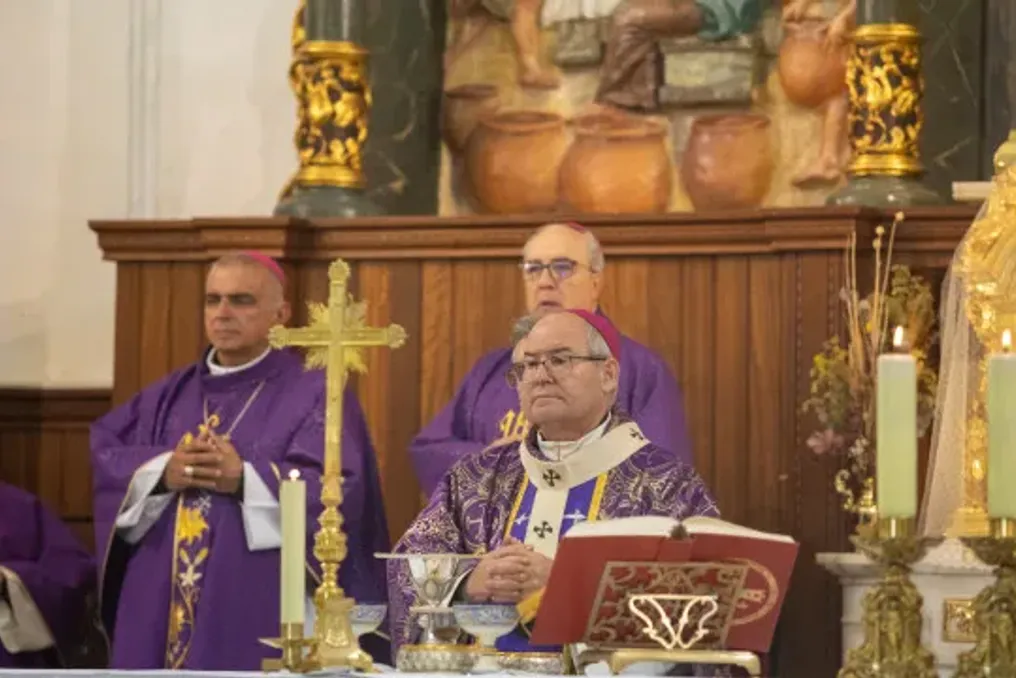
The Archbishop of Toledo announced that the Cathedral of Toledo will hold a solemn service to remember the victims of the railway disaster in Urda. The entire ecclesiastical province of Castile-La Mancha will participate in the event.
Archbishop Francisco Cerro made this announcement during a mass held today at the parish church in Urda. He addressed the families of the affected, as well as authorities and hundreds of residents of the area, according to the EFE agency.
Cerro spoke to the families, reminding them: 'You are not alone; you have the best of society with you. The Church of Toledo is with you.' The Archbishop called on all society not to forget this tragedy and to prevent its recurrence.
He added that it is necessary to learn to care more about life to restore a society that feels increasingly poor and needy, and which in moments of suffering requires embraces, tenderness, and the opportunity to speak out.
The Archbishop of Toledo also expressed gratitude to all emergency response services involved in the rescue and aid efforts for the victims, as well as to the residents of Urda and other settlements in the district who came as volunteers.
He noted: 'Many of you here got into a car and appeared there, not knowing what they would meet.' He reiterated the call for such accidents never to happen again, stating that the injured in hospitals have the 'embraces' of all people.
In the first hours after the accident on Thursday, thirty-four people were in four hospitals in Castile-La Mancha, Spain. According to the regional government, of these 34 people—five fewer than on Friday—fifteen were in intensive care units (ICUs), and nineteen were in regular wards. Seventy-six discharges were registered since Thursday, and a total of 110 people received medical attention in hospitals across Castile-La Mancha.
At least 69 people, including one Portuguese national, died in this accident, which occurred when over 540 people were traveling on two high-speed trains. According to the Spanish government and communications records from the control center, the driver of one train received incorrect instructions from the operator that did not comply with established protocols for the situation, leading to a collision with another train stopped on the same line at a speed of over 180 kilometers per hour.
Both trains, which were running between Madrid and Seville, stopped due to a failure in the automatic train control system caused by communication issues between equipment.