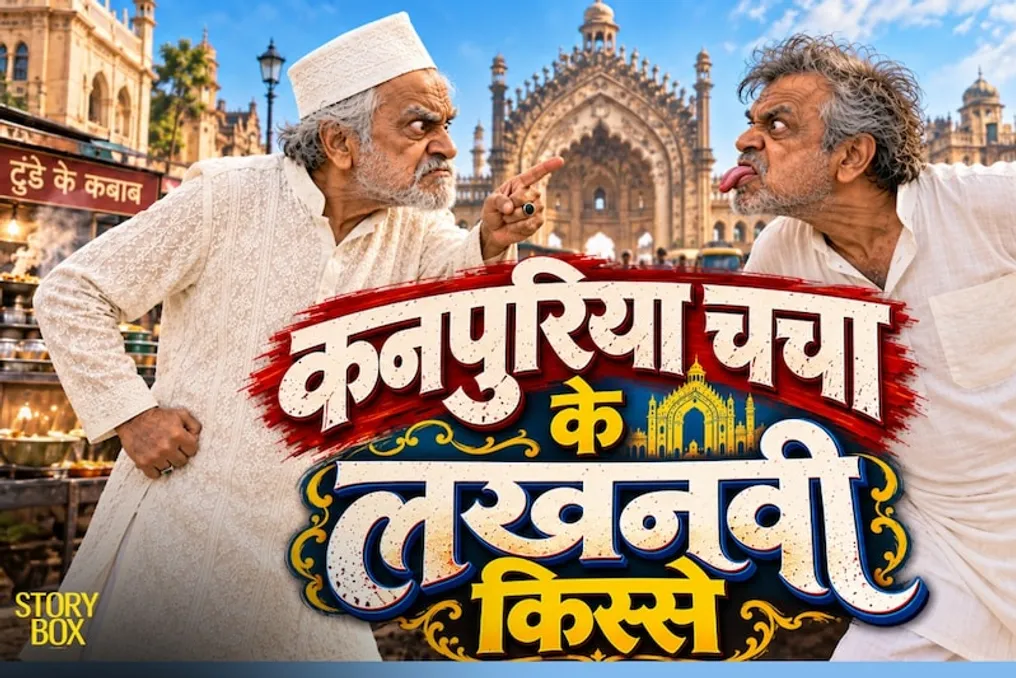
The cities of Kanpur and Lucknow are often compared to siblings whose lives are inseparable and who frequently visit each other. However, when a third party appears, they do not hesitate to criticize one another. As is known, residents of one city may lack good manners in eating, dressing, or speaking, and despite any attempts to imitate others, they cannot become the same.
For example, Kanpur might claim: 'Look, this Ikan-Vikan stadium operates seven days a week, they boast about it. But our Green Park Stadium has been functioning for decades. We first defeated Australia in sixty-eight. You see, they just brag.'
At the same time, the people of Lucknow consider themselves noble, living in houses dressed in exquisite attire, yet, in their opinion, living in luxury.
Lucknow responds: 'We don't say we dislike changing our temperament, but as for Idris brother's biryani, will you find it in his spicy biryani with pepper? These people love sweets; they don't know what shirmal is. Our sophistication, our refinement, what can be said about the Urdu language... And look, our culture is known worldwide. We have the Pandan system, and they have the Gutka system.'
The author admits that both cities are dear to him and that he has ties to both, but today's story is dedicated to this friendly squabble between the two cities. He will tell when this squabble began and who was Kanpur's Siknder Chacha, who swore that there would be no connections with Lucknow in his family, and what the conflict between Lucknow and Kanpur entails.
This issue arose around 2007. A family was on board one of the coaches of the 'Awadh Express,' which stopped at platform number three of Kanpur Central Railway Station. This was a time when highways between Lucknow and Kanpur had not yet been built, and the roads were in poor condition, so people preferred to travel by train. This family belonged to Quddusi Sahab, and his son, Sharik, was planning to visit family in Lucknow.
Sharik, although a decent person, was working as a food blogger in Kanpur at the time. His job involved visiting street stalls selling chaat, momos, and chhole bhature, where he would ask questions like: 'Hey brother, what is this here? Coriander... and they added this white thing... Okay, salt... do they add salt too? And what is this thing... I see it for the first time... Okay, oil... will you add this much oil? Wow! Ahaha.'
On the train were Sharik himself, Sharik's uncle, Siknder Chacha, and Sharik's mother. When the train started moving slowly, Sharik's mother, now called Chchi, said: 'Hey, the train is late. They said we would go. Who listens? We are going to the girls' house, and they are from Lucknow. You gentlemen act as if you are very noble; what the hell are you doing in two minutes?'
Siknder Chacha smoked gutkha out the window and, wiping his mouth, replied: 'What are these complaints of yours... They will boast as if everything is Nawab-like, and they ride in horse carriages. Look, everyone is sitting in auto-rickshaws. Brother, drive slower. Now there are as many people in Nakhallu as there are auto-rickshaws.'
Before continuing the story, it should be noted that the reason for Siknder Brother's dislike for Lucknow was related to the fact that a girl from Lucknow once broke his heart. She studied Kathak in Bathkhand, and an affair occurred. Since then, he has felt strong irritation towards Lucknow, and his secret goal was to prevent this connection.
This meeting was arranged with Shizo, the daughter of Anwar Sahab, a retired teacher in Lucknow. Shizo was very modest and homebody, making wall hangings from empty egg cartons and manufacturing side lamps from empty boxes. However, she loved to eat well, often going to eat Maggi around ten or nine in the evening, and knew how to express her opinion, for example, arguing with taxis from Charbagh about why they seat four passengers instead of three. She was beautiful and good.
Eventually, the train stopped at Charbagh station, and they got into the compartment to head to Anwar Sahab's house. On the way, Chchi said: 'Brother, as soon as we arrive, we will go to the bathroom first.' When asked why, she replied: 'Brother, to understand a person, you must look at their shoes; to see a house, you must look in the bathroom. Do you understand? That shows how much they value cleanliness.'
The compartment stopped in front of an old two-story white house in an alley. Upon approaching the car, Mamunne Mamoo, Shizo's uncle, met the guests almost running, greeting them: 'Greetings, greetings...' and inviting them inside. Siknder Chacha said: 'Mamoo, brother, give us some time... You won't go inside... The car will stay outside.'