Rabada and Harmer bring Proteas closer to victory in series of matches against Australia
Read more
IOL
iol.co.za

Rabada and Harmer bring Proteas closer to victory in series of matches against Australia

During the coverage of the third and final Test match between the Proteas and Australia teams, held at Newlands Stadium, observers followed the development of events. The team, consisting of John Goliath, Miron Naicker, and Rowan Callahan, accompanied the spectators. Zachir Adams was in the press box to provide an exclusive analysis of the match and convey the entire emotional component of the decisive series match.

During the lunch break on the fifth day of the match, a powerful attack by the South African bowlers led to Australia being in a critical position, losing seven players at 60/7, thus turning the chase of 288 runs into a dismal spectacle during the unusual first session at Newlands. Since the series and the ICC World No. 1 ranking were at stake, the Proteas pressed relentlessly.

Kgosi Rabada started acting immediately, causing Matt Renshaw to be caught on the off side for zero, and then taking Marnus Labuschagne LBW. After this, Rabada registered his 350th Test wicket when Travis Head lightly deflected the ball directly to Marco Jansen on the galli, leaving Australia in a difficult situation at 22/3.

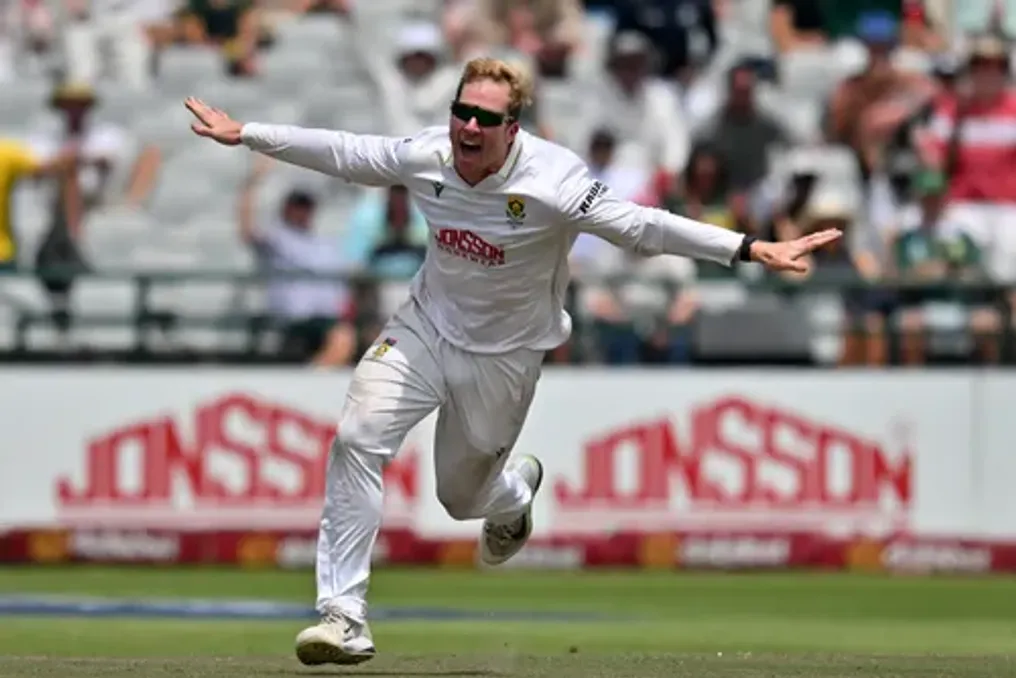
Subsequently, Simon Harmer turned the game into real chaos. After Marcus Ackermann dismissed Josh Inglis, who was scoring a hundred in the first innings, Harmer began to dominate on the slippery pitch. He removed Alex Carey, caught while batting by Jansen, dismissed Cooper Connolly for zero with a sharp turn caught by Ryan Rickelton, and also took Mitchell Starc's wicket (0) via the bat and then leg into Ackermann just before the break. Cameron Green (25*) continued to fight through this collapse.

Despite Australia still needing 228 runs with only three remaining players, the team found itself in a difficult situation in Cape Town.

Similar stories

Proteas vs Australia: Decisive Fifth Day of Match in Newlands Determines No. 1 Ranking in Tests
Read more
iol.co.za

Proteas vs Australia: Decisive Fifth Day of Match in Newlands Determines No. 1 Ranking in Tests

The outcome of the confrontation between South Africa and Australia boils down to a simple condition: South Africa must take 10 wickets, and Australia needs 288 runs to win. A victory in this match will secure the team a series win and the ICC Test No. 1 ranking.

Before the final day of the tense series in Newlands, Proteas spinner Ryan Rickelton noted that the situation was extremely clear: 'It's either a win or a loss. There will be no draw tomorrow (Saturday).'

Rickelton shared his impressions of the series, calling it special. He emphasized that the series was dynamic, with constant shifts in leadership between both teams, and noted that it was an 'amazing' tournament.

Unlike Australia's previous visit to South Africa eight years ago, this series focused exclusively on cricket, avoiding drama and disputes, which in itself created many plot twists.

Day four of the match was filled with dramatic moments. Thanks to the partnership of Ryan Rickelton and Vian Mulder, which brought up 156 runs for the sixth wicket, the home team managed to regain momentum. However, Australia interrupted this rise by dismissing Rickelton shortly after the left-arm bowler reached his third century in tests, leading to a collapse of Proteas by four wickets in just 16 overs.

Nevertheless, the game did not end. South Africa continued the fight, and Mulder, along with the last batsman Kagiso Rabada, added another 36 runs for the tenth wicket. Rickelton called this partnership 'very big' and 'massive.'

He admitted some disappointment that the dismissal of Rickelton deprived the team of the opportunity to approach the 300 or 350-run mark. Nevertheless, he believes that the possibility of reaching an effective 290 runs and forcing the opponents to do so on the fifth day is significant psychological pressure. He hopes that the last 20 or 30 runs scored will be enough for a breakthrough.

Responding to the question of how Proteas can take 10 wickets on a surface he describes as 'flat' and 'good for play,' Rickelton suggested that the new ball would provide opportunities for both scoring runs and taking wickets. He also noted that the pace of the game has slowed down, and if Australia decides to attack, it could work against them, as playing on a slow, low, and deteriorating surface presents a serious challenge.

Rickelton added that for right-handers, the ball behaves aggressively when swinging back. Since Australia has four left-handed batsmen, the South African team plans to put pressure on them, whether by waiting or actively attacking, depending on the opposition's playing style.

Temba Bavuma's resistance gives Proteas hope amid Scott Boland's onslaught
Read more
iol.co.za

Temba Bavuma's resistance gives Proteas hope amid Scott Boland's onslaught

Hope for the Proteas team in the conclusion of this match at St George's Park and for the entire series rests on the shoulders of their captain, Temba Bavuma. Despite Australia managing only 43 overs over two days of the second Test after two more sessions were lost due to bad weather and wet pitch, the home side faced a number of setbacks.

The world champions of Test matches found themselves trailing by four wickets with only 40 runs scored after the game finally started at 3:45 PM.

Scott Boland, a fast bowler with the best statistical average since World War II, demonstrated strong determination. Bowling from Park Drive End, Boland used the Kookaburra red ball, skillfully moving it off the edge in both directions.

The Victorian had already dismissed Test debutant Marcus Ackermann, adding to his previous catches of Aiden Markram and David Bedingham, and looked ready for further success.

Someone had to stop this onslaught, and that was done by Temba Bavuma and Ryan Rickelton, who came out as the sixth batsman for the first time since taking charge of the team from Kyle Verreyn.

They did not take risks; their play was tenacious, disciplined, and watchful, allowing every ball to pass by the bat. This sharply contrasted with Matthew Britzke's earlier play, who looked unprepared for red ball cricket when he tried to attack Mitchell Starc's wide delivery outside the crease.

Every run scored by Bavuma seemed earned from the depths of his soul. The Proteas captain, fully aware of the hopes resting on him, approached every delivery with immense caution and concentration. His discipline was unwavering; he masterfully left the ball outside the off stump and, when forced to play, did so softly and right under his eyes.

This forced Australia to change its plans and switch to a short-ball strategy, incorporating a light slip and deep square leg. However, Bavuma also stood firm in this situation, sending down his equivalent of Pat Cummins for six runs through fine leg.

However, the plan almost worked on the other end. Rickelton (31 off 51 balls, 5 fours) played just as cautiously alongside his captain, but Cummins forced the left-hander to hit a rising ball into the waiting hands of Marnus Labuschagne. Nevertheless, Labuschagne missed the chance, and Rickelton got a respite.

But just when it seemed the pair would safely see the team through the day, Boland was called again. Switching to Duck Pond End, he bowled another tempting ball that caught the outer edge of Rickelton and led to an impressive one-handed catch by Matthew Renshaw at first slip. The partnership of 52 runs, built over 109 balls, was broken, and the door for the South African middle order remained slightly ajar.

Vian Mulder managed to get through the last few overs with Bavuma, but Australia knows that the Proteas captain stands between them and the possibility of making a big step towards securing the series here in Gqeberha.

Popular