Science links Halloween to the search for dark matter and cosmic mysteries
Read more
Olhar Digital
olhardigital.com.br

Science links Halloween to the search for dark matter and cosmic mysteries

On Halloween, October 31st, astronomy observes International Dark Matter Day. This day provides scientists worldwide with an opportunity to share information with the public about one of the greatest mysteries of the cosmos.

Since 2017, over 350 events have been organized globally, regionally, and locally by institutions and private individuals. The goal of these events is to engage the public in discussions about what is known about dark matter, as well as the numerous experiments aimed at unraveling its secrets, according to data from Interactions Collaboration, an international community of particle physics communication specialists sponsoring this event.

To try and understand this mystery, imagine a 'box' containing everything that exists in the observable universe: atoms, molecules, planets, stars, black holes, and galaxies. Surprisingly, this 'box' constitutes only 5% of the cosmos. The remaining 95% is divided between dark energy and dark matter; dark energy accounts for 70% of the universe, while dark matter accounts for approximately 25%.

Dark matter was indirectly detected by Vera Rubin in the 1970s, but its nature remains unknown. It does not emit, reflect, or shine, yet it possesses gravity. We know of its existence because it distorts and accelerates entire galaxies. Regardless of whether it is an unknown particle, an exotic property of space, or something entirely new, dark matter could be the missing link in modern cosmology.

The choice of this date is closely linked to the Halloween holiday, which raises themes of mystery and invisibility. This initiative highlights the scientific quest for answers about dark matter, which is one of the universe's main enigmas. Although it has not been directly detected, dark matter is considered necessary to explain astrophysical phenomena such as galaxy rotation.

Since the 1930s, evidence has pointed to the presence of a form of matter that does not emit light, leading to the conclusion of 'hidden' matter whose existence is revealed only through gravitational interaction. Currently, about 40 experiments worldwide are searching for signs of this mysterious substance, hoping for significant progress in the next five to ten years.

Among possible candidates are particles known as WIMPs (Weakly Interacting Massive Particles) and axions. It is hypothesized that dark matter may include various types of particles, forming an unexplored 'dark sector.' In parallel, dark energy continues to be a mystery, possibly related to the 'cosmological constant' proposed by Albert Einstein.

These mysteries motivate scientists worldwide, including Brazilian researchers, to seek answers that could change our understanding of the universe. According to a study published in the journal Physical Review D, a second Big Bang could have given rise to dark matter. According to the most well-known theory, everything in the universe (matter, energy, planets, and stars) originated from a giant cosmic explosion—the Big Bang.

However, scientists now suggest that a similar second event might have occurred shortly after it, giving rise exclusively to so-called dark matter.

>
Similar stories

Astronomical images resembling horror movie scenes presented for Halloween
Read more
olhardigital.com.br

Astronomical images resembling horror movie scenes presented for Halloween

This Saturday (the 31st) is Halloween—a holiday characteristic of Anglo-Saxon countries, especially the USA, Canada, Ireland, and Great Britain. While celebrations on Earth inspire themed decorations, recordings show dark images of the Universe collected over decades, demonstrating that cosmic reality can often be more frightening than fiction.

In honor of this date, impressive pictures have been gathered, ranging from a monstrous zombie hand sculpted by the winds of a dying star to a skull-shaped asteroid that passed near Earth. These images offer a visual journey through ghostly nebulae and cosmic structures worthy of a true night of horrors.

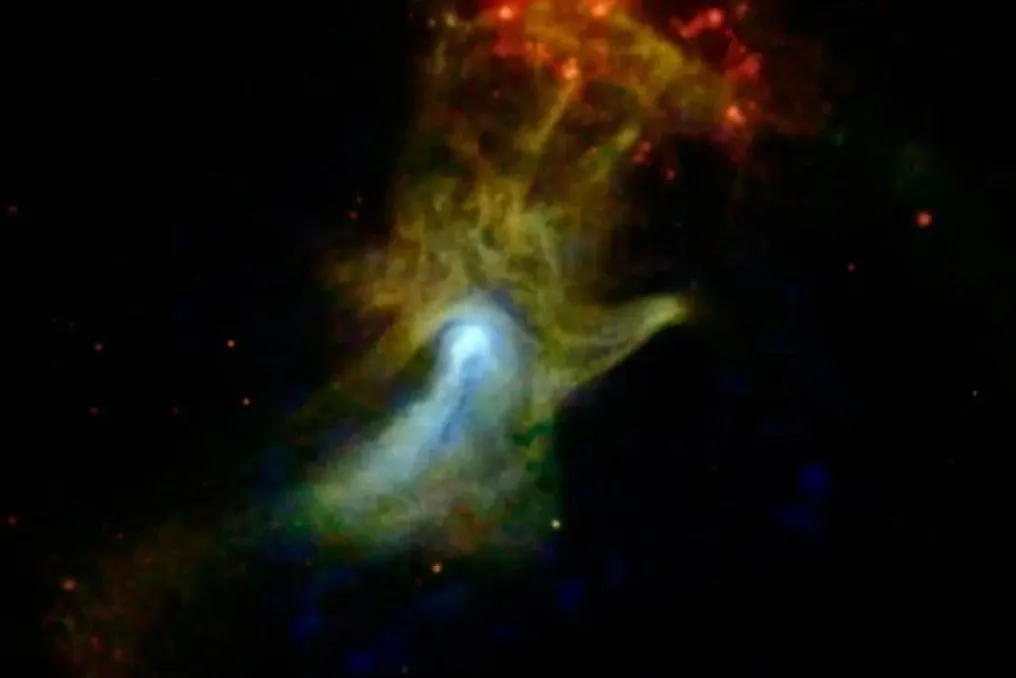
The area shown in an X-ray image, called the 'Hand of God,' looks too terrifying to bear that name; it more closely resembles a monstrous zombie hand ready to grab prey in space. However, it is actually a pulsating stellar wind nebula formed by dense remnants of a supernova. A supernova is a transient astronomical event occurring at the final stages of massive star evolution or when a white dwarf begins uncontrolled nuclear fusion, signifying the death of a star.

What about this horrifying face that seems to be screaming during a painful and fiery death? This is a scene very suitable for Halloween. Despite its frightening appearance, this scene does not include a real skull. It is an X-ray image of a galaxy cluster known as the Perseus Cluster, taken by NASA's Chandra Observatory.

This image, obtained by the Kitt Peak National Observatory in Arizona, USA, could look like a scene from a horror film where evil spirits try to escape the crucible of darkness. Nevertheless, it actually shows an interstellar cloud of gas and dust called SH2-136, located approximately 1200 light-years from Earth in the constellation Cepheus.

In this ominous picture, taken by NASA's Wide-field Infrared Survey Explorer (WISE), a green witch gazes into space. In reality, it is the IC 2118 nebula, which received the nickname 'Witch' due to its appearance. Fomalhaut is the brightest star in the constellation Pisces Australis. Located approximately 25 light-years from Earth, it is about 440 million years old, during which a dust belt has accumulated around it.

In this image, the Fomalhaut star system bears a strange resemblance to the terrifying Eye of Sauron from J.R.R. Tolkien's 'Lord of the Rings.' Tolkien described the eye as 'adorned with watchful and deliberate fire, and the black slit of its pupil opened into a pit, a window into nothingness.'

Eight years ago, a human skull-shaped asteroid passed near Earth. At its closest approach, the celestial body was about 480 thousand kilometers from the planet, or 1.3 times farther than the average distance between the Earth and the Moon, posing no threat to our planet. Approximately three weeks before reaching this distance, the asteroid was discovered by astronomers from the Pan-STARRS observatory in Hawaii and was officially designated '2015 TB145.' On October 30, 2015, the 400-meter wide object was photographed by the Arecibo Observatory in Puerto Rico, and to everyone's surprise, it looked like a skull face, earning the nickname 'Halloween Asteroid.'

Origin of Halloween: The Celtic festival of Samhain, with ancient roots in Ireland and Scotland
Read more
super.abril.com.br

Origin of Halloween: The Celtic festival of Samhain, with ancient roots in Ireland and Scotland

Although costumes, sweets, and carved pumpkins are part of the modern image of Halloween, the celebration popularized in the United States has much older and distinct origins. The best-known link points to Samhain, an ancient Celtic festival held at least 2,500 years ago in the regions that now correspond to Ireland, Scotland, and Wales.

For the Celtic peoples, Samhain was a crucial event on the calendar, occurring between late October and early November. This period symbolized the transition from the brightest phase of the year (spring and summer) to the arrival of winter, a season associated with darkness and death. According to tradition, on the night of October 31st, the boundary between the world of the living and the dead weakened, allowing spirits to circulate freely.

Ancient records suggest that the Celts believed that deceased individuals during the year migrated to another plane, while their spirits could return to visit the living. There was also the risk of someone accidentally entering this spiritual domain. Furthermore, the beliefs of the time mentioned the appearance of fairies emerging from mounds of earth, who enjoyed playing tricks on inhabitants.

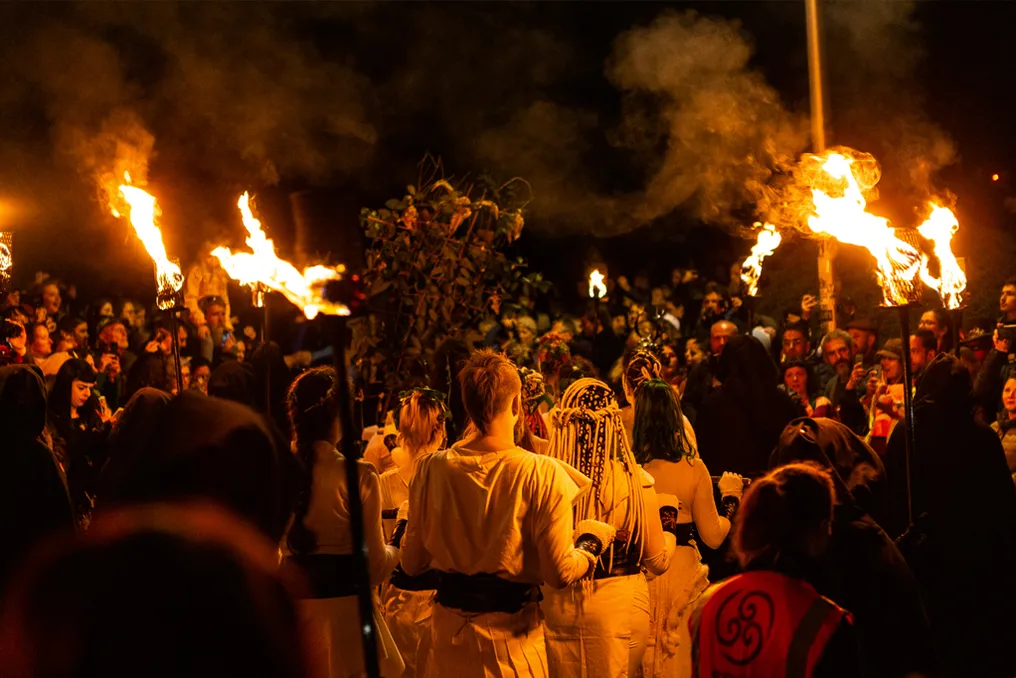
To protect themselves from these supernatural entities, such as fairies, witches, and goblins, communities lit large bonfires. Some accounts indicate that they also used disguises to ward off these unwanted beings. It is possible that banquets, games, storytelling, and alcohol consumption were part of the Samhain festivities, serving to welcome back the deceased.

However, the veracity of this information remains uncertain, as the ancient Celts left few notes about Samhain. Much of the current knowledge comes from Christian writers from a period after the predominance of Christianity, or from observations of local customs made in more recent centuries.

It is observed that the Catholic Church may have influenced the celebration. Around the 8th century, Pope Gregory III changed the date of All Saints' Day, moving it from May 13th to November 1st, coinciding with Samhain. Some experts speculate that this change was deliberate, in an attempt to 'Christianize' Samhain, given that the Celts were a pagan people who worshipped various deities.

A historical milestone occurred between 1845 and 1852, when Europe faced a severe humanitarian crisis. In Ireland, a fungus called Phytophthora infestans devastated potato crops, which sustained a third of the population. With the loss of approximately one million lives and economic ruin, many Irish people were forced to emigrate to the United States.

In doing so, they brought their traditions with them, including Samhain. Consequently, the first mentions of Halloween emerged in North America shortly after this period. In 1870, for example, an American magazine published an article describing it as an 'English' holiday, as reported by the BBC.

The modern name, 'Halloween', is a combination of two terms: 'Hallow', an old word for 'holy', and 'eve', in English, meaning 'evening before'. Until the 16th century, this term referred to the night before All Saints' Day, celebrated on November 1st. Over time, people began to call the night of All Saints' Day (All Hallows’ Eve) 'Hallowe'en', which later simplified to 'Halloween.'

The celebration has undergone significant adaptations; many current Halloween practices originated in American culture. Examples include the tradition of 'trick-or-treating', pumpkin carving, the use of costumes, and the tradition of frightening. Currently, Halloween is the largest non-Christian holiday in the United States.

For adherents of pagan religions, the celebration of Samhain remains active. It has been incorporated and adapted into beliefs such as Wicca and Druidism, becoming a relevant festivity. Besides honoring ancestors, Samhain is seen as a moment of 'symbolic death', where people write down what they wish to leave behind on pieces of paper and burn them in bonfires to make way for a new cycle.

Popular