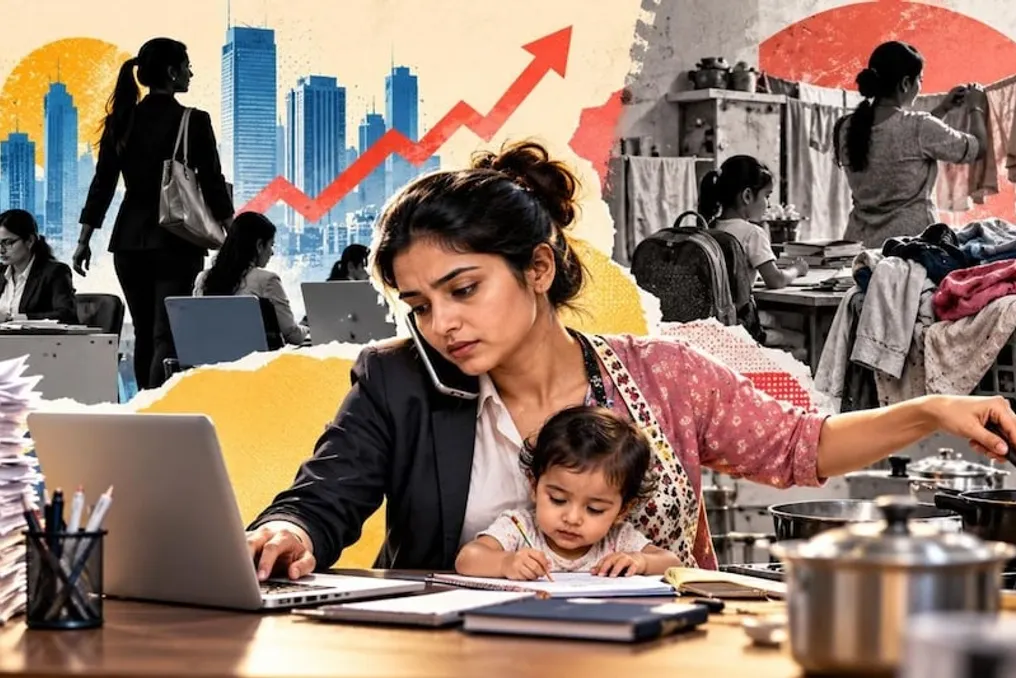
ICRIER study shows that despite increased female employment in India, the burden of household chores remains predominantly on them
Read more
Aaj Tak
www.aajtak.in

ICRIER study shows that despite increased female employment in India, the burden of household chores remains predominantly on them

In India, there is an increase in the number of women entering the labor market, yet the volume of unpaid domestic work remains virtually unchanged. According to the ICRIER report titled 'Participation Paradox,' the share of women in the workforce has significantly grown over the past eight years, but the distribution of household chores has not changed.

The number of working women in India has increased from 104 million in 2017–2018 to 201 million by 2025. Consequently, their share in the labor force has risen from 22% to 38%.

This growth is particularly noticeable in rural areas. In rural areas, the share of women in the labor force increased from 23.7% in 2017–2018 to 44.9% in 2025. In urban areas, this figure rose from 18.2% to 25.9%. Nevertheless, despite more active participation in paid work, an equal division of household chores has not occurred.

The largest increase in female labor force participation was recorded in rural areas: from 23.7% in 2017–2018 to 44.9% in 2025. In cities, this figure rose from 18.2% to 25.9%.

Despite the increase in women's participation in paid work, men's contribution to housework remains low. According to statistics, women spend an average of 464 minutes daily on household chores, while men spend 178 minutes. This means that women perform 4 hours and 46 minutes more domestic work daily than men.

The burden of domestic care also affects women's free time. The gap between men and women regarding time allocated for rest and entertainment has widened: in 2019, this gap was 57 minutes, and by 2024, it reached 70 minutes.

Responsibility for the home and children continues to create difficulties for women when seeking employment. About 60% of surveyed women reported that they cannot work outside the home due to household duties and childcare, whereas only 1% of men cited domestic responsibilities as a reason for being unable to work.

Alongside labor force participation, a gender pay gap persists. In rural areas, women's wages are about 45% of men's, and in urban areas, this figure reaches 61%. Thus, even with an increase in the number of working women, their income does not match that of men.

These data indicate that despite entering the labor market, the division of household chores between women and men is not equal. Many women are forced to perform tasks such as cooking, cleaning, and childcare in parallel with office work, which negatively affects their personal time and rest.
Similar stories

Female Founders Contribute to the Development of India's Social Sector, Demonstrating Better Funding Metrics
Read more
timesofindia.indiatimes.com

Female Founders Contribute to the Development of India's Social Sector, Demonstrating Better Funding Metrics

According to a survey conducted among over 145 organizations working in the social impact sector, more than 57% of non-profit organizations have at least one female founder. This figure significantly exceeds the share of women among Indian startups, which is only 18%. Furthermore, the representation of women in the non-profit sector surpasses corporate leadership, where women hold only 1.8% of CEO positions, 4.4% of CFO positions, and 29% of executive director positions.

These results are part of a report by the non-profit accelerator Change Engine titled 'East of Good: A Gender Lens,' which focuses on access to flexible funding. The study covered small, medium, and large organizations differing by annual budget. The study sample was also almost evenly divided between organizations eligible for foreign funding (with FCRA or US 501(c)) and those that were not.

Of the over 145 surveyed organizations, nearly 31% are exclusively female-founded, and about 27% have both male and female founders. The study also showed that women not only create more non-profit organizations but the structures founded by them receive better funding and have access to more long-term flexible financing.

It was found that non-profit organizations with at least one female founder have larger budgets. Data indicates that 70% of such organizations have an annual budget exceeding 1 crore rupees, compared to 43.5% of organizations founded only by men. Additionally, about 21% of organizations with female founders allocate more than 25% of their budget to flexible unrestricted funding, whereas this figure is around 13% among organizations founded only by men. Flexible funding is non-programmatic funding that non-profit organizations can use to invest in talent, technology, research, and organizational strengthening.

Regarding long-term grants, it was found that over 65% of organizations with at least one female founder have access to multi-year funding sources (three years or longer), compared to approximately 56% of organizations founded only by men. Among them, about 27% of organizations with female founders received multi-year grants exceeding 1 crore rupees, while this figure was only about 11% for organizations founded only by men.

The report emphasizes that when assessing (on a scale of 1 to 5) the ease of attracting unrestricted funds from Corporate Social Responsibility (CSR), High Net Worth Individuals (HNIs), domestic foundations, international foundations, and crowdfunding/retail, organizations with at least one female founder consistently received higher ratings across all categories, achieving an average score of 2.41 versus 2.06 for organizations founded only by men.

Nevertheless, challenges remain. The study shows that cheque sizes remain small for all: 'A striking 82% of organizations with at least one female founder and 83% of organizations founded only by men reported that typical unrestricted cheque sizes in India are less than 25 lakh rupees, demonstrating that the problem of small cheques affects both groups by gender,' the study notes.

Varun Aggarwal and Shubham Bansal, co-founders of Change Engine, noted that the data suggests that women are leading India's social sector and creating larger and better-resourced organizations. Aggarwal stated: 'We must encourage more women to enter this sector. In our accelerator, we meet female founders who are creating strong, ambitious institutions to solve some of India's biggest social problems. It is encouraging to see what we observe on the ground now supported by data. Six out of ten non-profit organizations in our survey were founded by a female founder.' Bansal added: 'However, the Change Engine founders emphasize that access to unrestricted flexible funding remains consistently low across all levels, as 80% of surveyed founders report difficulties in scaling their work due to the lack of unrestricted funding. This funding rigidity forces organizations to spend disproportionately more time on fundraising instead of focusing on innovation and impact.'

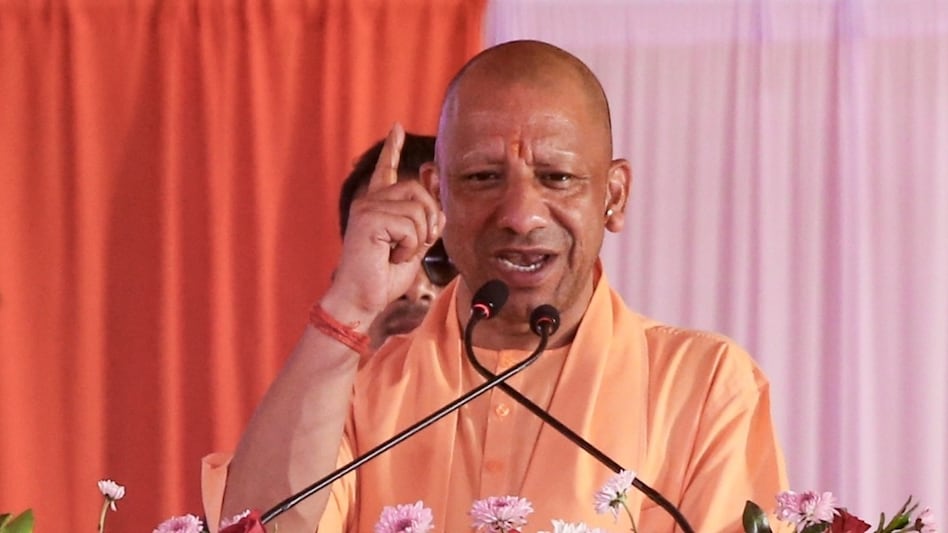
CM Yogi stated that women's strength stimulates UP's economic development, noting the courage of women working night shifts
Read more
www.aajtak.in

CM Yogi stated that women's strength stimulates UP's economic development, noting the courage of women working night shifts

Chief Minister Yogi Adityanath performed worship of the goddess Kalratri during the celebration of the seventh day of Sharadiya Navaratri. Emphasizing the significance of this event, he wrote on social media 'X' that the divine form of Goddess Kalratri, which destroys dark forces such as villains, demons, and Raktbij, establishing Dharma and granting fearlessness to devotees, sends us a message that the end of injustice, tyranny, and terror is the foundation for establishing justice, peace, and a society free from fear.

The Minister compared the current situation with the past, showing the previous government that until 2017, the state was plagued by fear and chaos caused by mafia, hooligans, and criminals like Raktbij. This fear and disorder created serious obstacles to the safety, education, and self-sufficiency of women and daughters. However, the zero-tolerance policy towards crime and offenders implemented by the 'double engine' government over 9.5 years has suppressed these antisocial forces, establishing the rule of law and an atmosphere of freedom from fear in the state.

The government demonstrates commitment to ensuring women's safety. Initiatives such as Mission Shakti, the integrated helpline 1090, police patrolling among women, and the 'Safe City' project have provided a safe environment for daughters and sisters—from the doorstep to the streets, educational institutions, and workplaces. The reduction in police response time from 65 minutes in 2016 to just 5 minutes is clear evidence of law enforcement efficiency and the government's commitment to protecting women.

Thanks to the atmosphere of safety provided by the state, women today work bravely even in night shifts. The increase in female labor force participation from 12 percent to over 36 percent serves as proof that the state's female strength is becoming an economic force, giving a new impetus to the economic development of Uttar Pradesh. The increased participation of women in all sectors, including agriculture, industry, services, and entrepreneurship, has given new energy to the state's development trajectory. This participation has also contributed significantly to the threefold growth of Uttar Pradesh's GDP and per capita income.

Popular