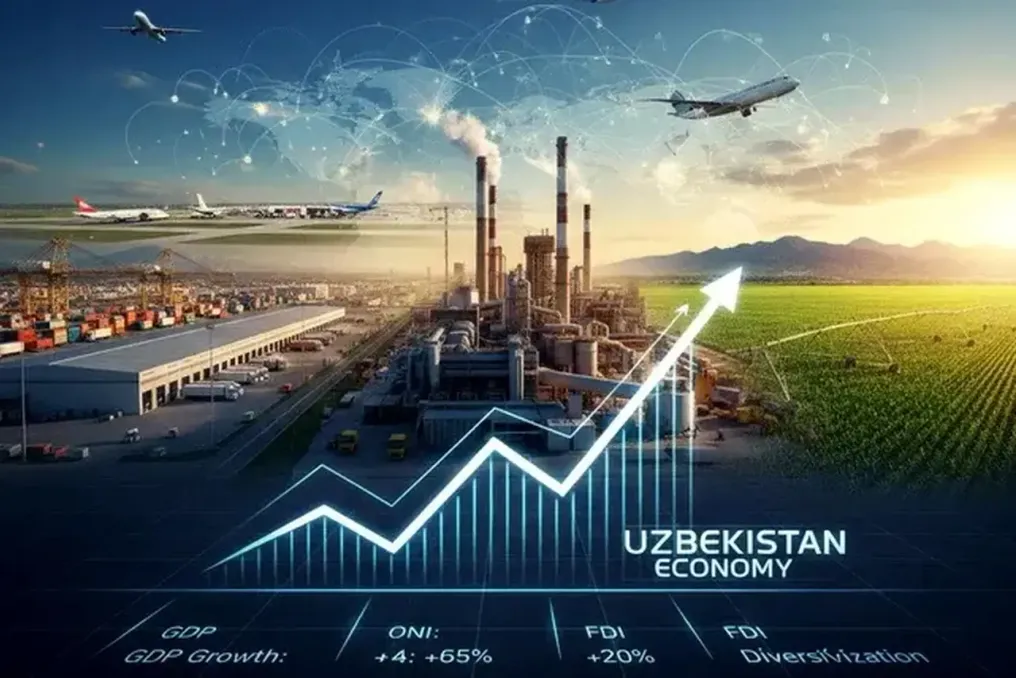
According to preliminary data from the National Statistical Committee, Uzbekistan's gross domestic product (GDP) reached 1,755.5 trillion soums at current prices during the period from January to September 2026. This represents a real growth of 8.3% compared to the same period last year.
The service sector contributed the most to GDP growth, increasing by 8.9%, adding 4.2 percentage points to the overall growth. Specifically, trade, including accommodation and food services, expanded by 15.1%, while transport, storage, information, and communication services grew by 18.1%. Other services showed growth of 3.2%.
Industry increased by 8.1%, contributing an increase of 2.0 percentage points to GDP. Construction activity grew by 12.5%, adding 1.0 percentage point. Agriculture, forestry, and fishing increased by 4.6%, contributing 0.7 percentage points. Net taxes on products grew by 8.4%, accounting for 0.4 percentage points.
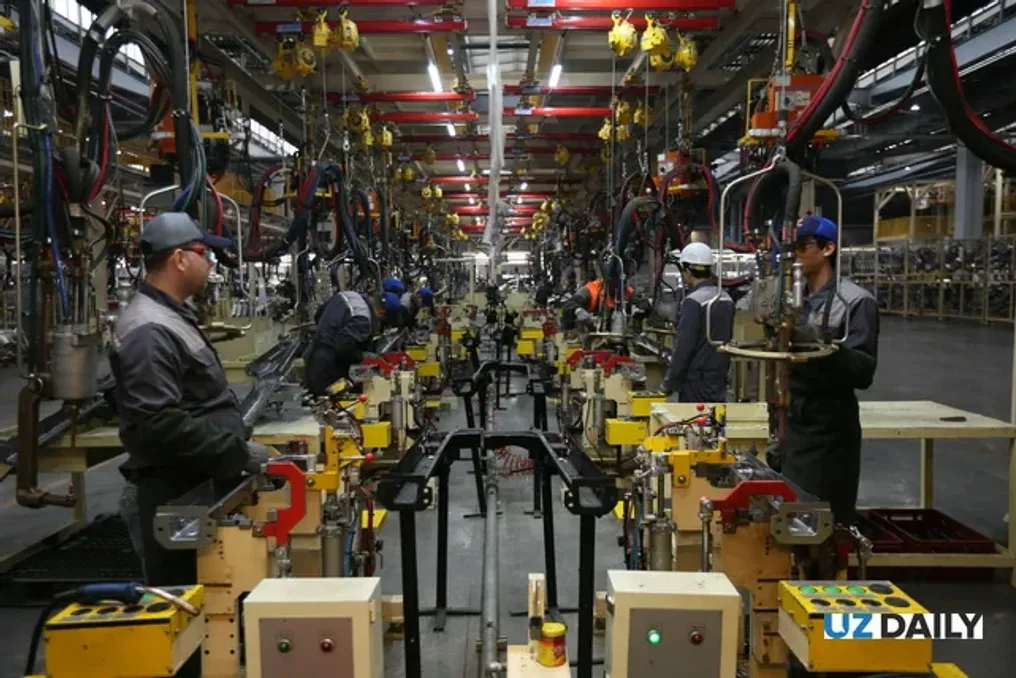
During the first nine months of 2026, industrial enterprises in Uzbekistan produced goods worth 1,085.7 trillion soums, reflecting an 8.1% growth in industrial production compared to the previous year. Manufacturing accounted for 86.9% of total industrial output, while mining and quarrying accounted for 6.5%.
Other sectors included electricity, gas, steam, and air conditioning production (6.0%) and water supply, sewerage, waste collection, and disposal (0.6%). All major industrial segments showed growth: manufacturing grew by 8.6%, electricity, gas, steam, and air conditioning production by 10.1%, mining and quarrying by 3.1%, and water resource management, sewerage, and waste by 1.6%.
Growth in manufacturing was supported by an increase in the production of machinery and equipment not elsewhere classified, which reached 148.9% of the January–September 2025 level. Output of other transport equipment reached 133.9% of last year's level, and output of other finished goods reached 132.3%. However, tobacco product output decreased to 83.4% of the year-ago level.
The total volume of agricultural, forestry, and fishing products and services amounted to 465.346.7 billion soums, equivalent to 104.6% of the level recorded in January–September 2025. Agricultural production, livestock farming, hunting, and related services generated 416.344.7 billion soums, or 104.7% of the previous year's level.
Forestry contributed 41.253.3 billion soums, corresponding to 105.0%, and fishing contributed 7.748.7 billion soums, or 101.2%. The main driver of growth was the 4.6% increase in agricultural production. Among all categories of farms, vegetable production grew by 3.6%, grain production by 16.3%, potatoes by 6.6%, and melon production by 4.5%.
In the agricultural sector, 62.2% of the volume was comprised of dehqan and household farms, 26.7% were farms, and 11.0% were agricultural organizations.
Consumer inflation during the period from January to September 2026 was 4.2%. Food price growth averaged 2.9%, contributing 1.19 percentage points to the overall inflation. Non-food goods prices rose by 4.6%, adding 1.50 percentage points, while services increased by 5.6%, adding 1.48 percentage points.
Among consumer basket categories, the largest price increase compared to December 2025 was recorded in insurance and financial services, where the index reached 143.9%. Clothing and footwear showed the lowest index—101.9%. Household services, water, electricity, gas, and other fuels, along with food and non-alcoholic beverages, contributed the largest aggregate share to the rise in consumer prices, amounting to 2.25 percentage points, or 54.0% of the total impact.
The volume of fixed capital investment from all sources of financing reached 584.154.2 billion soums, exceeding the level recorded for the same period in 2025 by 120.1%. Foreign direct investment and loans accounted for 63.6% of total investments, including 38.9% from foreign direct investment.
Household funds accounted for 12.3%, enterprise equity—11.6%, loans guaranteed by Uzbekistan—6.2%, the republican budget—4.3%, commercial bank loans and other borrowed funds—1.3%, and the Reconstruction and Development Fund—0.7%. The fastest growth was noted in investments financed by the Reconstruction and Development Fund, which reached 236.2% of the 2025 level, as well as in foreign loans guaranteed by Uzbekistan, which grew by 154.0%.
Investments financed by the republican budget reached 123.7% of the previous year's level. Commercial bank loans and other borrowed funds grew by 123.1%, foreign direct investment and loans by 120.5%, foreign direct investment itself by 120.5%, household funds by 111.0%, and enterprise equity by 109.9%.
The volume of construction works reached 339.328.2 billion soums, demonstrating a growth of 12.3%. Large enterprises and organizations completed work worth 89.542.7 billion soums, accounting for 26.4% of the total volume. Small enterprises and microfirms contributed 171.669.8 billion soums, or 50.6%, while informal sector entities provided 78.115.7 billion soums, or 23.0%.
Retail turnover reached 432.161.2 billion soums, which is 19.7% higher than last year. Large enterprises accounted for 17.8% of turnover, with their sales increasing by 12.3%. Retail turnover among small businesses grew by 20.4%, and the share of small businesses in the total volume reached 71.9%. Sales through unorganized trade amounted to 44.463.3 billion soums, which is 10.3% of the total retail turnover.
Uzbekistan's external trade volume reached 65.4 billion US dollars, which is $3.9 billion, or 6.3%, more compared to January–September 2025. Exports amounted to 25.8 billion US dollars, decreasing by 5.5%, while imports increased by 15.7% to reach 39.6 billion US dollars.
Goods accounted for 62.4% of exports. Manufactured goods represented 14.1%, other machinery products—10.2%, and chemical products and related goods—7.9%. Machinery and transport equipment accounted for the largest share of imports (32.5%), followed by manufactured goods (13.8%) and chemical products and related goods (12.1%).
The value of market services reached 1.003 trillion soums, which is 16.7% more than last year. Trade contributed the most to growth, increasing by 17.4% and providing 4.0 percentage points. Financial services expanded by 22.0%, adding 3.4 percentage points; transport services grew by 16.4%, adding 2.8 percentage points; accommodation and food services increased by 11.3%, adding 2.1 percentage point; and communication and information services grew by 21.4%, adding 1.6 percentage points.
Trade services generated the largest volume, amounting to 235.284.4 billion soums, equivalent to 117.4% of the previous year's level. Accommodation and food services reached 179.704.5 billion soums, or 111.3%; financial services reached 163.753.5 billion soums, or 122.0%; and transport services amounted to 162.833.9 billion soums, or 116.4%.
As of October 1, 2026, there were 621,100 enterprises and organizations operating in Uzbekistan, including 459,100 small enterprises and microfirms, excluding farms and dehqan households. Tashkent city had the highest number of such entities—118,860, followed by Tashkent region (59,191), Samarkand region (57,237), Fergana region (52,326), Kashkadarya region (47,969), Andijan region (37,943), and Bukhara region (37,469).
By economic activity, the largest number of enterprises belonged to trade (170,555), followed by agriculture, forestry, and fishing (135,411), industry (66,001), accommodation and food services (35,439), and construction (34,451). During the first nine months of 2026, 68,500 new enterprises and organizations were created, including 66,300 small enterprises and microfirms.
There were 22,029 enterprises with foreign capital in the country, of which 4,851 were joint ventures and 17,178 were foreign-owned enterprises.