During his visit to Tashkent, an Iranian journalist noted that the vast Center for Islamic Civilization was viewed from two perspectives: as a visitor discovering the depth of Uzbekistan's cultural heritage, and as an Iranian guest seeking familiar traces of a civilization that never recognized modern political borders.
These traces were found in manuscripts, works of art, and the names of scholars whose activities connected Central Asia with Iran and the wider Islamic world. This raised the question of how a country can preserve its own national history while also showing that its greatest cultural achievements were often shared with other cultures.
The Center for Islamic Civilization offers an ambitious answer to this question. The complex, which officially opened in March 2026, is located next to the historic Khast Imam ensemble, one of Tashkent's most important religious and cultural sites.
The guide during the visit, Mr. Ozod Kuvondikov, head of the Information Service of the Committee of Uzbekistan on Interethnic Relations, demonstrated high professionalism, patience, and deep knowledge of the places he showed, while speaking fluent English.
Architectural Narrative
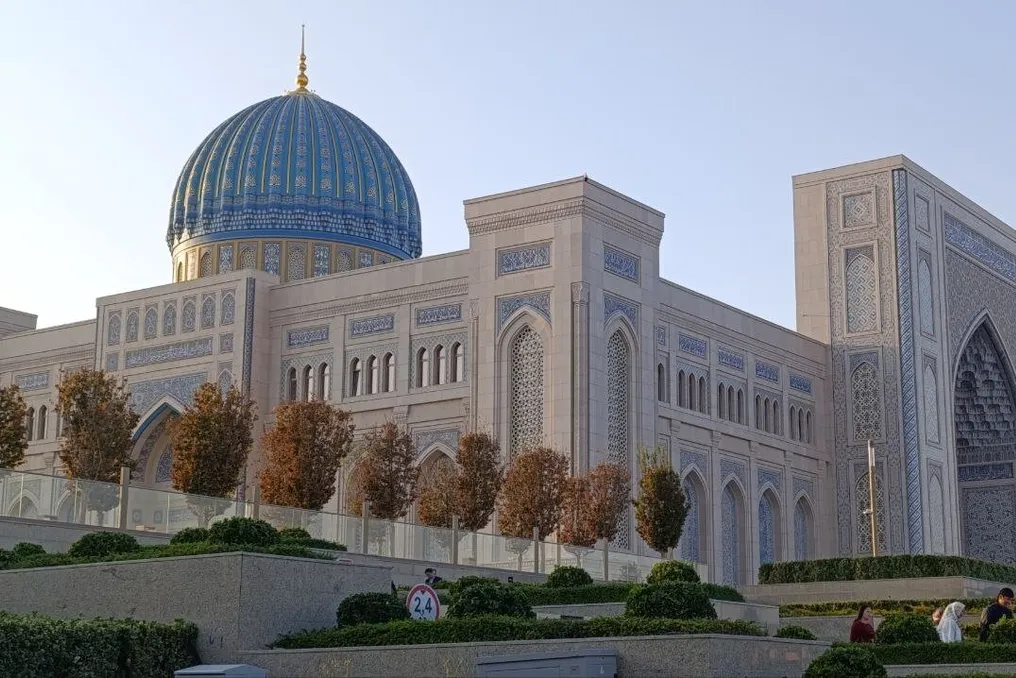
Even from a distance, the center is difficult to ignore due to its four monumental entrance portals, each approximately 34 meters high. These portals draw inspiration from the architectural traditions of various regions of Uzbekistan. The eastern entrance resembles the Ulugh Beg Madrasah in Registan Square in Samarkand, the western portal reflects the religious architecture of Bukhara, while the northern and southern entrances include references to other historical regions and cities such as Khiva, Shahrisabz, Karakalpakstan, Kokand, Tashkent, and Termez.
Together, these entrances form a kind of architectural map of the country, suggesting that Uzbekistan's heritage cannot be reduced to a single city, dynasty, or style; it developed through numerous regional traditions, each contributing its own forms, colors, and artistic vocabulary.
A central dome rises above the complex, exceeding 60 meters in height. The building occupies an impressive interior area—over 40,000 square meters—providing space for exhibition galleries, research centers, a library, educational zones, and conference halls. Official descriptions classify this complex as one of the country's largest recent cultural projects.
Inside, the scale is even more apparent: wide halls lead into exhibition spaces, and the bright surfaces and monumental proportions of the building allow visitors to pause rather than rush from one exhibit to another.
However, the most interesting feature of the center is not just its size, but the way the building strives to transform history into a continuous narrative. Instead of presenting the past as a series of disconnected treasures, the main exhibition follows a chronological route. It begins with ancient civilizations of Central Asia, moves to the pre-Islamic heritage of the region, then covers the period of scientific and cultural flourishing between the 8th and 13th centuries, and concludes with a display of artistic and political achievements from the 14th–16th centuries. The final section is dedicated to modern Uzbekistan and its vision of new cultural revival.
This structure emphasizes an important point: the history of Islamic civilization in Central Asia did not begin with the advent of Islam nor end with the decline of any specific dynasty; it emerged from earlier societies and continued for centuries of exchange, adaptation, and intellectual labor.
Hall of Fame: Scholars Beyond Borders
One of the first spaces to attract attention is the Hall of Fame, where huge mosaic panels vividly depict some of the most influential thinkers in Islamic history. Among the figures presented are Avicenna, known in the Islamic intellectual tradition as Ibn Sina; Al-Khwarizmi, whose works laid the foundations of algebra; Al-Biruni, a scholar whose research covered mathematics, astronomy, geography, and other fields; and Al-Farabi, a philosopher often called the Second Teacher after Aristotle.
The portraits are assembled from thousands of small tiles. From a distance, they form monumental images, and upon closer inspection, the patience and precision required to create such a complex composition become visible. This effect is both artistic and symbolic: each scholar is presented as an individual whose ideas helped shape a much broader intellectual world.
A Glimpse into the Ancient World
The center's historical journey goes much deeper than the Islamic period. In galleries dedicated to pre-Islamic heritage, archaeological artifacts present Central Asia as a place of human settlement, artistic production, and cultural contact spanning thousands of years. Among the numerous items described in the exhibition are stone tools and arrowheads associated with the Obi-Rahmat site, dating back approximately 80,000 years. Gold jewelry and other finds related to ancient Bactria—a historical region encompassing parts of modern Uzbekistan, Afghanistan, and Tajikistan—are also displayed.
A special exhibit is the sculpted head known as the Kushan Prince's Head, dated to the 1st or 2nd century CE and found at Dalverzins-Tepe in southern Uzbekistan. Its features and preserved details provide insight into the artistic culture that developed under the Kushan Empire, whose territory connected parts of Central and South Asia.
Nearby is a sculpture of a deer, dating back to the 1st millennium BCE, which recalls the symbolic significance of animals in ancient artistic traditions. Its presence gives the gallery a different character compared to the exhibits of manuscripts and religious objects in other parts of the building. Here, visitors encounter societies whose beliefs and artistic languages formed long before the advent of Islam.
These artifacts challenge the idea that the history of Uzbekistan can only be understood through the lens of the modern Uzbek state's history. The territory was home to numerous peoples, languages, religions, and political systems. Sogdian, Bactrian, Khorezmian, Persian, Turkic, and other cultural traditions were part of a broader historical landscape. For the Iranian visitor, this part of the exhibition seems particularly close, as ancient Bactria and surrounding regions were connected to the Iranian cultural world through language, religion, trade, and political contact. These connections were not simple or unchanging, but they constituted an important part of the history of the lands that today make up modern Iran and its neighbors.
When Technology Brings History Closer
The chronological galleries are supported by various digital installations. Multilingual screens provide information about the exhibits, and digital reconstructions place historical buildings and cities in their former surroundings. Interactive displays allow visitors to explore historical periods in ways that would be difficult to achieve with only plaques and display cases.
Some of the most engaging features use artificial intelligence to animate portraits of scholars and present their discoveries in a more personal format. Instead of simply reading a brief biography, visitors can meet a digital representation of a historical figure explaining aspects of their work. Such displays make a complex topic more accessible, especially for younger visitors or those unfamiliar with the history of Islamic science. Mathematics, philosophy, and astronomy can seem distant if presented only with dates and technical terms; the digital guide helps turn them into stories of human curiosity, disagreement, and discovery.
One of the most effective installations is the interactive Silk Road map. This historical trade network is often depicted in books as a series of lines connecting distant cities. Here, its routes become visible paths of movement and exchange, helping visitors understand how merchants, religious teachers, diplomats, artists, and ideas traveled between regions. The Silk Road was never a single road with a fixed route; it was a changing network of land and other connections linking East Asia, Central Asia, the Middle East, and Europe over many centuries. Its significance lay not only in the goods transported along it but also in the knowledge and artistic practices that accompanied them. This is why it is sometimes called the Silk Roads, rather than the Silk Road.
Looking at the map, the author pondered how often the history of our region is divided into national chapters, even when historical evidence points to constant interaction. The roads connecting Samarkand, Bukhara, and Khiva also linked them to cities further south and west, including cities of historical Iran.
Other interactive elements make the experience more playful. Visitors can try virtual archery or study an installation demonstrating how bellows supply air to a traditional tandoor oven. In the gallery dedicated to modern Uzbekistan, Humo AI acts as a digital assistant, answering questions about the center and the country's history. These activities may seem far removed from ancient manuscripts, but they serve a useful purpose by prompting visitors to ask questions. A museum is not just a place for contemplating the past; it is also a place for discovering how people lived, worked, cooked, and understood their world.
Quran Hall and the Long Journey of a Manuscript
The most solemn place in the center is the Holy Quran Hall, covering about 1,200 square meters and serving as the symbolic heart of the complex. The room is monumental: the walls are lined with pink marble, and an extremely large crystal chandelier hangs overhead. Silk carpets bearing verses from the Quran add another layer of artistry to the setting.
Nevertheless, the central object is the manuscript, not the surrounding architecture. This manuscript, known as the Uthmanic Quran, Quran of Uthman, or Samarkand Kufic Quran, is traditionally associated with the third Caliph Uthman ibn Affan and dates back to the 7th century. It is among the most famous early Quranic manuscripts and was included in the UNESCO World Heritage List in 1997.
According to a widely circulated account, the manuscript was brought to Samarkand during the reign of Amir Timur in the late 14th century. It remained there for centuries before being transported to St. Petersburg during the Russian Tsarist rule in the 19th century. After further relocation during the revolution, it returned to Tashkent in 1924. Visitors are advised to keep a respectful distance from the manuscript, and photography of the original is restricted. Copies and multimedia displays help explain its history, script, and significance. These restrictions are understandable: the fragile manuscript must be protected from excessive light, touch, and other risks.
Standing in the hall, the author was struck by the contrast between the vast space and the modest physical form of the object at its center. The chandelier, marble, and carpets create a sense of grandeur, but the manuscript itself consists of pages inscribed with lines. Its importance lies in the religious significance attributed to it, the history it has endured, and the generations that have considered it a treasure.
Artifacts Crossing Cultural Borders
In other parts of the center, the collection expands the narrative through religious objects, archaeological finds, manuscripts, textiles, and works of art. Some items come from Uzbek museums, others were acquired at international auctions or through cooperation with foreign institutions. In cases where the originals remain abroad, ...