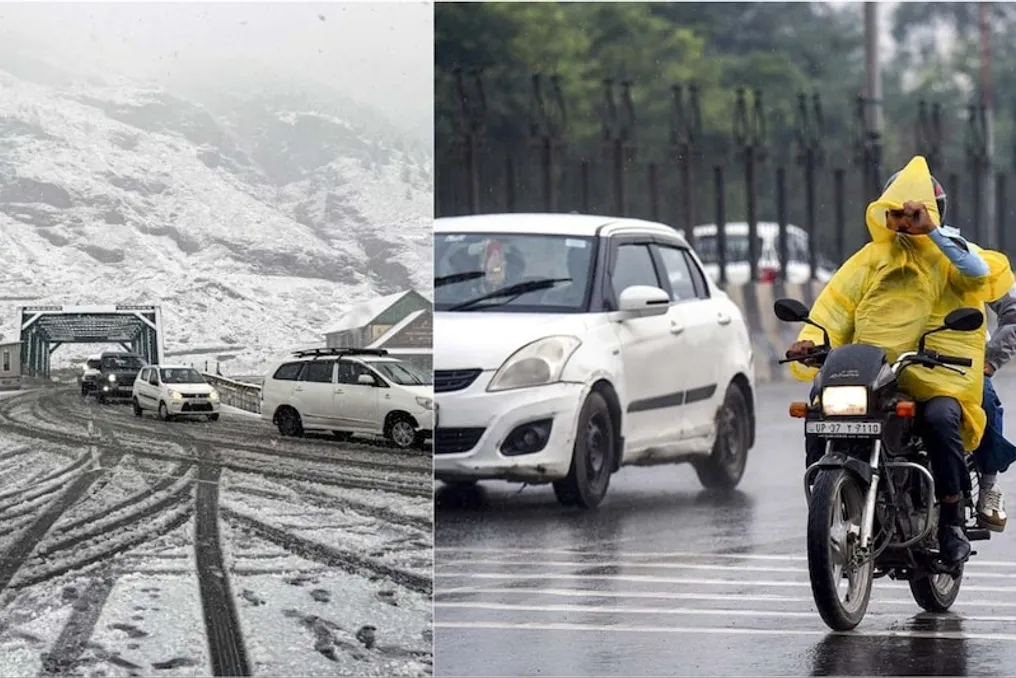
The weather in October has taken on such a cool character that it gives the impression that November has been skipped and December has already arrived. In some areas, temperatures are dropping due to rain, while the cold is intensifying in mountainous regions. The cause of these changes is a weak weather system associated with Cyclone Arnab and an active western disturbance.
According to meteorological service forecasts, rain, thunderstorms, and strong winds are expected in many parts of the country from October 30th until early November. Delhi recorded its coldest October day in four years on Thursday. Furthermore, rain is predicted in the states of Uttar Pradesh, Bihar, Jharkhand, Odisha, and several southern states.
On Thursday, a significant drop in temperature occurred in Delhi due to rain and cloud cover. The maximum temperature at the Safdarjung weather station reached 25.4 degrees Celsius, which is 6 degrees below normal. The previous day, Wednesday, the maximum temperature was 31.8 degrees Celsius. Earlier, on October 8, 2022, the maximum temperature in Delhi also dropped due to rain, reaching 23.4 degrees Celsius. Thus, Thursday became the coldest October day in four years.
Despite the decrease in daytime temperatures, nighttime temperatures continued to rise. The minimum temperature in Safdarjung was 19.2 degrees Celsius, which is 3 degrees above normal; the previous day it was 15.7 degrees Celsius. This is due to cloud cover. On Thursday, light or very weak rains occurred in different parts of Delhi: 0.5 millimeters fell in Safdarjung, and 1 millimeter fell in Palm. In the Jhorra Kalan area southwest of Delhi, 44 millimeters fell, and in Pitampure, 4 millimeters fell.
The meteorological service reports that light rain and strong winds are also possible in Delhi on October 30th. After this, the weather is expected to improve from October 31st. In the following week, daytime temperatures may rise, while nighttime temperatures will begin to decrease.
According to Mahesh Palawat, Vice President of SkyMet, several weather systems are active simultaneously in North India. The western disturbance is influencing the mountainous regions. Additionally, a cyclonic circulation has formed over northern Haryana. Cyclone Arnab has weakened and turned into a low-pressure area around Chhattisgarh and Odisha. This causes moist air from the Bay of Bengal to move towards North India.
Due to all these factors, cloudiness and rain have been observed in Delhi and other parts of North India. Mahesh Palawat noted that starting from October 31st, the influence of these weather systems will begin to weaken, which may lead to an increase in daytime temperatures. However, there is a possibility of another drop in maximum temperature in the second half of November.
According to IMD, rain, thunderstorms, and strong winds are expected in many states of North India on October 30th. There is also a possibility of hail in some areas. Rain and thunderstorms are possible in Jammu and Kashmir and Ladakh on October 30th. It is forecasted that rains will occur in various places in Himachal Pradesh until November 2nd. In Uttarakhand, heavy rain accompanied by strong winds and lightning may occur in some areas on October 30th.
Rain and strong winds are expected in Punjab on October 30th. Similarly, thunderstorms and strong winds are forecast in Haryana, Chandigarh, and Delhi, with hail also possible in some places. The weather in Uttar Pradesh will also change. Very heavy rains are possible in eastern Uttar Pradesh until October 30th, and from October 31st to November 4th, rain is expected in various areas. Rains will persist in western Uttar Pradesh until October 30th.
Northern states of East India will also face a rainy season. According to IMD, rain is possible in Bihar until October 30th, with very heavy rain forecasted for northern Bihar on that day. Furthermore, precipitation is expected in various parts of Bihar from October 31st to November 4th.
Jharkhand expects heavy rain on October 30th. In the plains of West Bengal and sub-Himalayan West Bengal, rain is possible until October 31st, after which light to moderate rain is expected in some places in early November. A new rainy period may begin in Odisha from November 1st. The meteorological service warns of possible heavy rain on November 1st, very heavy rain on November 2nd, and heavy rain in some areas on November 3rd. Heavy rains are expected in the Andaman and Nicobar Islands on October 31st. Temperature increase is expected in South India in early November.