Cultural exchange between China and Germany is actively developing
Read more
CGTN
cgtn.com

Cultural exchange between China and Germany is actively developing

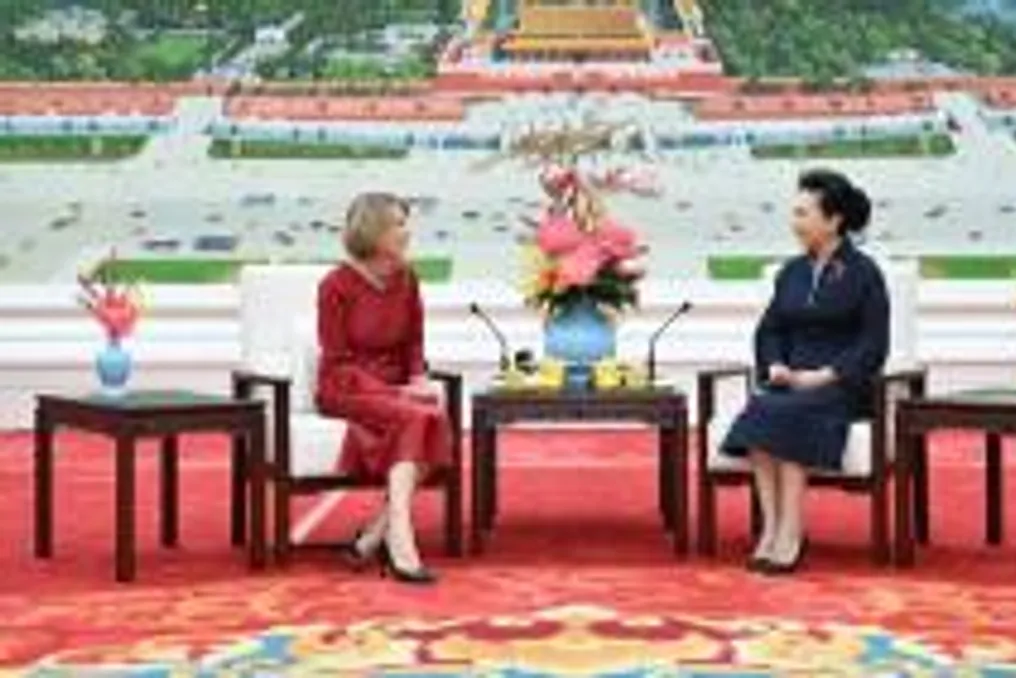
Peng Liyuan, wife of Chinese President Xi Jinping, met with Elke Budenbender, wife of German President Frank-Walter Steinmeier, for tea in Beijing on Friday. This meeting took place during the German President's state visit to China, which will run from October 27 to 31.

Peng Liyuan recalled her trip to Germany with President Xi in 2017 and spoke warmly about the friendship between the two countries. She also highly praised Budenbender's long-standing commitment to protecting the rights and interests of women and children.

During the meeting, they watched a short film showcasing the active cultural and social exchange between the two nations. Peng emphasized that the countries possess rich and diverse cooperation in the fields of education and culture, expressing hope for continued exchanges between the Chinese and German peoples, deepening mutual understanding, and strengthening friendly ties.

For her part, Budenbender thanked Peng for her hospitality and highly valued Peng's contribution to the cultural and social exchange between China and Germany. She stated her readiness to contribute to strengthening cooperation in relevant areas and deepening friendship between the peoples.

The cultural exchange between China and Germany has evolved into a complex and rich network encompassing languages, festivals, art, tourism, education, and much more. The Leibniz Institute of Confucius in Hanover organizes summer camps, distance language partnership programs, and speech contests, attracting more German students to China.

Meanwhile, the Burg Chinese Choir from Bonn organized a trip for 80 students and teachers to Yunnan. There, they sang by the campfire during the Lantern Festival I, studying over 60 Chinese songs and gaining direct experience of local culture.

Festivals and artistic events bring language learning into the realm of shared public experience. The Red Town Hall in Berlin has hosted 'Happy Chinese New Year' gala concerts for 12 years, where 300 guests watch dances, folk music, and martial arts. The festive temple fair in Frankfurt featured Chaoshang Inge dances and Ansai drums in the streets of Germany. In Duisburg, the China Festival combined concerts and film screenings with Tai Chi and pop electronic music, while an exhibition in Chengdu brought together German and Chinese artists side-by-side to explore technology and perception.

Tourism links are developing in parallel. A tourism exhibition in Gansu Province in Berlin gathered over 40 representatives from the German tourism industry, and one German agent has already organized 38 campers from Turkey to China. China's visa-free entry policy for German citizens, extended until 2026, has significantly simplified bilateral travel.

This exchange has ceased to be a series of isolated events; it has become a unified ecosystem—institutional, creative, and everyday—giving concrete meaning to the concept of 'rich and diverse.'
Similar stories

China becomes a center of cultural exchange in the world of fashion at Jinshang Fashion Week event
Read more
cgtn.com

China becomes a center of cultural exchange in the world of fashion at Jinshang Fashion Week event

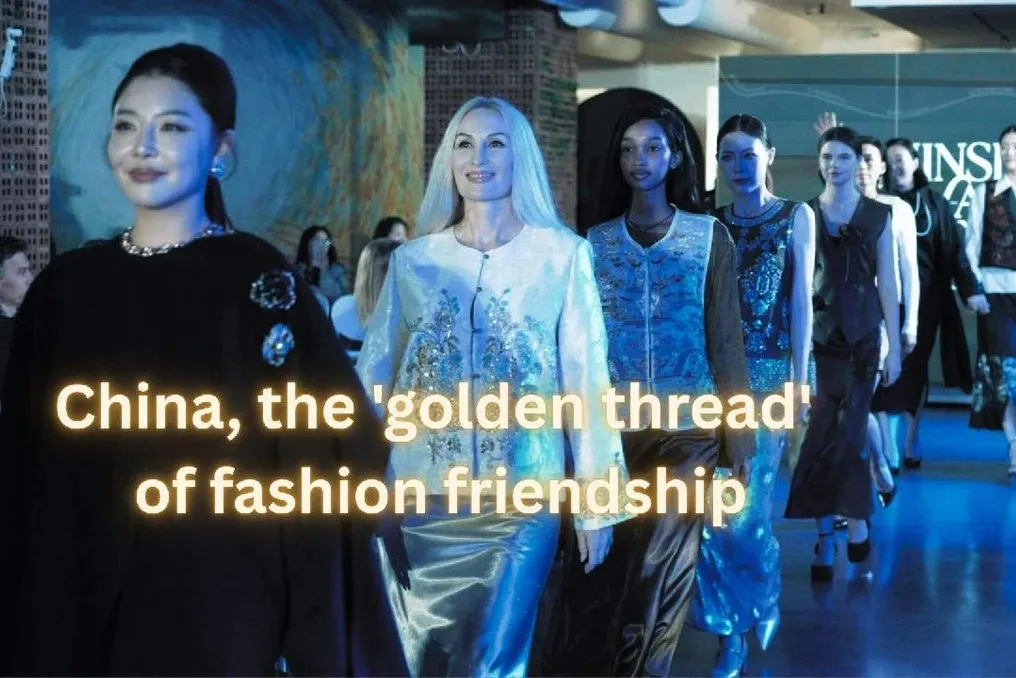
Despite the autumn chill and rain, many people gathered in Beijing as the city transformed into a venue for meetings in fashion, diplomacy, and cultural interaction. The Jinshang Fashion Week event, themed 'Golden Thread 2026,' attracted participants from over ten countries, representatives from more than thirty embassies, and fashion enthusiasts from across the city.

Since the opening of Jinshang Square in 2016, this was only the second fashion-related event to take place there. The ambition of the venue is to create a platform where culture and creativity can integrate into daily life.

Founder Lillian Tian, a native of Beijing, notes that the city has become both her hometown and a constant classroom, shaping her perspective and inspiring her desire to contribute to society. During an interview after the show, she stated: 'The heart shapes the environment, and the environment shapes the heart.'

Tian emphasized that fashion is a powerful expression of personality, and therefore deserves a space that stimulates creativity and meaningful connections. She added that Jinshang Square is a place created with great care and passion, bringing together artists, designers, entrepreneurs, and diplomats, providing opportunities for people from different walks of life to meet and exchange ideas.

Her connections with diplomats have developed over more than ten years, contributing to the organization of such events and positioning China as the 'golden thread' connecting dialogue. Thus, the event serves as both a fashion exhibition and a living demonstration of cultural diplomacy. Through textiles, craftsmanship, and inspired fashion, the diplomatic community of Beijing creates a space for the meeting of Eastern and Western traditions in a new format.

Lillian Tian noted that China is home to one of the world's greatest civilizations, whose cultural heritage spans five thousand years. She believes that this heritage is not limited to museums or historical books but lives in design, materials, traditions, and the details of daily life. She also stressed that true cultural exchange goes beyond fashion or art, occurring through lifestyle, shared experiences, and the daily existence of people, which transforms cultural differences into mutual understanding.

Every exquisitely designed piece presented on the runway served as an introduction to another culture—from Equatorial Guinea to Turkey, Ethiopia, Slovakia, Dominican Republic, and other countries. This sense of cultural significance extends beyond the runway. Tian believes that the Chinese audience is increasingly interested in international high fashion, which offers meaning alongside beauty. These consumers travel well, are confident in their culture, and are less interested in wearing logos merely for the logo's sake; instead, they want to know who created the item, why it was created, and what cultural story it carries.

She stated that people seek meaning as much as they seek beauty, demanding exceptional craftsmanship, a compelling story, and a unique creative vision. This emphasis on meaning and craftsmanship extends to sustainability issues. As China implements green development under Plan-5, Tian insists on the importance of creating fashion with greater responsibility and care. She argues that there is a natural link between traditional values and modern sustainability. Chinese traditions have long emphasized repair, reuse, passing down items through generations, and creating durable objects, reflecting respect for materials, craftsmanship, and the resources invested in creation.

Today, designers explore similar concepts through natural dyes, hand embroidery, thoughtful material selection, and slow production processes. When an item is created with meticulousness and designed to be valued for years rather than discarded after a season, it becomes part of a more responsible approach to fashion. For her, heritage and sustainability are closely linked: one stems from the wisdom of the past, and the other from the pressing priorities of the future.

This link between heritage and the future was supported by Christoph Manke, a German philosopher and visiting professor at Peking University specializing in aesthetics. He also told CGTN that contemporary fashion uses resources from both the past and the present to shape the future. He noted that combining different cultures is always a good idea, but he was most interested in how different cultures maintain productive relationships with themselves, not just with each other, and how they can use their traditions creatively and innovatively to not just repeat the past, but to look forward and redefine themselves.

Manke concluded that the ability to reinterpret one's own traditions for the future is relevant to any culture. He suggested that China does this daily and is very open to seeing how it works in other parts of the world—to learn from them, and also to encourage and unite them in a space where these various experiments can occur in parallel dialogue.

This same balance of heritage and innovation is transforming China's global fashion identity. Tian said that the country remains a major buyer, but she expects its influence as a host and trendsetter to grow. It is important to note that the exchange is becoming two-way: international houses are now coming to China not only to reach consumers but also to seek opportunities for collaboration with local creators. Tian believes that the next chapter of 'Made in China' should symbolize intention, originality, exceptional craftsmanship, and responsibility towards people, culture, and the planet. She concluded that the future of global fashion will be defined by such mutual exchange, where different cultures contribute equally and together create something new.

Macao promotes Spanish-speaking business development in China due to cultural proximity
Read more
noticiasaominuto.com

Macao promotes Spanish-speaking business development in China due to cultural proximity

Entrepreneurs and representatives assert that Macao's cultural closeness to Spanish-speaking countries facilitates entry into the Chinese market, especially given the expansion of the semi-autonomous region's strategy towards the Spanish-speaking world.

Borja Sanchez, an entrepreneur who has monitored events in Macao for about twenty years, arrived in Hong Kong in 2006. He was born in Barcelona but has roots in Galicia. Initially, he came to promote Spanish cuisine in two semi-autonomous regions of China, and seven years later, he founded Los Ibericos, a company involved in importing and distributing Spanish food products.

From the Pearl River side, this entrepreneur has observed Macao's consistent policy of economic diversification and believes that the decision to act as a bridge between China and Spanish-speaking countries 'is a logical evolution.'

In an interview with Lusa on the first day of the 31st Macau International Fair (MIF), he noted: 'The Chinese government understood that we are a separate cultural bloc. I think they understand the world of Portuguese-speaking countries very well thanks to Macao. And this is a logical and natural consequence.'

China designated Macao as a platform to strengthen economic and trade cooperation with the Portuguese-speaking world in 2003, establishing the Forum for Economic and Trade Cooperation between China and Portuguese-Speaking Countries. More than two decades later, this goal was expanded to include Spanish-speaking countries.

Despite whether Macao's new vision will be realized, Sanchez asserts that 'it depends on the will.' He added: 'What often happens with Macao government initiatives, in my opinion, is that they are very interesting in theory, but nothing is achieved.'

He emphasized that Macao possesses all the necessary resources to implement these plans: 'It has infrastructure, budget, there is a need to diversify the economy, and I think it can do it if it wants,' mentioning the hotel sector, restaurant business, and the strong presence of Portuguese culture in the territory.

The idea of cultural proximity is shared by the Spanish Consul General in Hong Kong and Macao, who views this strategy as an opportunity for Madrid to 'expand trade and investment both in Macao and from Macao to other geographical regions.'

The diplomat, Jesus Garcia Aldas, observed: 'Macao is also a place close to the history, language, and culture of Spain, Portugal, and Iberia. Therefore, it is always a very welcoming place for doing business.'

He also highlighted the 'growing closeness between Spain and China in recent years.' Spanish Prime Minister Pedro Sanchez visited China four times in the last four years, and the Kings of Spain visited the Asian country at the end of 2025.

Currently, about 4,500 Spaniards reside in China, and according to the diplomat, two thousand are in Hong Kong and about 500 in Macao.

Miguel Latorre, one of the directors of the Spanish Chamber of Commerce in Hong Kong, arrived in the region in 2023 and believes that the expansion offers Spanish entrepreneurs something hard to find in other cities of the region. He stated: 'Spaniards, Portuguese, we are brothers,' recalling how he felt in a 'familiar landscape' when he first visited Macao. He argues that this proximity generates trust and comfort for Spanish-speaking entrepreneurs.

'We see this as the ideal bridge between China, Hong Kong, and the ecosystem that has formed in Victoria Harbour (...) we consider this expansion a very positive sign,' he noted.

Victoria Harbour is a Beijing project aimed at creating a global metropolis based on China's Special Administrative Regions of Macao and Hong Kong, as well as nine other cities in the neighboring Guangdong province, where more than 86 million people live.

For Victor Herrera, manager of the consulting firm CW CPA—a Hong Kong firm specializing in supporting Latin American companies interested in entering Asia—the inclusion of Spanish-speaking countries in Macao is 'very important.'

He reported that upon arriving in Hong Kong, where Cantonese and English are spoken, there is a lack of 'muscle' to promote business specifically oriented towards the Spanish-speaking region, so Macao's intention to promote such activities 'would be ideal.'

The Mexican specialist listed two main difficulties for entrepreneurs from Spanish-speaking countries entering China in Lusa: language, although this is being mitigated by the development of new translation technologies, and lack of legal knowledge.

He concluded: 'These companies, when they come to do business, have usually already conducted import and export operations and faced problems because communication was unclear, because they did not read contract terms, because there was no contract, there was no solid basis for business development. There was hope, trust, and 'whatever God wills.'

Popular