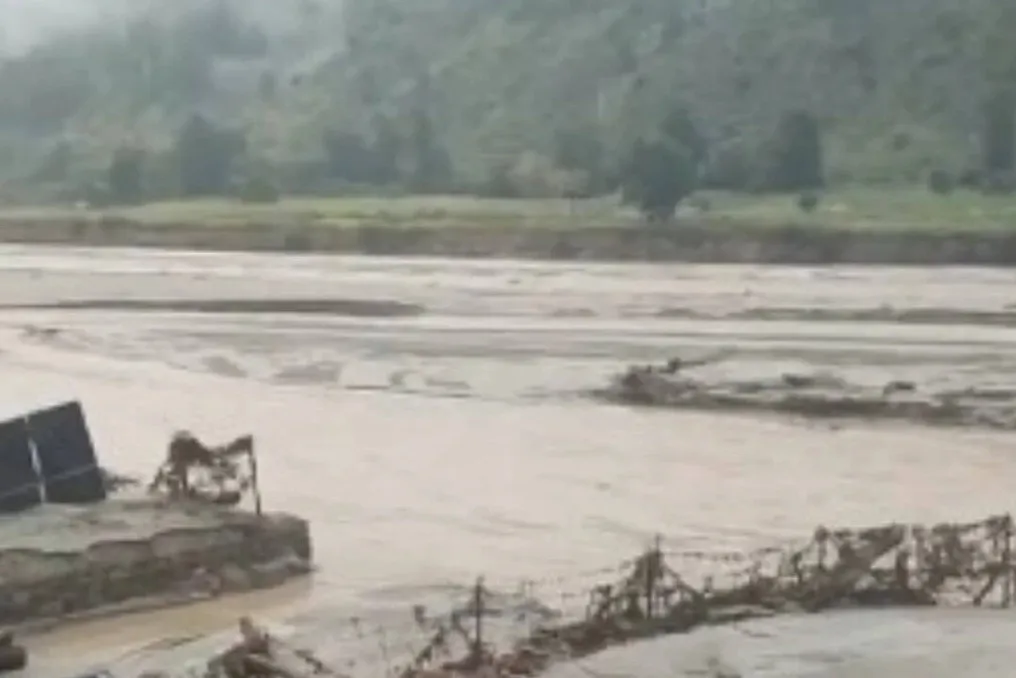
A flood event caused by a Glacial Lake Outburst Flood (GLOF) in Bhutan triggered alerts in parts of Assam and West Bengal on Friday. This incident resulted in the formation of a new temporary lake downstream, which raises concerns regarding potential secondary hazards.
The National Centre for Hydrology and Meteorology of Bhutan (NCHM) confirmed that the outburst led to the creation of an artificial lake in Taktsemahang, located at the confluence of the Singathpu Chu and Lungchu Chu rivers, also known as Gangchen Tag Chu. This newly formed water body is currently under observation for potential secondary flooding threats, and NCHM strongly advises residents of the Mochhu and Punatsangchu river valleys to remain vigilant, avoid riverbanks and low-lying areas.
The GLOF, which occurred on October 29, originated in the Singathpu glacier, which, according to the International Centre for Integrated Mountain Development (ICIMOD), contained between 6 and 7 million cubic meters of water—equivalent to approximately 2,400–2,800 Olympic swimming pools—before the breach. The volume of released water is still being estimated. The Central Water Commission of India (CWC) subsequently issued a special flood warning for West Bengal and Assam, cautioning about a possible sharp rise in water levels in the Alipurduar and Dubri districts as the floodwaters moved through the Sankosh river system.
West Bengal declared a high alert across North Bengal, but the GLOF had a minor or zero impact on the state. On Friday morning, as water flowed down from the hills of Bhutan, the Sankosh River rose 1.5 meters above its normal level but soon began to recede. By Friday afternoon, the crisis appeared to have passed, and people who were in flood shelters returned home. No damage was reported.
The Alipurduar district administration opened 18 flood shelters in the Kumargramduar block on Thursday evening, and about 10,000 people living along the Sankosh banks in the Kumargram tea plantation, Kumargram forest village, Pakriguri, and Bolka found refuge in these centers, along with several thousand people from Assam.
Assam Chief Minister Himanta Biswa Sarma stated that the state is closely monitoring the possible impact of the glacial lake outburst on all vulnerable administrative districts of Dubri and Kokrajhar. He noted: 'Our teams are ready to respond if necessary. Residents are advised to remain vigilant, follow official updates, and cooperate with officials.'
According to Bhutan's national publication 'Kuensel', the floodwaters caused by the GLOF rushed down the Mochhu River, damaging roads, bridges, and public infrastructure in Gasa and Punakha. No casualties were reported. The floodwaters washed away structures in Gasa Tsachu, damaged sections of the second-level Punakha-Gasa National Highway and the Gasa-Laya road, and swept away the Bailey Bridge built in Punakha in 2022 with Indian support.
Ashim Sattar, a glacial hazard expert from IIT Bhubaneswar, told TOI that the formation of temporary lakes downstream is a known risk during such disasters. Sattar explained: 'During a GLOF, powerful floodwaters erode river valleys and carry large amounts of debris, which can temporarily block river channels and form new lakes. Such lakes usually drain naturally, but they can also become secondary flood threats if not regularly monitored.'
He added that Singathpu was a medium-sized glacial lake located near the Lunana glacier complex, a cluster of four lakes including Tortormi, which is considered one of the most dangerous in Bhutan.
According to NCHM, the flooding reached Taktsemahang around 20:27 on Thursday. Warning sirens along Mochhu and downstream Punatsangchu were activated as monitoring stations recorded a sharp rise in water levels. In Yebese, the water level peaked at 6.7 m at 23:00 before dropping to the normal level of 2.84 m around 00:30 on Friday, representing a drop of 3.86 m over 90 minutes.
Sattar noted that the timely activation of the regional early warning network prevented loss of life.
This incident highlights the growing threat of cascading disasters in the Himalayas, where an initial glacial breach can cause secondary hazards downstream through valley erosion, sediment deposition, and temporary river blockages.
Previous assessments by ICIMOD and UNDP identified 47 large potentially dangerous glacial lakes (PDGLs) in the transboundary basins of the Koshi, Gandaki, and Karnali rivers. Current estimates indicate that 388 GLOFs have been documented in the Hindu Kush Himalayan region, including the Karakoram and the Central and Eastern Himalayas.