The number of reports of electoral harassment in the workplace has significantly increased since Sunday, the 25th, the day Luiz Inácio Lula da Silva (PT) was re-elected president of Brazil. During the following week, various social media posts promoted persecution and retaliation against voters.
In response to this situation, the Digital Labor Card application issued a notification with guidelines on the topic on Thursday, the 29th. On the same day, the Labor Public Prosecutor's Office (MPT) initiated a lawsuit against Meta, the company that owns platforms such as Instagram, Facebook, and WhatsApp.
The MPT requested that Meta, owned by Mark Zuckerberg, remove content that encouraged employers to monitor, expose, fire, or refuse to hire individuals based on their electoral choices. The issue was discussed with Marcel Zangiácomo, an expert in procedural and substantive labor law, and partner at the firm Galvão Villani, Navarro, Zangiácomo e Bardella Advogados.
Over the three days following the second round, the MPT registered more than 1,140 reports of electoral harassment in the workplace. This balance was presented by the MPT's Secretary of Institutional Relations, Maurício Coentro de Melo, during a press conference held on Wednesday, the 28th.
Among the scenarios that can constitute electoral harassment are threats of dismissal, intimidation, discomfort, and discrimination of employees due to their political leanings.
After the defeat of Flávio Bolsonaro (PL), politicians and business owners who supported the candidate began inciting, threatening, or announcing the dismissal of people who had voted for Lula. State deputy Jessica Ramos Moreno (PL), known as Jessicão, wrote on X/Twitter on Sunday night: 'Do you have an employee who is a PT supporter? Fire them!'
Jessicão, who was the most voted candidate for the Legislative Assembly of Paraná, posted messages such as: 'Do you have an employee who is a PT supporter? FIRE THEM! Is your barber a PT supporter? Change barbers. PT supporter friends? FIRE THEM! His damn vote harms your business, harms your family, and harms your whole life! Fire the bad one????'
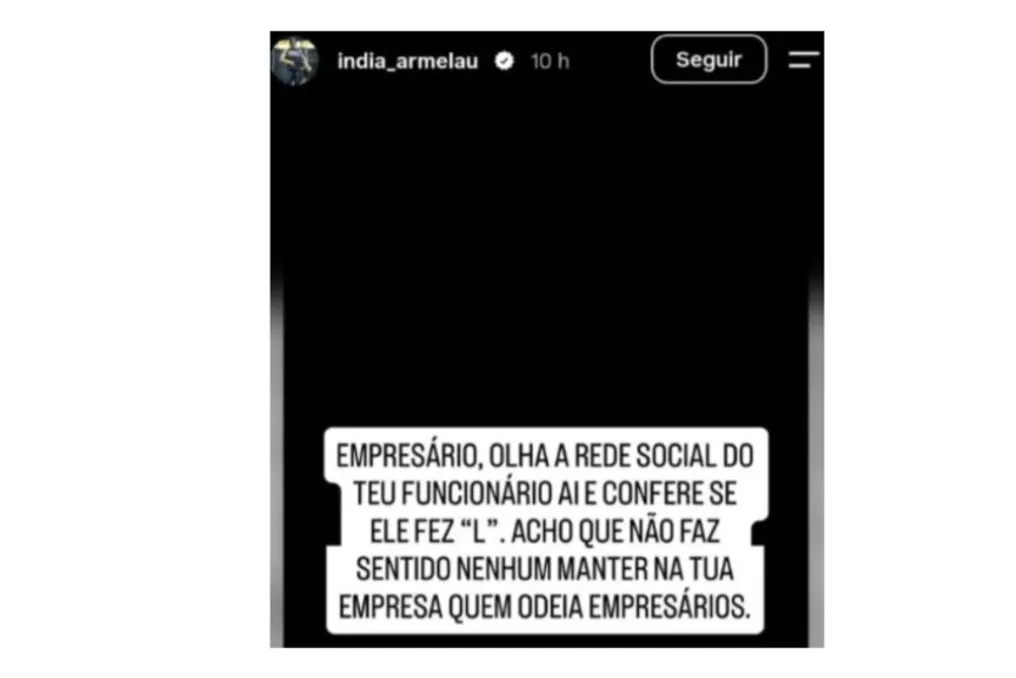
Another example was given by state deputy Índia Armelau (PL), the most voted for the Legislative Assembly of Rio de Janeiro. She posted on an Instagram story: 'Business owner, look at your employee's social network and check if they voted 'L'. I don't think it makes sense to keep someone in your company who hates businessmen.'
The Labor Court of Rio de Janeiro granted a request from the state MPT, prohibiting the deputy from encouraging employers to persecute, dismiss, or discriminate against workers because of their political convictions. After the controversy, Índia Armelau released a statement clarifying that 'No one can be threatened, discriminated against, or lose their job because of their political choice. Freedom of conscience and the secrecy of the vote are rights guaranteed by the Federal Constitution,' as reported by the Ministry of Labor and Employment (MTE).
The MPT organized a task force composed of prosecutors to identify discriminatory practices against workers, focusing especially on social media. Furthermore, the body is filing public civil actions aimed at stopping such behaviors and seeking compensation from those responsible.
Marcel Zangiácomo points out that 'Article 1 of Law No. 9.029/1995 prohibits discriminatory practices both in hiring and in maintaining employment' and adds that 'Article 4 provides consequences for those who terminate the employment contract for discriminatory reasons.'
For those who have been victims of electoral harassment at work, Zangiácomo advises: 'If the dismissal is due to discrimination based on political opinion, the worker can seek the Labor Court to request that the damages suffered be repaired. Under Law No. 9.029/1995, when the court recognizes that the dismissal was discriminatory, the worker can choose between returning to the job, receiving everything they missed during the leave period, or receiving double the salary for that period. They can also request compensation for moral damages.'
The procedural law expert emphasizes that the company may also face administrative sanctions, but stresses that 'each case must be analyzed based on the circumstances and evidence because a simple difference of political opinion does not automatically make a dismissal discriminatory.'
For those who have not yet been victims but fear being so, Zangiácomo recommends seeking the Labor Court or reporting to the Labor Public Prosecutor's Office if they suffer pressure, discomfort, or persecution for their ideas. He warns that the situation can be classified as moral harassment or even a specific crime, depending on the facts.
Finally, the lawyer reinforces that freedom of thought and defense of political opinions must be respected by both the employer and the employee, as legislation does not allow using employment to coerce someone into thinking a certain way. He concludes that 'differences of political opinion are not enough, by themselves, to justify punishments or dismissals,' and that the workplace must respect disagreements without preventing the fulfillment of tasks.'
>}