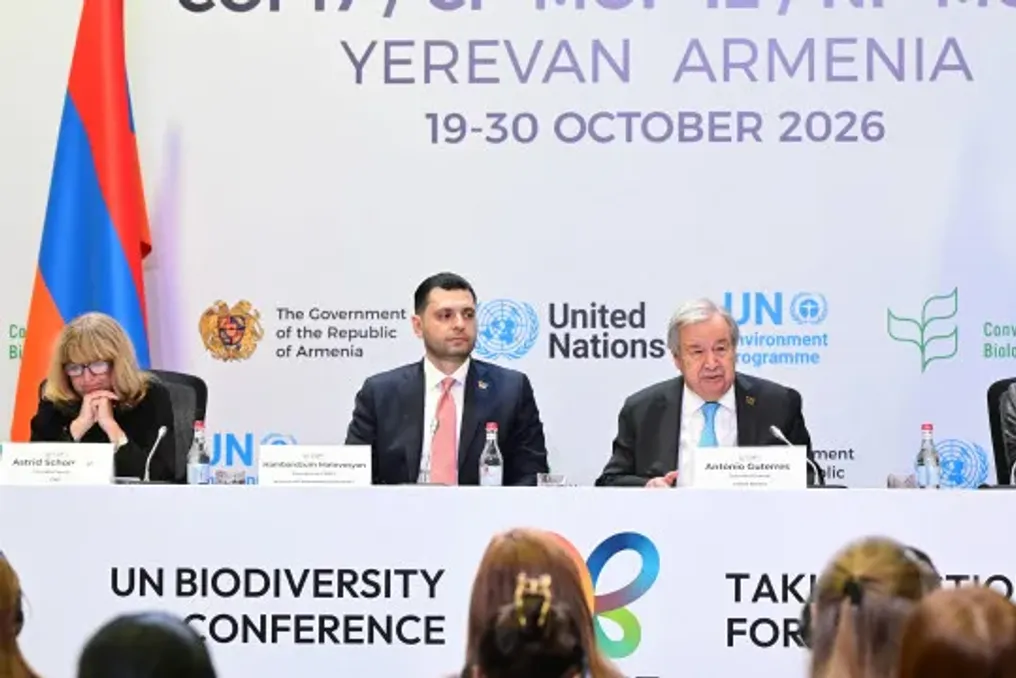
COP17 on biodiversity approaches end without agreement on key nature preservation points
Read more
Noticias ao Minuto
noticiasaominuto.com

COP17 on biodiversity approaches end without agreement on key nature preservation points

The 17th Conference of the Parties to the United Nations Convention on Biological Diversity (COP17), held in Yerevan, Armenia, is just hours away from its official closing, with participating states showing significant distance from reaching a consensus on the central elements for Nature preservation, which may lead to discussions continuing into the night.

After almost two weeks of proceedings, significant divergences remain regarding crucial topics. These include granting subsidies to environmentally harmful activities, such as oil extraction; defining the best methodology to fund biodiversity protection; and increasing corporate contributions to a United Nations fund dedicated to nature conservation, which faces resource scarcity.

Francisco Ferreira, president of the environmental association Zero, commented in a note sent to Lusa that several vital issues still await a decision. He stressed that although technical advances and important decisions have occurred over the two weeks, the more complex political issues remain unresolved. Ferreira stated that COP17 showed that the world possesses the necessary knowledge to curb biodiversity loss, but the obstacle lies in the absence of political will, funding, and concrete decisions, with progress towards 2030 falling short of the goals set in 2022.

A plenary meeting scheduled for early afternoon was postponed until early evening, while smaller working groups continue to operate. Discussions at COP17 are primarily focused on drafting a 'global stocktake' of progress in the area of biodiversity, a document awaited but still pending despite initial optimism about its completion before the current day.

This stocktake should be based on the results obtained after the 2022 Biodiversity Agreement, known as the Kunming-Montreal Agreement, which is comparable to the Paris Agreement on climate change. This agreement defined 23 goals to be achieved by 2030, such as protecting 30% of terrestrial and oceanic areas, combating pollution and invasive species, and restoring degraded ecosystems; however, most of these goals are behind schedule.

The objective of the global stocktake is to guide states toward the correct path through tangible proposals, but countries face notable difficulties when dealing with issues related to subsidies granted to harmful practices, estimated at $2.6 trillion annually. Another relevant point of contention is determining who should bear the financial objectives set for 2030, in a context where the public finances of many countries are under pressure, leading them to try to avoid the responsibility of increasing allocations.

Francisco Ferreira identified financing as the 'main blockage' of the summit, highlighting an 'enormous contradiction between funding for conservation and subsidies that promote habitat destruction, soil degradation, and overfishing.' In addition to monetary issues, the president of Zero mentioned that the positions adopted by certain countries, specifically Russia and Saudi Arabia, are complicating collaboration between biodiversity and climate change, as well as scientific recognition and articulation with other international pacts.

The president of Zero also expressed concern about the persistence of divergences regarding the effective participation of indigenous peoples and local communities, emphasizing that it is deeply worrying the time spent 'discussing words' instead of implementing concrete actions, given that biodiversity protection sustains both human living conditions and economies.

The European Union has been trying to persuade large emerging economies, such as China, to adhere to the official donor base, without success so far. Efforts to strengthen the 'Cali Fund,' a United Nations mechanism intended to share profits generated by companies exploiting genetic data of plants and other organisms, are also proving challenging.

In previous events, such as the biodiversity summit in Colombia in 2024, negotiations ended without an agreement on conservation funding, which were resumed and concluded in Rome in early 2025. In Yerevan, it is expected to be decided today whether Panama or Ecuador will host the next summit, COP18, in 2028. On the eve of the COP17 closing, Astrid Schomaler, UN biodiversity officer, called on countries to demonstrate 'audacity and innovation to find common ground.'
Similar stories

Diaspora can help finance platform for accessing medical consultations in Cabo Verde
Read more
noticiasaominuto.com

Diaspora can help finance platform for accessing medical consultations in Cabo Verde

A platform is planned to be launched in Cabo Verde that will provide access to consultations and a range of basic medical examinations on all islands of the country. This platform will be partially financed by diaspora funds and will be presented on Saturday in Lisbon as a potential solution to minimize the need for travel to receive medical care.

The concept is similar to what has already been used in Portugal in the field of thermals and was developed to ensure that patients who cannot physically reach a doctor can receive consultations and examinations.

Despite a relatively high ratio of doctors per capita, the island nature of Cabo Verde exacerbates healthcare access problems. Historically, cooperation in this area has existed with Portugal, where sick people who have not received care at home are sent annually.

On Saturday, during the gathering of Cape Verdean professionals in Portugal, which will be attended by the Prime Minister of Cabo Verde, Francisco Carvalho, health issues and patient transfers to Portugal will be one of the central topics of discussion.

Jaime Branco, a rheumatologist and honorary director of NOVA Medical School, will present the Salus Nexa platform, developed by this higher education institution, which he describes as a 'social innovation project.'

He noted that when speaking of innovations, people often think of technological progress, but the proposed project is primarily a project of social innovation.

Although telemedicine already exists in Cabo Verde and shows satisfactory results, the novelty of this project lies in its goal: to connect the Cape Verdean diaspora with the healthcare needs of citizens who remain in their home country.

Two million Cape Verdeans live in the country, and only a quarter of them are in Cabo Verde, with the rest constituting the diaspora.

Branco emphasized that this connection unites people and encourages them to care for the well-being of relatives, friends, communities, and islands, despite the distance.

The platform, which will be presented on Saturday, will be able to operate through kiosks installed on all islands of Cabo Verde, providing consultations and even routine tests such as blood sugar levels, blood pressure, or basic lung function tests.

All user health data will be stored on servers located directly in Cabo Verde. The diaspora has the option to partially or fully finance this project, as this will allow them to provide access to their families, friends, community, or island, depending on the amount they are willing to contribute.

Jaime Branco also believes that tourism, which is the main economic driver of the country, is interested in supporting this platform, as safety and access to medicine are key factors when choosing a tourist destination. He added that a foreign tourist in Cabo Verde will be able to access their treating physicians from countries of origin through these kiosks.

The specific characteristics of the kiosk installation region will be taken into account so that the tool can be adapted to the needs of the local population, as determined by local authorities. The Salus Nexa project has already been discussed by its initiators and the authorities of Cabo Verde and will now be presented at this gathering of Cape Verdean professionals, which will take place in the Lusophone University auditorium in Lisbon.

New climate goals proposed predict only 6% reduction in emissions by 2035, according to UN alert
Read more
g1.globo.com

New climate goals proposed predict only 6% reduction in emissions by 2035, according to UN alert

In the run-up to COP31, the climate goals recently presented by countries indicate a possible decrease in global greenhouse gas emissions of only 6% by the year 2035. This percentage represents a reduction ten times lower than what is necessary to limit global warming to 1.5°C.

This alert was issued by the United Nations (UN), which points out that despite the commitments made since the signing of the Paris Agreement in 2015, the planet is still far from controlling its temperature increase.

The assessment, released this Tuesday (27) by the United Nations Framework Convention on Climate Change (UNFCCC), occurs shortly before COP31, scheduled to take place between November 9 and 20 in Antalya, Turkey.

The document analyzed 127 new national climate goals, known as NDCs, which were submitted between January 2024 and August 2026. These goals cover 154 participants in the Paris Agreement, including the European Union and its members, who are responsible for about 71% of global emissions recorded in 2019, excluding deforestation and land use changes.

According to the UN, even if all new commitments are fully met, global emissions will tend to be only 6% below 2019 levels on average by 2035. To keep warming within the 1.5°C limit, or with a small and temporary excess, emissions should fall by approximately 60% in the same period, according to estimates from the Intergovernmental Panel on Climate Change (IPCC).

The 1.5°C target was established by the Paris Agreement in 2015 with the aim of preventing severe climate impacts, such as droughts, sea-level rise, and glacier melt. However, recent studies suggest that the world may have already surpassed this critical point. To limit the temperature increase to less than 2°C, the required reduction would be approximately 37%.

The UN also calculated that if all actions planned in the new goals are fully implemented, including those depending on international support and funding, the reduction could reach 9% by 2035. Although these goals are the main mechanism of the Paris Agreement against the climate crisis, the document signals that global emissions may peak before 2030 and only begin to decline in subsequent years.

The projection indicates that the annual volume of greenhouse gases should be between 49.6 billion and 55.9 billion tons of CO2 equivalent in 2035. This metric allows for the summation of various gases, taking into account the warming potential of each.

However, the predicted reduction will still be insufficient to prevent the planet from exceeding the 1.5°C limit. Based on national goals and future projections, global warming could reach 3.2°C by the end of the century.

The UN report also offers a second estimate, considering countries' long-term objectives, such as the commitment to net-zero greenhouse gas emissions by mid-century. In this scenario, projected warming would be between 1.7°C and 2.3°C by 2100, provided that countries meet their long-term goals and adopt reduction measures in the coming decades.

Additionally, the report warns that the CO2 emission limit compatible with the 1.5°C goal, known as the carbon budget, may be exhausted before 2030. According to the UN, this limit is about 130 billion tons of CO2 starting from early 2026, which is equivalent to approximately three years of current global emissions. In contrast, the forecast indicates that countries will emit about 368 billion tons of CO2 between 2026 and 2035, a volume almost three times higher than the limit available to keep warming at 1.5°C.

What has changed in countries' commitments

Despite the results presented, the UN recognizes that governments have incorporated more climate change combat initiatives into their national goals. Approximately 90% of the participating countries analyzed declared that they had taken into account the conclusions of the first global stocktake of the Paris Agreement, held at COP28 in Dubai in 2023.

Furthermore, 99% of countries presented internal measures to reduce emissions, focusing primarily on the energy, transport, industry, agriculture, and waste management sectors. Energy transition is among the central priorities for countries, according to the UN analysis.

The percentage of participants who proposed modernizing electricity grids increased from 51% to 70%, while the proportion of those planning to expand energy storage rose from 33% to 56%. The report also highlights that 92% of participants included methane in their climate goals and 90% presented commitments related to land use and forests, such as reforestation and combating deforestation.

However, the advances show inequality. A second report, based on 137 national documents released this Tuesday, revealed that 61 participants progressed towards climate goals, while another 27 moved away from the objectives or showed mixed results. The UN emphasizes that such progress does not guarantee that countries are reducing their emissions at the necessary rate to meet agreements.

Adaptation and climate finance

Adaptation to the effects of climate change also gained prominence in the new goals. The UN reported that 86% of participants integrated measures in this area, aiming to protect food production, water resources, and health, in addition to preventing disasters.

Among these countries, 92% mentioned losses and damages caused by climate change, such as economic losses, infrastructure destruction, and deaths in extreme events, a number higher than the 56% registered in previous goals.

Nevertheless, the implementation of these measures faces obstacles. By October 2026, 81 developing nations had presented national adaptation plans, but 36 of the 41 plans evaluated among small island states and least developed countries were still in initial stages of implementation.

Financing remains a significant challenge. Global climate investments reached an average of US$ 1.9 trillion annually in 2023 and 2024, representing a 32% growth compared to the previous two-year period. Of this amount, only 9% was directed to international transfers to developing countries, corresponding to approximately US$ 183 billion annually.

Resources specifically allocated to adaptation totaled US$ 63 billion per year, which constitutes a 20% drop and represents only 3% of identified global climate financing. On the other hand, developed countries exceeded the promise to mobilize US$ 100 billion annually to support developing nations in 2023 and 2024, reaching US$ 132.8 billion and US$ 136.7 billion, respectively. It should be noted that this goal was originally supposed to be met in 2020.

3

Popular