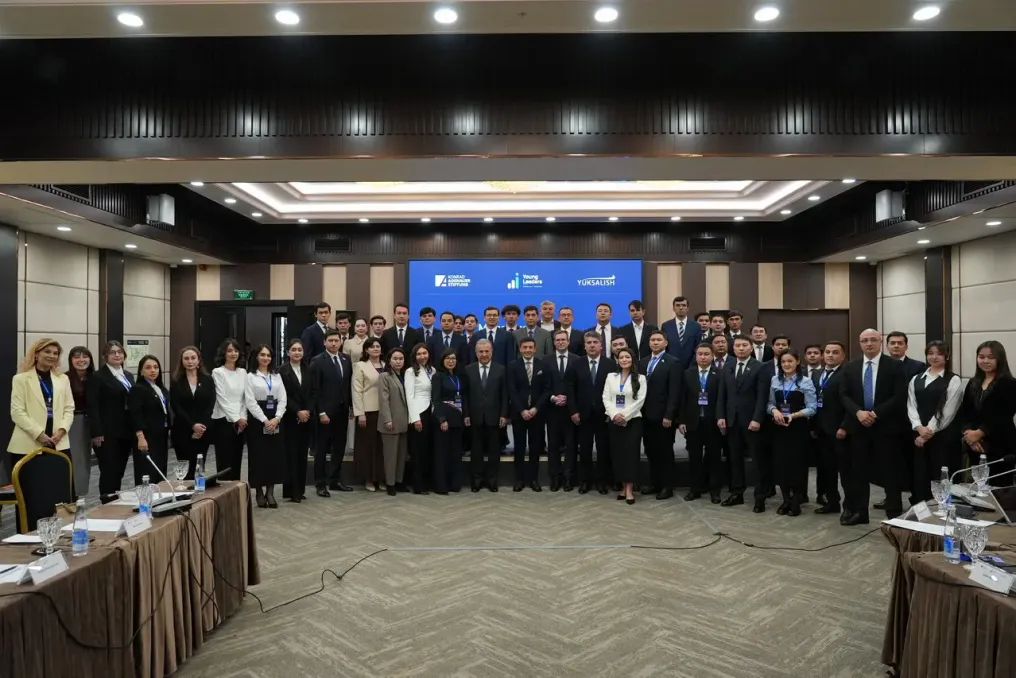
In Tashkent, Uzbekistan, the regional program 'Young Leaders of Central Asia and Azerbaijan' launched, gathering over thirty young representatives from state bodies, parliaments, research and analytical centers, as well as civil society organizations from six countries.
The program, organized by the nationwide movement 'Yuksalish' in cooperation with the Konrad Adenauer Foundation, will take place from October 26 to 30 in Tashkent and Bukhara. Its goal is to strengthen professional ties, exchange experiences, and develop practical cooperation on key priorities for regional development.
At the opening ceremony, Akramjon Nematov, First Deputy Director of the Institute of Strategic and Regional Studies under the President of Uzbekistan (ISRS), emphasized the growing importance of regional dialogue as a strategic tool for achieving sustainable development, stability, and joint response to common challenges.
He noted that the world is undergoing deep transformations affecting almost all spheres of international relations. Rapid progress in technology, artificial intelligence, and the digital economy opens up unprecedented opportunities for modernization and growth. Simultaneously, geopolitical competition is intensifying, climate and demographic changes are accelerating, and issues of energy, water, and food security are becoming increasingly acute.
Nematov pointed out that the current period is unique because these processes are happening simultaneously, intersecting and reinforcing each other. Although they generate new risks and uncertainty, they also provide chances for countries and regions capable of adapting to changes in a timely manner.
The structuring of the international order has been accompanied by a decrease in the effectiveness of some traditional multilateral mechanisms, which face difficulties in resolving crises and reaching agreed-upon decisions. In Nematov's opinion, in such circumstances, cohesive regions capable of independently defining common priorities, reconciling interests, and joining forces to solve common problems are particularly important.
He stressed that no single country can effectively handle the full spectrum of modern cross-border challenges alone or fully utilize emerging opportunities. Regional cooperation allows for the consolidation of resources, knowledge, and technology, turning common problems into incentives for joint development.
In this context, Nematov highlighted significant changes in Central Asia over the past years. The will for political action and joint efforts of regional leaders have contributed to strengthening mutual trust, resolving a number of sensitive issues, restoring transport links, and expanding trade, economic, investment, cultural, and humanitarian cooperation.
Regional interaction is entering a new phase where greater emphasis is placed on aligning national strategies, implementing joint projects, and creating a unified space for economic development. The results of the eighth Consultative Meeting of Heads of State of Central Asia and Azerbaijan, held in Avaza on October 8, confirmed this trend and opened new prospects for cooperation in the fields of industry, transport, energy, digitalization, ecology, and human capital development.
Azerbaijan's participation expands opportunities to strengthen connectivity between Central Asia, the Caspian region, and the South Caucasus, promoting the development of new transport routes and industrial ties.
Nevertheless, Nematov warned that for regional rapprochement to become stable and irreversible, it requires a solid intellectual, educational, and social foundation.
As technological changes accelerate, the competitiveness of countries increasingly depends on the quality of their human capital, educational systems, scientific research potential, and ability to implement innovations. This makes the training of a new generation of specialists possessing modern knowledge, competencies, and skills in international cooperation extremely important.
Nematov mentioned initiatives by the President of Uzbekistan Shavkat Mirziyoyev aimed at expanding youth and educational interaction. These include holding the Central Asian Youth Forum, organizing regional contests for innovative ideas, promoting academic mobility, and developing joint educational programs and research projects.
He also drew attention to Mirziyoyev's proposal at the Avaza meeting to create a Regional Atlas of in-demand professions and competencies. This initiative is designed to align education systems with the future needs of national economies, especially in the industries of manufacturing, energy, transport, digital technologies, artificial intelligence, and green economy.