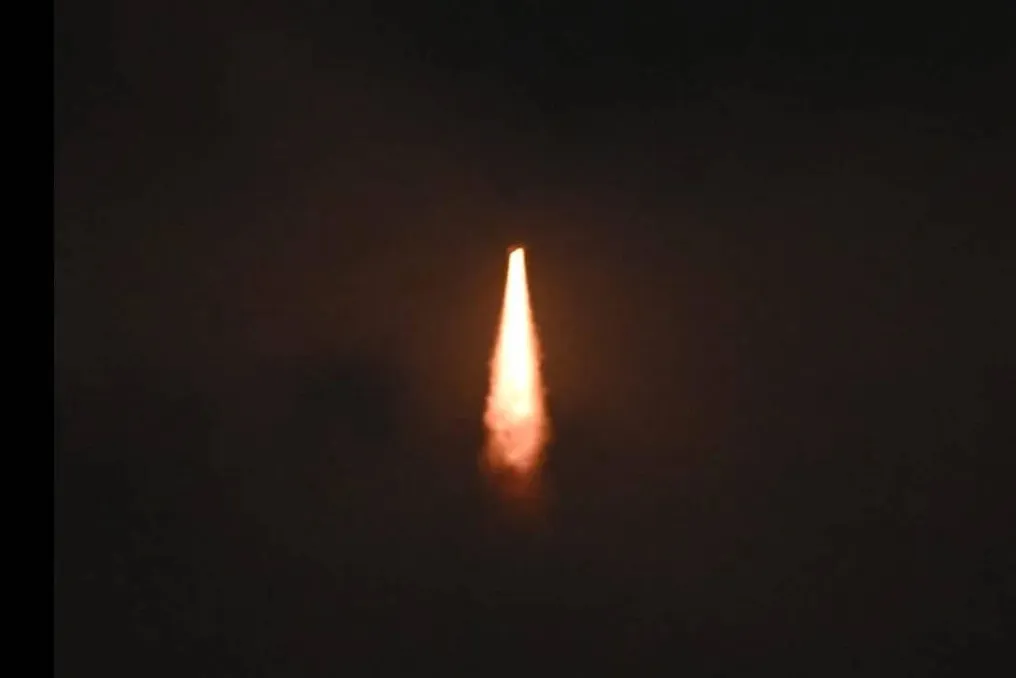
India's regional satellite navigation system, NavIC, has received a significant boost following the successful launch of the NVS-03 satellite. This launch was conducted by the Indian Space Research Organisation (Isro) on the night from Friday to Saturday.
The GSLV-F18 rocket, which carried the 2250 kg NVS-03 satellite, took off from the second launch pad of the Satish Dhawan Space Centre (SDSC-SHAR) in Sriharikota at 23:51 on Friday as scheduled. This marked the twentieth flight of the Geosynchronous Satellite Launch Vehicle (GSLV). Approximately 18 minutes after liftoff, the NVS-03 satellite was placed into a Geostationary Transfer Orbit (GTO) with an apogee of 37,023 km and a perigee of 170 km.
NVS-03 is the third satellite in Isro's next-generation navigation system, designed to ensure continuous services within the Indian Regional Navigation Satellite System (IRNSS), known as NavIC. The satellite is equipped with both domestic and acquired atomic clocks. Furthermore, it transmits an L1 frequency signal in addition to the existing L5 and S-band signals.
NavIC is India's independent regional satellite navigation system, intended to provide Positioning, Navigation, and Timing (PNT) services across the country and in a zone extending approximately 1500 km beyond the Indian subcontinent. The addition of the L1 signal, alongside existing signals, is expected to enhance compatibility with other satellite navigation systems and expand NavIC's civil applications.
The NVS-03 mission aligns with Isro's plan to deploy five second-generation navigation satellites—NVS-01 through NVS-05—to augment the existing NavIC constellation and improve the reliability and continuity of navigation services. The launch is crucial because NavIC previously could not provide autonomous positioning services due to a shortage of operational satellites.
Previously, on July 29, Minister of State for Space Affairs Jitendra Singh stated in a written reply to the Lok Sabha that the constellation had only three satellites providing PNT services, whereas a minimum of four is required for basic services. Although the timing service remained operational, the commissioning of NVS-03 could help restore autonomous positioning capability. The Minister noted at the time: 'Since NavIC is used in an environment with multiple constellations for most use cases, users are not vulnerable. The next NavIC satellite, NVS-03, is ready for launch, and two more satellites, NVS-04 and NVS-05, are in advanced stages of development.'
The constellation issue arose after the failure of NVS-02, which was launched on January 29, 2025, but failed to execute orbital insertion maneuvers. The Isro committee found that the electrical signal did not reach the pyrotechnic valve in the satellite's oxidizer line, preventing the ignition of the propulsion system and the achievement of the planned orbit. This failure prompted Isro to implement corrective measures for subsequent missions.
The first satellite of the second generation series, NVS-01, was launched aboard GSLV-F12 on May 29, 2023, and was the first in this series to be equipped with domestic atomic clocks.