Ruckelton praises Proteas' fight, noting team spirit ahead of the match's decisive day
Read more
IOL
iol.co.za

Ruckelton praises Proteas' fight, noting team spirit ahead of the match's decisive day

Currently, no one is tallying up the results of sessions, matches, or the series because the situation in this competition has changed drastically from one stage to the next, and it would be risky to do so.

However, South Africa, thanks to perseverance, diligence, and fighting spirit, has secured a position that allows it to compete for victory in this exciting final Test.

Just 24 hours before this, when the score was around 40/4, and the inspiring captain Temba Bavuma was removed from play shortly before the end of the day, it seemed like just an unattainable dream.

Nevertheless, as the Proteas have repeatedly demonstrated over the last two years, they have found the strength to withstand intense pressure before launching a counterattack.

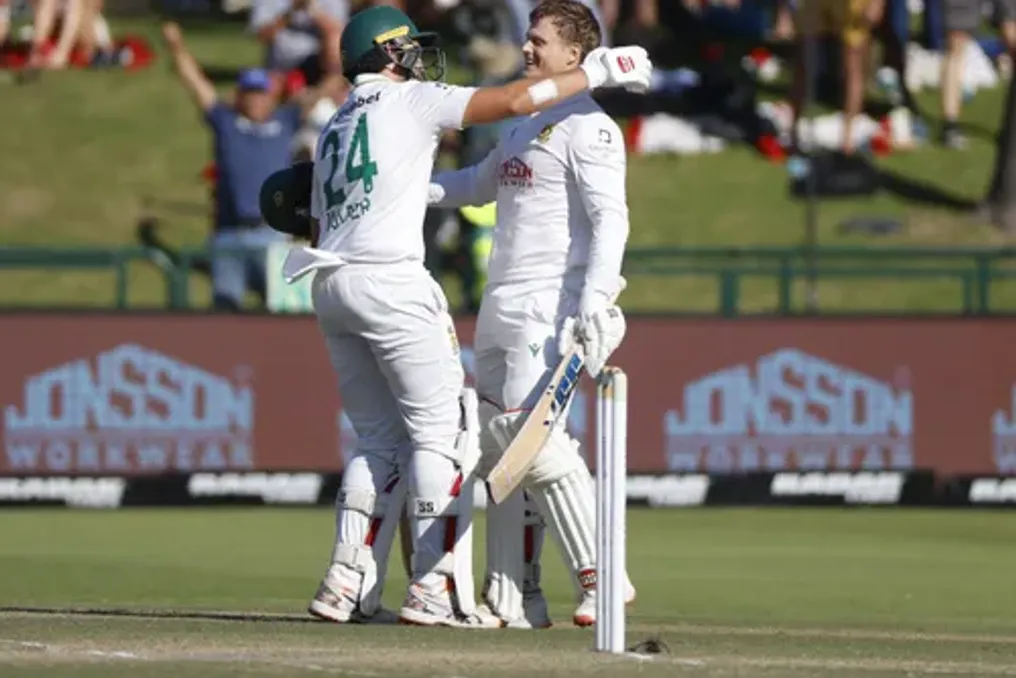
On Friday, players from the St Stithians duo—Ryan Ruckelton and Juan Mulder—took the field. Both scored significant centuries—the third for Ruckelton and the fourth for Mulder—which allowed them to fundamentally change the course of this Test.

Although Matthew Britske heroically battled in the morning, scoring 43 runs, there was still a large amount of work to be done to give the Proteas team enough material for defense.

Then Ruckelton (101) and Mulder (115) stepped in, literally risking their bodies while the Australian fast bowling continued to bombard them with bouncers, simultaneously using their skill to counter Nathan Lyon's fierce spin, extracted from the hard grass. They formed a partnership of 154 runs, which once again embodied the resilience inherent in the entire team.

Ruckelton spoke about the Proteas team culture: 'We are not a team full of huge names and superstars, but we work hard for each other, and we fight for each other, and we really try to do the right thing for each other.'

He added: 'We like to complicate our lives. But Shux always leans towards positivity.'

He continued: 'When I scored eight runs yesterday, he said that's eight less than what we need to get tomorrow. So, you know, it's always talk. Whatever we get, it will be enough. It has to be enough!'

'And this belief that he instills in us as players resonates from small moments to obviously larger group moments. But I think Temba also relies on this. He always emphasizes that every day there is a chance to do something special for the team. And when your day comes, grab it with both hands. That's how we operate. We support each other a lot.'

The support was evident during this partnership; when Mulder seemed to start losing his form shortly before the tea break, Ruckelton adjusted his partner for the sake of the team's position.

He explained: 'I felt that Juan sometimes started going outside of his plan, so just to keep each other in check, because we knew that the longer we played, the more they would get frustrated.'

'It was just an attempt to win small moments. We knew that this morning we were effectively at 40/4. They were going to attack us heavily, and it was just an attempt to spend time on the field.' He concluded: 'It was never about scoring runs or getting too ahead of ourselves. It was about having our plan and sticking to it.'

Now the baton is passed to the bowlers. Only once before has any team chased the target of 288 runs required by Australia to win here in Newlands.

However, the Proteas will not forget that the Australians did this 24 years ago under the leadership of the inspiring Ricky Ponting, as this Test is set to conclude at the very last moment.

Similar stories

Proteas aim for victory in Cape Town, risking the world number one ranking
Read more
iol.co.za

Proteas aim for victory in Cape Town, risking the world number one ranking

After two intense matches in which both teams suffered serious blows, South Africa and Australia head to Newlands for the final game of the heavy test cycle, which is tied at 1:1.

Australia delivered the first blow in Durban, followed by Themba Bavuma knocking Proteas off their feet with a powerful counter-attacking shot in Gqeberha.

Although the World Cup is not being played in Cape Town, the stakes remain high. A victory would allow South Africa to achieve a second consecutive home series win against their arch-rival and displace Australia from the world number one ranking.

For the Proteas team, which has repeatedly had to defend its status as Test Champions, this prospect is extremely attractive. Even after dethroning Australia in last year's Test World Cup final at Lord's, skeptics continued to label them 'paper champions.'

Nevertheless, fast bowler Ryan Rickelton is not planning to be distracted from the current task. He noted that after winning the World Cup, Bavuma spoke with the team, emphasizing that the goal is to leave a more long-term impression and confirm it by playing against the best teams in the world.

Rickelton added that Australia has long been the best and most powerful team in the world. He believes that even beating them on home soil is a huge achievement. However, speaking about the bigger picture, he mentioned the upcoming summer home tournament, which, if successful, could lead the team to the World Cup final in London in June.

He concluded that while both teams are in a very equal state, acknowledging that Australia holds a significant advantage in world cricket due to recent and past history. Currently, the team is simply fighting for the next day, hoping to have a good week.

The current 1:1 scoreline is reminiscent of the 2018 series, when the teams arrived in Cape Town after battles in Durban and Gqeberha. Rickelton, who did not participate in that confrontation, understands the importance of this familiar situation.

He stated that they are now in a similar 1:1 position before the final match of the series in Cape Town against a strong team, which adds confidence and significance. The team is set for a good performance, and success this week will give a significant boost to the team, coaching staff, and their methods. They are focused on achieving the current objective and maintaining stability in their approach to the games.

The third and final match is scheduled for Tuesday.

Simon Harmer noted the new culture of the Proteas team after the victory in St George's Park
Read more
iol.co.za

Simon Harmer noted the new culture of the Proteas team after the victory in St George's Park

Proteas spinner Simon Harmer acknowledged that the ability to recover from a humiliating defeat by Australia in Durban and level the series score at St George's Park in Gqeberha demonstrated the quiet resilience inherent in the entire squad.

After South Africa fell behind early in the two-match series, the team began searching for answers following the first Test match, where they felt they had let themselves down by allowing the Australians to easily pass through in Kingsmead.

For Harmer, the disappointment was not only related to the loss itself but also to their failure to capitalize on the moment when Australia was under pressure near the end of the first day of the first Test. They then allowed Australia to dominate with the ball after a poor batting performance, showing a lack of fundamental skills and discipline that made them a dangerous side in Tests in recent years.

When the squad gathered to analyze the mistakes, it became clear: in the first Test, the Proteas were their own worst enemy. Harmer admitted: 'I think realistically, we knew we weren't at the level we wanted to be.'

He added: 'I remember standing on the field watching the scoreboard, seeing the guys on the field, and thinking: 'This is what a real team looks like'. '

He continued that everyone felt they had let themselves down. 'If you look at the dismissals in the first innings, it was quite obvious that we weren't dismissed by strong deliveries, but we somehow found ways to get out of the game.'

This prompted the team to conduct a collective recalibration before the match in Gqeberha. Instead of panicking, the team focused on simplicity, discipline, and supporting each other. Harmer noted: 'If you are losing to a world-class team, and you can calmly say: 'Guys, we were beaten,' you can calm down and think: 'You know what, we will show up in the next game.' '

He also emphasized that there was a lot of motivation and fire in the team that had not been fully unleashed, and that they had lost on terms not of their own making.

The reaction in Gqeberha was decisive. Thanks to the magnificent first innings of captain Temba Bavuma (179 runs) and the destructive all-round skill of Marco Jansen, the Proteas put pressure back on the tourists, exposing weaknesses in the Australian lineup that many considered invincible before the match started.

Harmer noted: 'I think the most frustrating thing for us in Durban was knowing that there were a couple of players who came into the Test squad or were moved from their position, and we couldn't utilize that.'

He added that in Pittsburgh, they managed to apply pressure on them, and the realization that they too were human allowed them to succeed. 'If we bowl well and put pressure on them, there is a chance we can overcome them. It was really nice to turn that around.'

For Harmer, who himself contributed to the crucial debut half-century in the Test, this victory highlighted the trait of a mature team. Instead of relying on individual star talent, as in past eras when the team heavily depended on a few veterans, the current generation of Proteas thrives on collective responsibility.

Harmer recalls: 'When I first debuted for South Africa in 2015, there were many players capable of winning games on their own.'

He contrasts this with the current situation: 'Now I feel like we have a bunch of guys where different people always raise their hands. We don't rely on one person. We aren't dependent on Aiden not scoring, so we have problems, or if KG doesn't take wickets, we have problems. Even how Vian [Mulder] played today, he really helped us. That is a characteristic of a very good team.'

Temba Bavuma's resistance gives Proteas hope amid Scott Boland's onslaught
Read more
iol.co.za

Temba Bavuma's resistance gives Proteas hope amid Scott Boland's onslaught

Hope for the Proteas team in the conclusion of this match at St George's Park and for the entire series rests on the shoulders of their captain, Temba Bavuma. Despite Australia managing only 43 overs over two days of the second Test after two more sessions were lost due to bad weather and wet pitch, the home side faced a number of setbacks.

The world champions of Test matches found themselves trailing by four wickets with only 40 runs scored after the game finally started at 3:45 PM.

Scott Boland, a fast bowler with the best statistical average since World War II, demonstrated strong determination. Bowling from Park Drive End, Boland used the Kookaburra red ball, skillfully moving it off the edge in both directions.

The Victorian had already dismissed Test debutant Marcus Ackermann, adding to his previous catches of Aiden Markram and David Bedingham, and looked ready for further success.

Someone had to stop this onslaught, and that was done by Temba Bavuma and Ryan Rickelton, who came out as the sixth batsman for the first time since taking charge of the team from Kyle Verreyn.

They did not take risks; their play was tenacious, disciplined, and watchful, allowing every ball to pass by the bat. This sharply contrasted with Matthew Britzke's earlier play, who looked unprepared for red ball cricket when he tried to attack Mitchell Starc's wide delivery outside the crease.

Every run scored by Bavuma seemed earned from the depths of his soul. The Proteas captain, fully aware of the hopes resting on him, approached every delivery with immense caution and concentration. His discipline was unwavering; he masterfully left the ball outside the off stump and, when forced to play, did so softly and right under his eyes.

This forced Australia to change its plans and switch to a short-ball strategy, incorporating a light slip and deep square leg. However, Bavuma also stood firm in this situation, sending down his equivalent of Pat Cummins for six runs through fine leg.

However, the plan almost worked on the other end. Rickelton (31 off 51 balls, 5 fours) played just as cautiously alongside his captain, but Cummins forced the left-hander to hit a rising ball into the waiting hands of Marnus Labuschagne. Nevertheless, Labuschagne missed the chance, and Rickelton got a respite.

But just when it seemed the pair would safely see the team through the day, Boland was called again. Switching to Duck Pond End, he bowled another tempting ball that caught the outer edge of Rickelton and led to an impressive one-handed catch by Matthew Renshaw at first slip. The partnership of 52 runs, built over 109 balls, was broken, and the door for the South African middle order remained slightly ajar.

Vian Mulder managed to get through the last few overs with Bavuma, but Australia knows that the Proteas captain stands between them and the possibility of making a big step towards securing the series here in Gqeberha.

Popular