Uzbekistan's population reached 39.5 million people by October 2026
Read more
UzDaily
uzdaily.uz

Uzbekistan's population reached 39.5 million people by October 2026

As of October 1, 2026, the permanent population of Uzbekistan reached 39.5 million people, representing an increase of 1.8% compared to the previous year.

During the first nine months of the current year, 638,600 births and 123,400 deaths were registered. Thus, the natural population growth amounted to 515,200 people.

Samarkand region retains the status of the most densely populated region in the country, while the fastest population growth was noted in Suhardarya region.

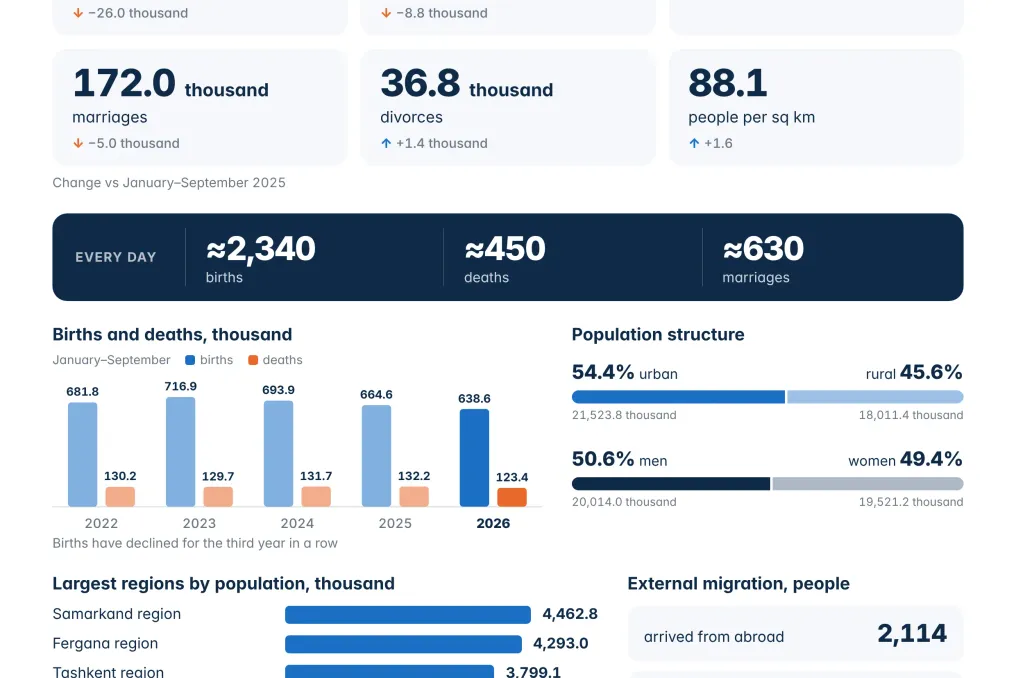
More detailed information on demographic trends, migration, and population distribution by regions is presented in the infographic.

Similar stories

GDP in Uzbekistan grew by 8.3% from January to September 2026
Read more
uzdaily.uz

GDP in Uzbekistan grew by 8.3% from January to September 2026

According to data from the National Statistical Committee of Uzbekistan, the gross domestic product (GDP) of Uzbekistan reached 1,755.5 trillion soums at current prices for January-September 2026. This represents a real growth of 8.3% compared to the same period in 2025. Preliminary data was published on October 30, 2026.

Previously, figures for January-September 2022-2025 were adjusted to account for the results of population and agricultural censuses. For comparison, in the first nine months of 2025, GDP was 1,494.9 trillion soums with a growth of 8.0%, while in the same period of 2024, the economy grew by 6.1%, reaching 1,224.4 trillion soums.

The GDP deflator for January-September 2026 was 108.4% relative to the previous year. The highest growth rates were recorded in industry (112.1%) and other service activities (109.7%). Agriculture, forestry, and fishing were below the national average at 107.8%; trade and accommodation/food services were at 106.4%; construction was at 105.5%; and transport, storage, information, and communication were at 103.1%.

Gross value added across all sectors accounted for 95.9% of GDP and increased by 8.3%, contributing 7.9 percentage points to the overall GDP growth. Net taxes on products accounted for the remaining 4.1% of GDP, showing an 8.4% increase and contributing 0.4 percentage points to the growth increase.

Industry generated added value of 450.4 trillion soums, showing a growth of 8.1%. Trade and accommodation/food services provided 247.1 trillion soums, which is 15.1% more. Each of these sectors contributed 2.0 percentage points to GDP growth. Transport, storage, information, and communication brought in 135.4 trillion soums, increasing by 18.1% and adding 1.4 percentage points. Construction reached 140.2 trillion soums, increasing by 12.5%, and contributed 1.0 percentage point to the growth.

Other service activities added 448.5 trillion soums, increasing by 3.2% and providing 0.8 percentage points of GDP growth. Agriculture, forestry, and fishing generated 261.7 trillion soums, showing a growth of 4.6%, and contributed 0.7 percentage points. Compared to January-September 2025, the share of industry in the economy rose from 26.0% to 26.8%, while the share of construction increased from 8.2% to 8.3%. The share of services decreased from 49.6% to 49.4%, and the share of agriculture, forestry, and fishing decreased from 16.2% to 15.5%.

Industrial added value grew by 8.1% to 450.4 trillion soums. The main driver of growth was manufacturing, where added value increased by 8.6% to 373.1 trillion soums. Electricity, gas, steam, and air conditioning production grew by 10.1% to 29.8 trillion soums. Mineral extraction and quarrying increased by 3.1% to 44.4 trillion soums, while water supply, sewerage, waste collection, and disposal grew by 1.6% to 3.1 trillion soums.

The total volume of construction works increased by 12.5%, and added value in construction amounted to 140.2 trillion soums. Growth was observed in building and structures construction at 6.6%, civil engineering works at 29.0%, and specialized construction works at 33.1%. At the same time, the share of buildings and structures in the construction sector decreased from 75.3% to 71.3%. The share of civil construction increased from 16.2% to 18.1%, and the share of specialized construction works rose from 8.5% to 10.6%.

Added value in the service sector reached 831.0 trillion soums, which is 8.9% higher compared to last year. The fastest growth was demonstrated by communication and information services, which expanded by 21.6%, followed by trade with a growth of 17.3% and transport, storage, with an increase of 16.1%. Accommodation and food services grew by 11.2%, and other services by 3.2%.

Retail trade, excluding motor vehicle sales, accounted for the largest share of trade added value—48.3%, compared to 48.9% the previous year. Wholesale trade accounted for 40.1%, down from 40.3%, and wholesale and retail trade of motor vehicles and their repair accounted for 11.6% versus 10.8%.

Transport and storage accounted for 5.0% of GDP. Road transport held the largest share of added value in this sector—57.4%, compared to 55.0% the previous year. Auxiliary transport activities accounted for 18.1%, air transport for 8.7%, rail transport for 8.5%, and pipeline transport for 7.3%.

Agriculture, forestry, and fishing grew by 4.6%. Forestry increased by 5.0%, and crop and livestock production by 4.6%. GDP per capita reached 44.6923 million soums, which is 6.4% higher in real terms compared to the first nine months of 2025, when it was 38.7468 million soums.

The Information and Communications Technology (ICT) sector accounted for 2.7% of the economy, up from 2.5% in 2025 and 2.3% in 2024. The added value of this sector reached 45.5 trillion soums, up from 35.8 trillion soums the previous year and 23.7 trillion soums in 2024. Computer programming, consulting, and related services accounted for 54.0% of ICT added value. Communication services accounted for 29.2%, data hosting and processing, and web portals for 10.0%, software publishing for 4.2%, and computer and communication equipment repair for 2.6%.

Small businesses generated 904.8 trillion soums in added value, accounting for 53.8% of the total economy. Of this amount, services accounted for 46.7%, agriculture, forestry, and fishing for 27.0%, industry for 14.6%, and construction for 11.7%. Small businesses provided 93.2% of the added value in agriculture, forestry, and fishing, 75.4% in construction, 50.9% in services, and 29.4% in industry.

The share of the unobserved economy, including household and individual activities, as well as the shadow economy, was 21.8% of GDP, lower than the previous year's figure of 23.9%. By sector, the unobserved economy accounted for 57.6% of added value in agriculture, forestry, and fishing, 23.8% in services, 8.3% in construction, and 4.9% in industry.

Uzbekistan's population reached 39.5 million people by October 2026
Read more
uzdaily.uz

Uzbekistan's population reached 39.5 million people by October 2026

According to the National Statistical Committee, the permanent population of Uzbekistan as of October 1, 2026, was 39.5352 million people. This represents a growth of 1.8% compared to the same date last year. These figures are based on the results of the census of population and agriculture conducted as of January 15, 2026.

Between January and September 2026, 638,600 births and 123,400 deaths were registered in the country, ensuring a natural population increase of 515,200 people. Additionally, 172,000 marriages and 36,800 divorces were registered during these nine months.

International migration showed 2,114 arrivals from abroad and 6,398 departures, resulting in a net outflow of migrants of 4,284 people.

Urban population exceeds 21.5 million

As of October 1, the share of the urban population of Uzbekistan reached 21.5238 million people, accounting for 54.4% of the total residents. The rural population was 18.0114 million people, or 45.6%. Among male residents, there were 20.014 million, corresponding to 50.6% of the population, while women numbered 19.5212 million, or 49.4%.

The most densely populated region in Uzbekistan remained the Samarkand region with 4.4628 million residents. It was followed by the Fergana region with 4.293 million, the Tashkent region with 3.7991 million, the Kashkadarya region with 3.7462 million, and the Andijan region with 3.5744 million. The population of Tashkent city alone reached 3.2785 million.

The smallest populations were recorded in the Syrdarya and Navoi regions—965,400 and 1.1966 million, respectively. The Surkhandarya region demonstrated the fastest annual population growth at 2.2%. The Kashkadarya region and Tashkent city showed growth at 2.1%, while the Jizzakh region grew by 2%. The slowest growth was noted in Karakalpakstan (1.1%) and the Navoi region (1.3%).

Population density increased to 88.1 people per square kilometer as of October 1, 2026, compared to 86.5 in the previous year and 81.4 in 2022.

Birth rate declines for the third consecutive year

During the first nine months of 2026, Uzbekistan registered 638,600 births, which is 26,000 fewer than in the same period of 2025. The birth rate was 21.7 per 1,000 people. The birth rate has been declining for the third consecutive year. In January-September 2023, the country had 716,900 births, then 693,900 in 2024, and 664,600 in 2025.

Of the children born in the first nine months of 2026, 329,800 were boys (51.6%), and 308,800 were girls (48.4%). Urban areas recorded 310,500 births, accounting for 48.6% of the total, while rural areas contributed 328,100 births, or 51.4%.

The number of deaths decreased by 8,800 compared to last year, reaching 123,400. The mortality rate was 4.2 per 1,000 people. Men accounted for 68,500 deaths (55.5%), and women for 54,900 (44.5%). Of the 65,700 deceased people (53.2%), 57,700 lived in rural areas, and 65,700 (53.2%) lived in cities.

Decrease in marriages amid increase in divorces

Between January and September 2026, 172,000 marriages were registered in Uzbekistan, which is 5,000 fewer than in the same period of 2025. The marriage rate reached 5.9 per 1,000 people. Marriage registrations have been declining since 2022, when 197,000 marriages were recorded in the first nine months of the year.

In 2026, 88,000 marriages were registered in urban areas (51.2% of the total), and 84,000 in rural areas (48.8%). Divorces went in the opposite direction, increasing by 1,400 to 36,800. The divorce rate reached 1.3 per 1,000 people. Urban areas accounted for 21,900 divorces (59.5% of the total), compared to 14,900 (40.5%) in rural areas.

Internal migration exceeded 260,000 people

During January-September 2026, the total number of people who changed residence within Uzbekistan was 260,746. Including international arrivals, the total number of people arriving at new residences reached 262,860, while the total number of departures was 267,144. International departures exceeded arrivals by 4,284 people.

Tashkent city recorded the highest number of arrivals (91,142), and 65,072 people left the capital. The city also led in international arrivals, accepting 1,396 people from abroad. Karakalpakstan registered the highest number of departures abroad (2,329), followed by the Tashkent region (1,647) and the Navoi region (1,312).

International departures were decreasing from a peak of 14,666 in the first nine months of 2023. The corresponding figure fell to 8,374 in 2024 and 7,585 in 2025, and then continued to fall to 6,398 in 2026. Meanwhile, arrivals from abroad increased from 1,133 in January-September 2025 to 2,114 for the same period in 2026.

Revision of population data after the census

The National Statistical Committee noted that the latest population estimates reflect methodological adjustments made after the new population census. Before the census, the population of Uzbekistan was calculated by adding annual data on births, deaths, and migration to the results of the 1989 census. Over time, discrepancies arose between these estimates and the actual population.

According to the committee, the differences arose partly because censuses record people according to their actual place of residence, whereas births, deaths, and migration are registered based on permanent residency records. To ensure comparability, data from previous years were also recalculated. The committee stated that the statistics may be further adjusted after the publication of the final census results.

Number of Uzbeks Going Abroad for Study Decreased by One Third
Read more
podrobno.uz

Number of Uzbeks Going Abroad for Study Decreased by One Third

There is a decline in interest in studying abroad among citizens of Uzbekistan. In the first nine months of 2026, 16,522 people traveled to foreign countries for educational purposes. This figure is 8.1 thousand people, or 33%, less than in the same period last year.

Changes in Popular Destinations

The list of most sought-after countries for study has changed. While Tajikistan led the way last year, Russia now holds the top spot. Previously, Tajikistan held the first position, but in the current period, it dropped to seventh place in the ranking.

According to data from the National Committee on Statistics, in January-September 2025, 5.5 thousand Uzbeks chose Tajikistan for their studies, whereas in 2026, this number decreased to 904 people.

Russia is currently the leader, with 3.8 thousand Uzbek citizens traveling there in nine months. The Republic of Kyrgyzstan is in second place with 2.8 thousand people, and the Republic of Korea is in third place, having accepted 2.1 thousand students.

Among other popular destinations, Turkey remains, chosen by 1.8 thousand Uzbeks during the reporting period. Additionally, 1.2 thousand people went to China for education, and 1.1 thousand to Kazakhstan.

European countries and the USA did not make it into the top seven most popular destinations. 784 Uzbek citizens traveled to the United Kingdom for study, 374 to Germany, and 231 to the United States. Furthermore, almost 1.3 thousand Uzbeks chose other countries for their studies.

The trend of a decrease in the number of Uzbeks leaving the country for study was observed previously as well. In the first two months of 2026, this figure was 3.9 thousand people, which is 1.2 thousand less than the previous year.

Popular