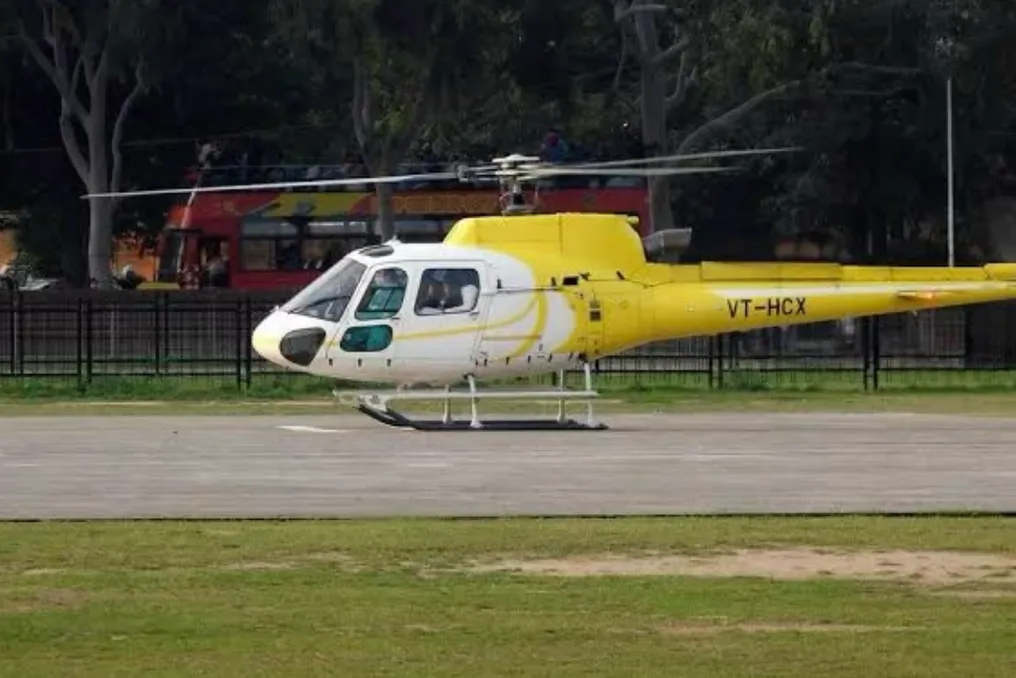
Several hours after the crash of an Aryan Aviation helicopter, in which seven people died, near Gaurikhand on June 15, 2025, the Ministry of Civil Aviation determined that two Trans Bharat helicopters involved in the incident on Friday were flying in conditions deemed unsuitable. As a result, the ministry suspended the licenses of both Trans Bharat pilots for six months.
Although the cause of the Trans Bharat crash on Friday, in which six people died, will only be known after the investigation report is published, there are alarming signs regarding this situation and the activities of several other helicopter operators in the mountainous region. The Uttarakhand government temporarily suspended the operations of the entire Trans Bharat fleet.
Industry insiders noted that six days before the Friday crash, another Trans Bharat helicopter carrying five pilgrims from Sahastradhara to Kedarnath via Guptkashi made an emergency landing at Bauari stadium on October 24. Fortunately, all six people—five passengers and the pilot—were unharmed, and the helicopter soon took off again.
Sources reported that on May 20, 2026, a Trans Bharat Bell 407 helicopter flying from Badrinath to Dehradun with seven people on board encountered strong downdrafts over the Chamba–Arakot sector in Tehri Garhwal. During the subsequent emergency landing, the tail section struck a 33 kV power line. The pilot, a former Indian Air Force pilot, managed to safely land all passengers without injury.
The Uttarakhand Civil Aviation Department (UCADA) is investigating this case. There is no single authority responsible for safety in the Char Dham corridor. While the DGCA issues licenses to operators and pilots, UCADA manages helipads, sets slots, and coordinates shuttle operations. The Parliamentary Committee on Transport, Tourism, and Culture, led by Sanjay Kumar Jha, labeled this system 'inherently unsafe and unsustainable' in August 2025, noting a 'vacuum of responsibility' between the two departments. The committee also observed that the DGCA functioned as a passive licensing body. Furthermore, it was noted that India still lacks mandatory training or certification for pilots operating in the Himalayas, considering the specific terrain.
The situation has significantly changed since last summer, following a series of helicopter crashes in Uttarakhand. Air traffic control units are being established; one now exists in Kedarnath, and another will soon appear in Badrinath. Routes have been defined in the region, and takeoffs are now limited in number and controlled in a set order with specific intervals. This is a drastic change from the almost unregulated helicopter movement in the mountainous region before last summer.
Captain Nitin Velde, a senior helicopter pilot operating in Uttarakhand, stated that 'many systematic improvements have occurred. Char Dham operations are extensive in all aspects. From commercial activity to maintenance, from operations to air traffic control—every department is working hard to ensure safety and achieve efficiency. After the 2025 season, many different measures have been implemented to comply with the highest safety standards. These include air traffic control in Sahastradhara and Sitapur to ensure coordinated and controlled flights.'
Captain Velde added: 'There is a fuel tanker in Sahastradhara to ensure optimal fuel supply from IOCL. The takeoff and landing pad is separated from the parking area to ensure an orderly flow of positioning. Surveillance cameras are installed throughout the valley, transmitting video feeds through a mobile application. Everyone can receive a live broadcast of the valley's weather conditions. For higher helipads above 10,000 feet, weight restrictions are in place, which guarantees a greater power reserve during landing and takeoff. Pilot training has increased since last year. Adequate training is available in the Char Dham sector, as well as for Kedarnath shuttles. DGCA FOIs staff visit the valley weekly, and the UCADA operations department is fully involved in real-time monitoring and support.' He concluded that 'Friday was a sad day when, apparently, the weather in the Badrinath valley's departure phase was bad.'