Francis Halzen, a naturalized American and Belgian citizen, was awarded the 2026 Nobel Prize in Physics for his fundamental work in the development of IceCube. This observatory is located deep within the ice at the South Pole in Antarctica and has the capability to identify high-energy neutrinos, providing new information about the most extreme environments in the Universe.
The topic was discussed on the Space View program this Friday (30), where physicist Alexandre Cherman participated to detail how IceCube aids in investigating the most intense cosmic phenomena and what neutrinos can reveal about them. Cherman, who is an astronomer, holds a PhD in theoretical physics, is a data scientist, educator, speaker, and author of eight books, and is also a co-author of the educational game Cosmic Real Estate, produced by Estrela Cultural. He currently leads the Astronomy department at the Rio de Janeiro City Planetarium Foundation.
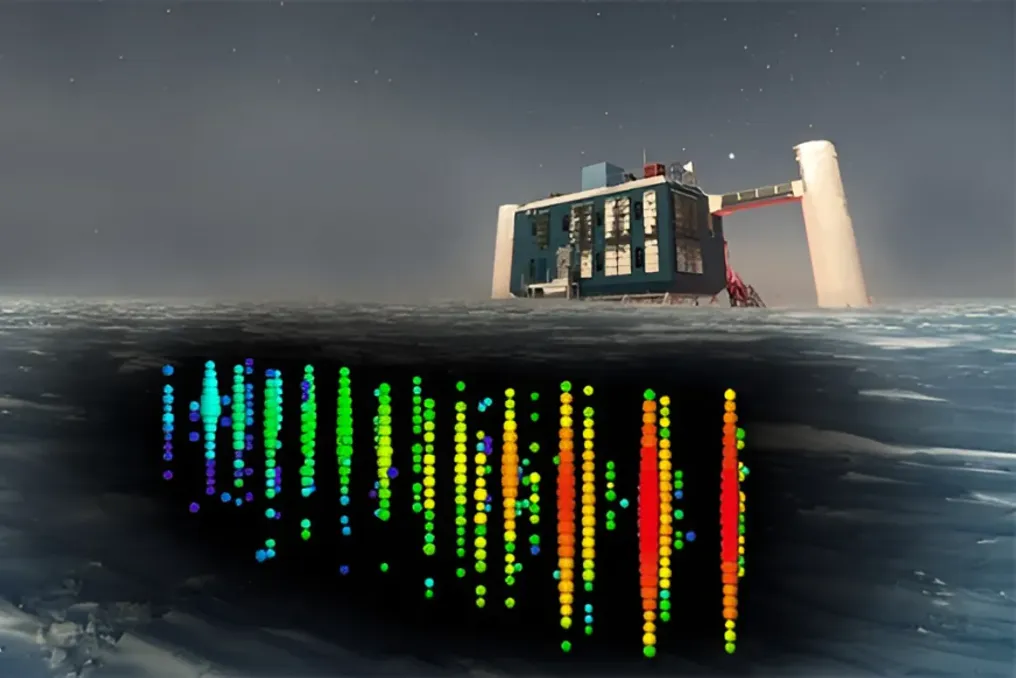
The concept of using Antarctic ice as a particle detector dates back to 1988. After more than twenty years of development, IceCube began operating in 2010. Its structure covers about one cubic kilometer of ice and is composed of 5,160 optical sensors distributed across 86 vertical cables extending between 1.45 and 2.45 kilometers in depth.
Neutrinos are subatomic particles that have no electric charge and possess very little mass. Generated in various natural events, they can pass through celestial bodies, such as planets and stars, and even the human body, interacting minimally with matter. It is estimated that approximately one hundred trillion of these neutrinos pass through a person every second.
The detection of these neutrinos occurs when they collide with an atom present in the ice, generating charged particles. These, in turn, emit a brief bluish glow known as Cherenkov radiation. The sensors capture these signals, allowing researchers to calculate the energy and determine the direction of the particle's origin.
Unlike conventional telescopes, which function by capturing light, IceCube focuses on observing particles. Due to the lack of electric charge in neutrinos, their paths are not altered by magnetic fields. This allows them to point towards the location of cosmic accelerators, meaning extreme environments capable of generating particles with energies far exceeding those achieved in terrestrial laboratories.
The discoveries made by the observatory have boosted the field of neutrino astronomy, which complements observations made with light and gravitational waves. IceCube remains operational and is receiving continuous improvements to increase its detection capacity, identify new sources of these particles, and aid in understanding the most extreme phenomena in the Universe.
Marcelo Zurita, president of the Paraíba Astronomy Association – APA, a member of the SAB – Brazilian Astronomical Society, technical director of the Brazilian Meteor Observation Network (Bramon), and national coordinator of Asteroid Day Brazil, presents the program, which is broadcast live every Friday at 9 PM (Brasília time) on the official channels of the outlet on YouTube, Facebook, Instagram, X (formerly Twitter), LinkedIn, and TikTok. The original content was published on Olhar Digital.