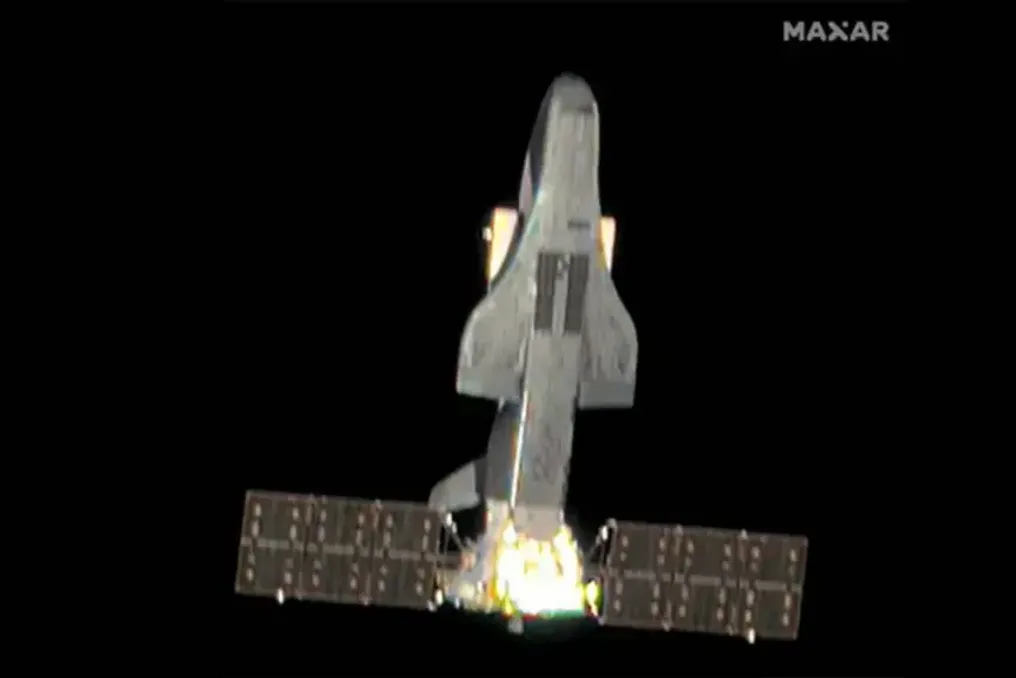
An image published by the U.S. Department of Defense's Defense Intelligence Agency (DIA) shows China's Shenlong spacecraft docked to another satellite in orbit. The photograph, taken in 2024, also reveals open hatches on the vehicle's cargo bay.
The recording was obtained by the Vantor WorldView 3 satellite from a distance of about 90 kilometers. Thanks to a resolution of 4.5 centimeters per pixel, the image provided details of the spacecraft that were previously only available to ground observers.
This photograph is part of a declassified DIA report concerning the scale and range of space threats posed by competing nations. The satellite to which Shenlong is connected has not yet been identified.
Shenlong, first launched in 2020, is a reusable robotic spacecraft developed by China. Since then, it has carried out numerous missions, some lasting for months in orbit.
The craft is currently on its fourth mission, which began in February 2026. China states that the project is testing technologies aimed at increasing the accessibility of round-trip flights into space, but it does not disclose details of its current activities.
In June 2026, the American space intelligence company LeoLabs detected a new object near the craft. After additional observations, the company concluded with high confidence that this object was released by Shenlong. LeoLabs reported at the time: 'This activity is consistent with satellite deployments performed by the spacecraft during previous missions.'
This incident aligns with patterns observed in other flights. During its second mission in 2023, Shenlong also released an object and may have conducted rendezvous and proximity operations, where two spacecraft maneuver to approach each other. Similar behavior was recorded during the third mission, which concluded in 2024.
Another example of such operations is presented in the DIA report. In November 2022, Shenlong allegedly conducted rendezvous maneuvers with a companion satellite, initially maintaining a distance of about one kilometer. At a certain point, both objects approached each other to less than 100 meters before a possible meeting and subsequent satellite deployment.
Such maneuvers can help test various capabilities of the craft, such as rendezvous, inspection of other satellites, and placing smaller objects into orbit. There is also a possibility that some equipment is deployed before returning to Earth. However, the actual purpose of these operations remains unknown.
China asserts that Shenlong is used to test reusable spacecraft technologies. After the mission that concluded in 2024, the craft returned to Earth after 268 days in orbit. The Chinese space agency stated that the experiment demonstrated the improvement of the country's reusable space transport technologies, which, according to them, could facilitate peaceful round-trip flights into space.
The United States also possesses the X-37B robotic spacecraft, developed by Boeing. Similar to Shenlong, little detail about its capabilities and missions is published. In February 2025, the U.S. Space Force released its first official photograph of X-37B in orbit. The image apparently showed the craft in high low Earth orbit with open hatches on the cargo bay.
China and the United States are striving to expand their space capabilities within a competition observers call a new space race. Both craft are classified military projects kept secret, and images like those published by the DIA provide records of their activities without fully revealing their capabilities or objectives.