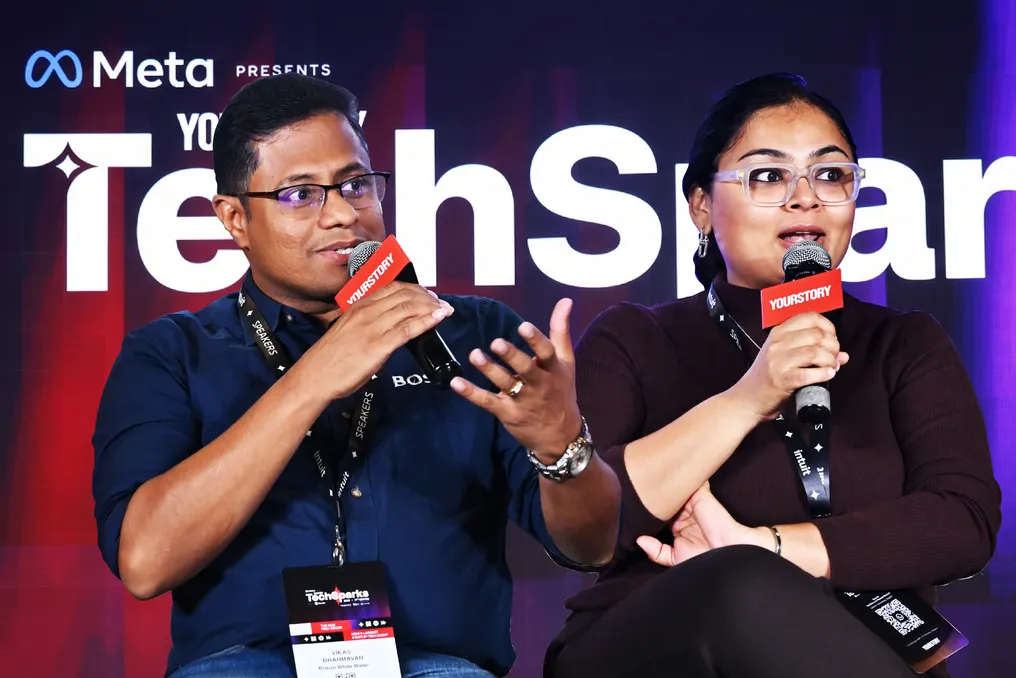
Although India's technological agenda is increasingly defined by artificial intelligence, data centers, and digital infrastructure, a more fundamental issue lies in ensuring the country has sufficient reliable electricity and water to support growing cities and industries.
At the TechSparks 2026 conference, during a panel discussion titled 'Invisible Infrastructure: Restoring India's Energy, Water, and Clean Air Systems,' Shreya Mishra, co-founder and CEO of SolarSquare, and Vikas Brahmavar, founder and director of Boson Whitewater, discussed the importance of scaling these solutions, which require more than just technological innovation.
Shreya Mishra, co-founder and CEO of SolarSquare, noted significant changes in the residential solar energy market in India over the past five years. When SolarSquare first entered the market, adoption was limited; consumers had a weak understanding of rooftop solar panels, and initial costs deterred many households. Nevertheless, the company believed that the economics of distributed energy generation and the need for energy security would ultimately drive growth.
Mishra stated that 'distributed solar power, meaning solar panels on every roof, will become the cheapest source of energy.' According to her, it took five years for one lakh (100 thousand) homes in India to switch to residential solar energy when the company started. Today, the country adds many homes every week, and SolarSquare has already powered over 60,000 homes.
However, economic factors alone do not alleviate consumer concerns. Rooftop solar panels require significant upfront payments, and households may worry about equipment reliability, maintenance costs, and whether the system will generate the promised amount of electricity. Therefore, for companies in this sector, building trust is as important as justifying financial viability.
Mishra also views distributed solar energy as a way to reduce the costs associated with long-distance electricity transmission. Although energy can be generated relatively cheaply, transmission and distribution costs can increase the final price for consumers. Her argument is that generating power closer to the point of consumption can help bridge this gap. Currently, SolarSquare serves both individual households and about 500 housing societies.
On the other hand, water presents a different challenge. Vikas Brahmavar, who transitioned from software to working on water reuse, reported that years of effort were required to create the necessary policy environment to support this sector. He explained that 'water, unlike the sun, has a fixed sun that shines,' emphasizing that wastewater treatment must account for changing water quality. The business also needs supportive policies and a viable economy to scale.
This necessity is becoming increasingly acute as cities and industries compete for ever-diminishing freshwater resources. Groundwater extraction remains the primary source of supply, while industrial needs, such as data centers, cooling towers, semiconductor manufacturing, galvanizing, and laundries, require substantial amounts of water. Brahmavar reported that over the past four years, his company has reused about 147 billion liters of water that would otherwise have been lost.
This opportunity is particularly relevant amid the expansion of data centers and the growing demand for water-intensive infrastructure. Reusing treated wastewater for industrial purposes can help reduce the strain on freshwater sources while creating a commercially viable market for recycled water.
However, the water supply economics can be counterintuitive. Brahmavar pointed to the Cauvery supply in Bengaluru, noting that consumers are billed around 7 rupees per kiloliter, while the government spends about 95 rupees per kiloliter to transport water from a distant river to the city. He suggested that this gap illustrates the problem faced by alternative water sources: the solution must compete not only with the availability of fresh water but also with how existing water supply systems are priced and subsidized.
If residential solar energy benefits from growing awareness of consumer savings, recycled water faces an additional hurdle—public perception. Brahmavar recounted how his company spent two and a half years engaging with over 300 housing complexes about the possibility of using recycled water, including for drinking. The response showed that convincing people to accept treated wastewater can be difficult, even if the purification technology is available.
Currently, the company is focused on industrial applications, where recycled water can replace fresh water without requiring consumers to overcome the same psychological barrier associated with consumption. In his view, 'technology is the least of the problems'; the more serious obstacles are commercial viability, public perception, regulatory compliance, and on-the-ground implementation.
Meanwhile, SolarSquare is moving beyond just installing rooftop solar panels. Mishra stated that the company aims to become a full-fledged home energy brand, expanding into batteries, electric vehicle chargers, home energy monitoring, energy optimization, and smart grid integration. The company also uses software for remote monitoring of installations and identifying issues. Mishra noted that monitoring data can help detect voltage fluctuations and recurring power outages, allowing the company to identify potential problems and recommend solutions, such as battery storage, where appropriate. She said such capabilities can improve customer service and reduce the need for physical inspections.
The experiences of SolarSquare and Boson Whitewater demonstrate two different stages of climate infrastructure development. Residential solar energy benefits from growing consumer awareness and a clearer financial proposition, while wastewater reuse is still working to overcome barriers related to pricing, policy, and perception. However, the common challenge for both companies is how to transform a technically viable solution into infrastructure that people and organizations can adopt at scale.