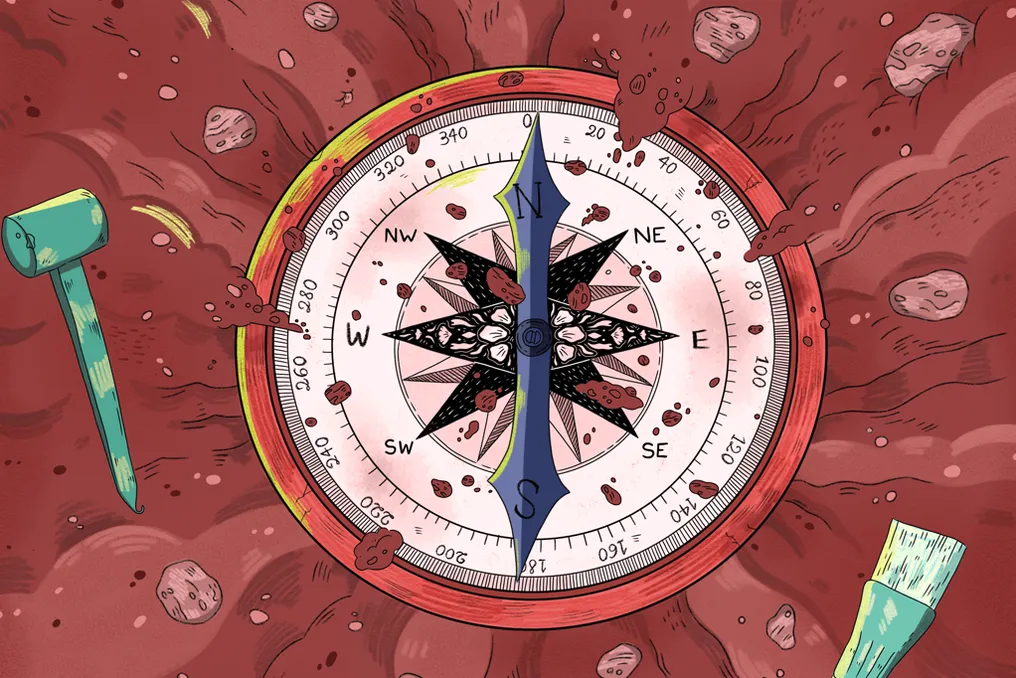
The exact origin of the compass, one of the most important instruments for navigation, is still a mystery. Ancient civilizations, including the Greeks, already had knowledge of the concept of magnetism. More than two thousand years ago, the Chinese demonstrated an understanding that magnetite could be used to indicate the north and south poles, although the exact moment this knowledge became a navigational tool for sailors remains uncertain.
The first European mention of the compass dates back to 1180, recorded in the book 'De Utensilibus,' written by the English theologian Alexander Neckam. However, there are indications that the Chinese were using rudimentary magnetic devices long before this period.
Considering the intense maritime activity of Arabs and Scandinavians during the twelfth century, it is reasonable to suppose that the compass may have been developed independently in different cultures. The first prototypes consisted of a magnetized needle floating in water, fixed to corks or small pieces of wood.
In subsequent periods, models of compasses emerged that did not use a liquid container. Although these models were practical, they were vulnerable to shocks and vibrations, which compromised directional accuracy. Only in the nineteenth century, thanks to technological advancements that solved leakage problems, did the liquid compass model become the standard, providing greater stability and reliability in navigation.
Even with the advent of modern technologies such as GPS, the traditional compass maintains its importance. For safety and redundancy reasons, contemporary aircraft and vessels still keep an analog compass on their panels. This age-old navigation instrument continues to be an essential element for orientation, proving its continued relevance in the history of navigation.