Researchers from Tsinghua University, Infinigence AI, and AgiBot have introduced a learning approach called Collective Experience Learning (CEL). This method allows robots to learn from the successes of other robots instead of relying primarily on human demonstrations.
According to a report published by QbitAI on October 30th, the team tested this methodology on a cluster of 96 real robots. The corresponding scientific paper is available on arXiv under the number 2610.25736.
The original problem that the researchers are solving relates to labor resources. Robots improve by accumulating practical experience, but today this is most often achieved through repeated movements by humans or operator intervention to correct errors. Although hundreds of robots can be deployed, qualified operators cannot be scaled at the same pace.
When using CEL, successful experience gained by one robot is saved and shared, allowing a robot facing a task to learn how its colleagues resolved similar situations.
Task Testing and Results
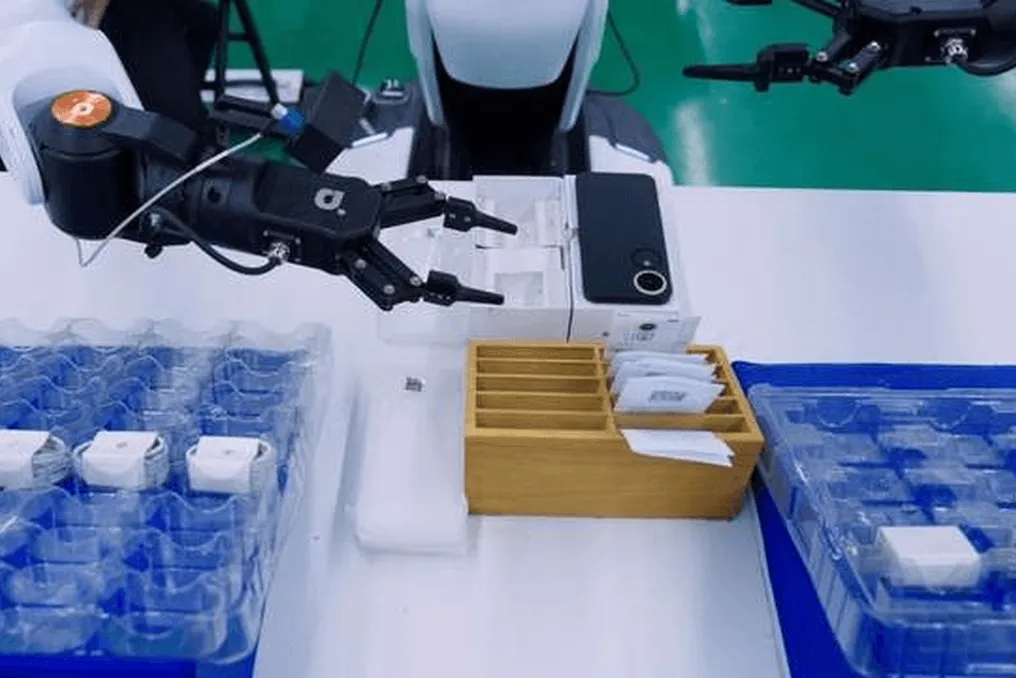
The team tested five different tasks covering both domestic and factory work: sorting colors, folding clothes, charging a phone, assembling a stool, and packaging a phone. Two robots not involved in the training performed 600 trials, incurring 15 failures, which resulted in an overall success rate of 97.5 percent. The success rate across all five tasks exceeded the average performance of six human operators.
Specifically, in phone packaging, which is a multi-stage industrial task, the success rate increased from 79.2 percent to 98.3 percent after applying collective learning, with only two failures recorded in 120 consecutive attempts.
A scaling trend was also noted: while keeping the same amount of real-time training, increasing the number of participating robots from 16 to 96 raised the success rate from 86.7 percent to 98.3 percent.
Technical Components of the System
The operation of this system is ensured by two key elements. The first is a fault-tolerant asynchronous learning system named FATS. This system is built on the open-source large-scale reinforcement learning platform RLinf. Robots upload their experience immediately after completing a task, without waiting for others, and the cluster continues to operate even if devices disconnect.
During the test with 96 robots, the cluster collected 9,834 episodes. Twenty-two robots had a total of 30 failures, but the loss of robot time was only 1.3 percent of the total operating time.
The second component is an algorithm called failure-guided experience retrieval fine-tuning (FERT). One manipulation can last minutes and involve thousands of action steps, but feedback often boils down only to final success or failure. FERT uses both aspects: when a robot encounters difficulties, it retrieves successful experience from analogous situations and focuses the learning specifically on these examples.
The report was provided by Infinigence AI. The results are presented by the research group and have not yet undergone independent verification.