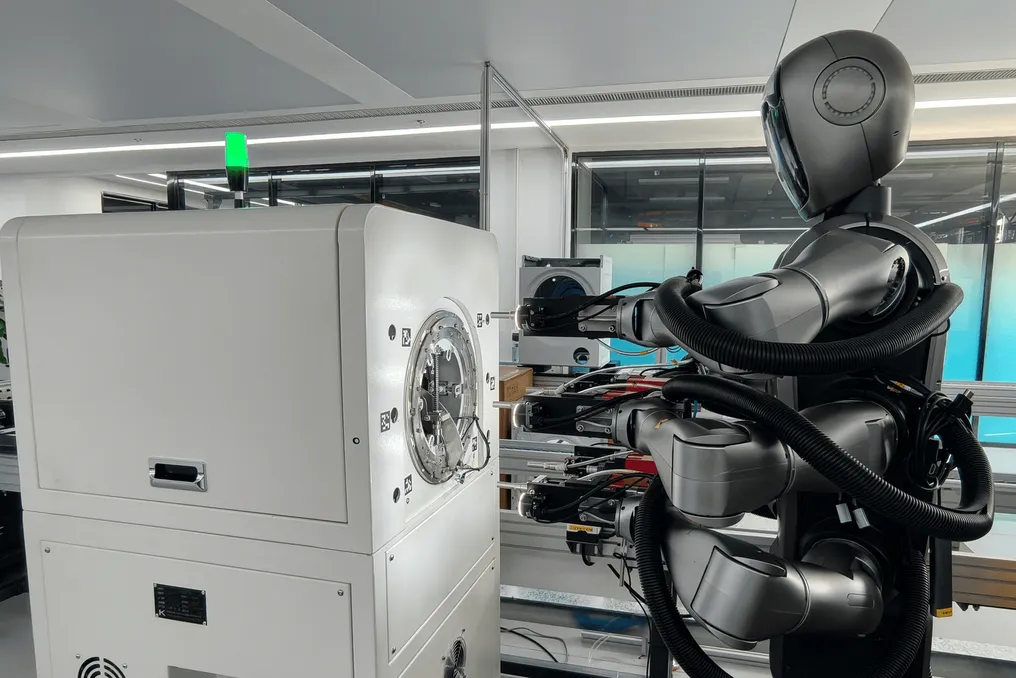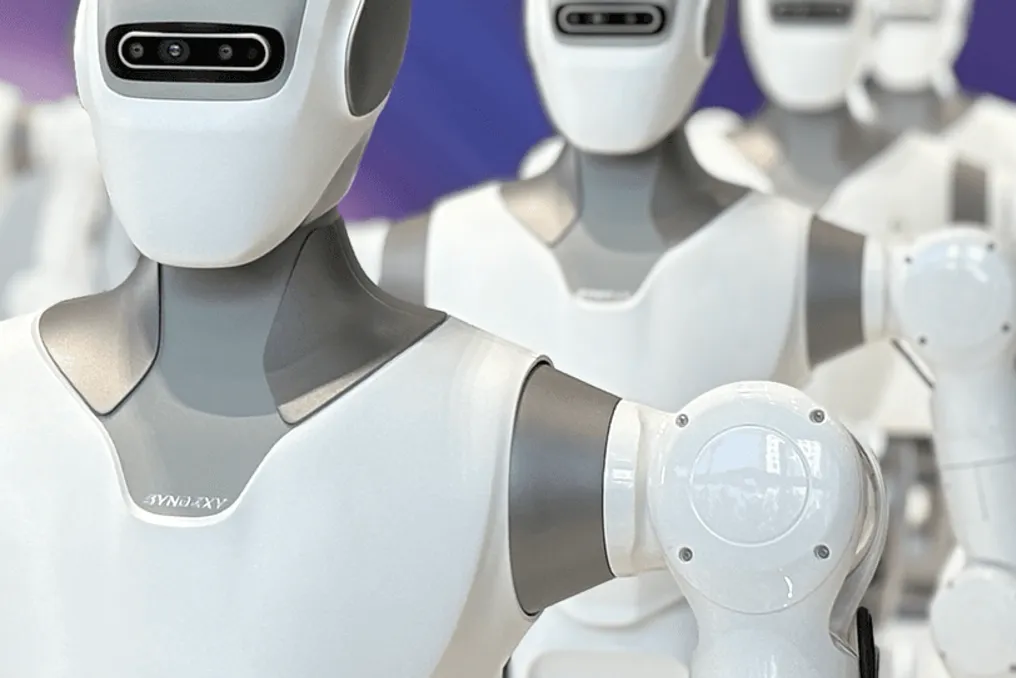
Beijing-based embodied AI company SynDexy announced on October 30 that it has successfully completed the initial small-batch shipment of its SynDexy C1 dexterous humanoid robot. This marks a transition for the product from the research and validation phase into engineering delivery and actual deployment.
These robots are intended for executing precise assembly procedures within customer factories specializing in consumer electronics and electronic components, tasks that require a high degree of consistency and accuracy. During preliminary testing, SynDexy reported that the C1 unit achieved a success rate exceeding 98 percent when performing critical operations.
The C1 model is a wheeled, two-armed humanoid. Its primary advantage lies in integrating both visual and tactile capabilities. Hardware-wise, it incorporates proprietary visuotactile sensors, which the company claims provide micron-level spatial resolution and highly dynamic fine sensing, enabling the robot to grasp objects dexterously and handle them compliantly in real time. Software functionality is managed by SynDexy M1, a manipulation model that merges data from vision, touch, and force. SynDexy refers to M1 as the first model of its kind, although this assertion has not been substantiated with external benchmarks.
The robot possesses 22 degrees of freedom throughout its structure and operates its motion control system on a 1-millisecond cycle. The development cycle was notably brief; work on C1 commenced in April 2026, the first prototype was finalized in July, and the initial small batch was dispatched in October, totaling approximately six months. The company credits this rapid progress to establishing the product requirements based on genuine production line demands from the outset.
Founded in 2025, SynDexy develops its own robotic hardware, visuotactile sensing technology, and manipulation models. The company targets high-precision manufacturing sectors, including automotive parts, semiconductor micro-components, and consumer electronics. Fang Bin, the chief scientist, holds a professorship at the School of Artificial Intelligence at Beijing University of Posts and Telecommunications, bringing over a decade of experience in embodied perception, interaction, and dexterous manipulation. The core development team comprises members from institutions such as Tsinghua University, Beihang University, Harbin Institute of Technology, and Beijing University of Posts and Telecommunications, alongside contributions from Huawei, DJI, and Tencent, with researchers constituting over 90 percent of the workforce.
Handling delicate items like small connectors and flexible materials in electronics plants presents a significant challenge for robotics due to part variability and minimal tolerance for error. Touch sensing is identified as a key method through which industries are attempting to overcome this difficulty.
SynDexy intends to maintain its focus on high-precision dexterous manipulation within industrial applications. The company chose not to disclose the identities of the customers who received the initial robots or the exact quantity delivered.