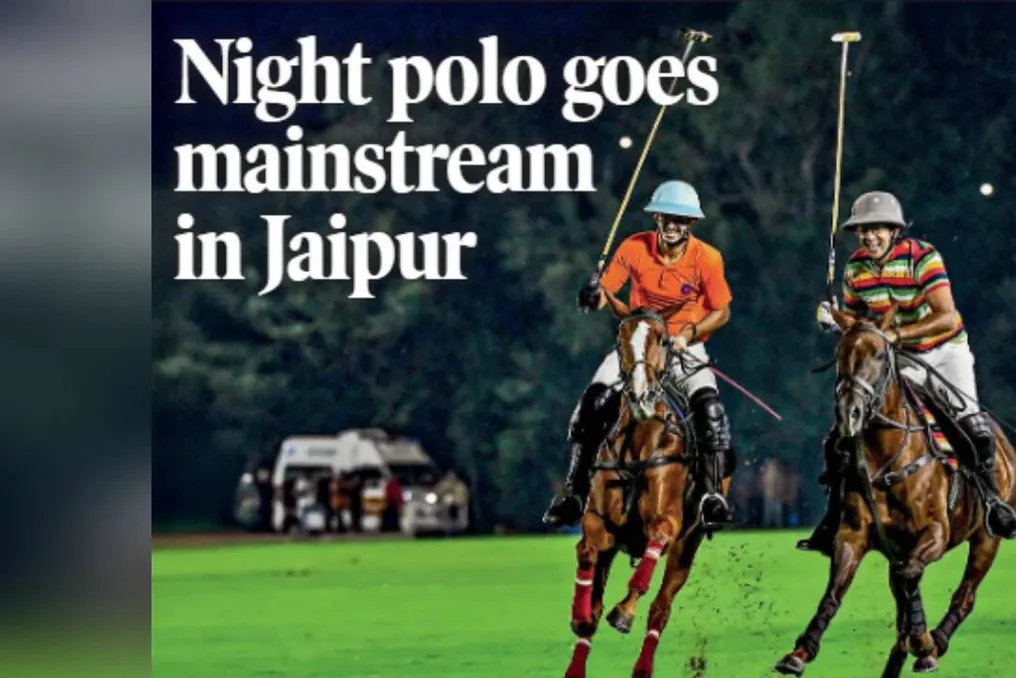
Polo in Jaipur has become more accessible to spectators. Matches at the Rambagh Polo Club field now start at 7:30 PM, allowing office workers to attend games after work and families to watch matches after the daytime heat subsides.
In the last couple of months, 10 new floodlights have been installed in the area near the Vidhan Sabha and the high court. In the district where the lights over the Sawai Man Singh stadium long signaled the IPL season, there is now another reason to stop by to watch a match.
The stands are filled with young fans watching their first game, taking selfies, and getting acquainted with the sport, whose usual audience mainly consisted of royal families, cavalry, and club circles. Despite this, one can still see wide-brimmed hats, pastel linen jackets, and chiffon saris. The club hopes to provide more reasons to visit.
The 'An Evening At The Polo Night' format was previously held in Hyderabad and Noida on smaller sand-covered arenas. However, the matches in Jaipur take place on a full-sized grass field under lighting as part of the official tournament schedule.
For Major Anat Rajput, from 61 Cavalry, an experienced player, the advantage is obvious: more people can come to watch. He notes that previously matches and finals were held during the day, which severely limited accessibility for both men and women. According to him, the development of any sport occurs when the number of spectators increases, which in turn stimulates interest in the sport or investment in it.
In this center of 'kings' sport', horses and riders regularly take to the field under floodlights hoping to attract a wider audience, promote tourism development, and preserve some of the city's heritage, writes Mandakini Shali.
For Padmanabh Singh, a 28-year-old Indian polo captain and descendant of the former royal family of Jaipur, encouraging spectators is also part of maintaining the city's tradition. He emphasizes that he has always viewed polo as inextricably linked to the culture of Jaipur. In his opinion, Jaipur is one of the main polo centers in the world and has contributed much to the sport; many landmark moments happened right here. Therefore, when talking about preserving and restoring culture and heritage, he implies polo, as it is part of tourism.
Rambagh Polo Club actively promotes this sport with the support of the Rajasthan tourism board. Padmanabh's mother, Diya Kumari, holds the position of Deputy Minister and Minister of Tourism. Last month, a delegation from the UAE visited Jaipur to discuss cooperation in polo, horses, and tourism, showing particular interest in the Marwari horse, a local breed of Rajasthan.
Padmanabh reported that the delegation was very interested in observing these horses. They discussed opportunities to encourage active cultural exchange between the UAE, Rajasthan Tourism, and Rambagh Polo Club, noting their willingness to support polo and ensure global recognition for this magnificent breed that has served Rajasthan for centuries.
Access to a suitable field remains a problem. Active polo communities supported by the Army, professional players, and corporate sponsors exist in Delhi, Maharashtra, and West Bengal. However, Rajput worries that changing venues could harm the sport, spectators, and sponsors. He recalls that the finals of all elite tournaments in Delhi were traditionally held at the Jaipur Polo Ground, located in the heart of Delhi. Unfortunately, this field was lost several months ago, and now more matches will be held at the Army Polo and Riding Centre. He regrets the loss of the central Delhi ground, as more spectators and sponsors gathered there, and this number will now decrease.
He sees encouraging signs in the increase in the number of young players involved in the sport. Rajput added that the number of imported horses increases annually, as does the number of children wishing to participate in competitions. If there were about four teams in the Junior National Championship before, there are now six or seven.
Although polo remains an expensive pursuit, schools help introduce children to it. Many educational institutions, such as Mayo and Delhi College, offer equestrian and polo lessons, and they are developing very well.
Demand for lessons in Jaipur already exceeds the capacity of the Sawai Man Singh Polo School and Academy. Padmanabh mentioned that this school was founded several years ago and is unique in its kind, showing excellent results. It has 50 students, which is the maximum capacity, and it has had a waiting list for the past three years. Due to the limited number of horses, they cannot accept more students, but the school is located in the city center and is subsidized by the polo club. Padmanabh donated some of his horses to the academy and often visits to mentor the students. When someone achieves success, he takes them out for training with him.
Padmanabh noted that the experience of playing polo in Jaipur after dark spans over a century. He described a brass ball for night polo with a small candle inside, used by women who played at night. When matches are held under floodlights at Rambagh, the horse regimen needs to be changed. Matches fall during what is usually their dinner time. Padmanabh stated that this does not cause major changes; they just need to adjust feeding times, so they have to adapt schedules.
The horses have successfully adapted to the later times without problems. He added that they feel better because they avoid the daytime heat and do not have issues with food, water, or rest.
}} , 3.