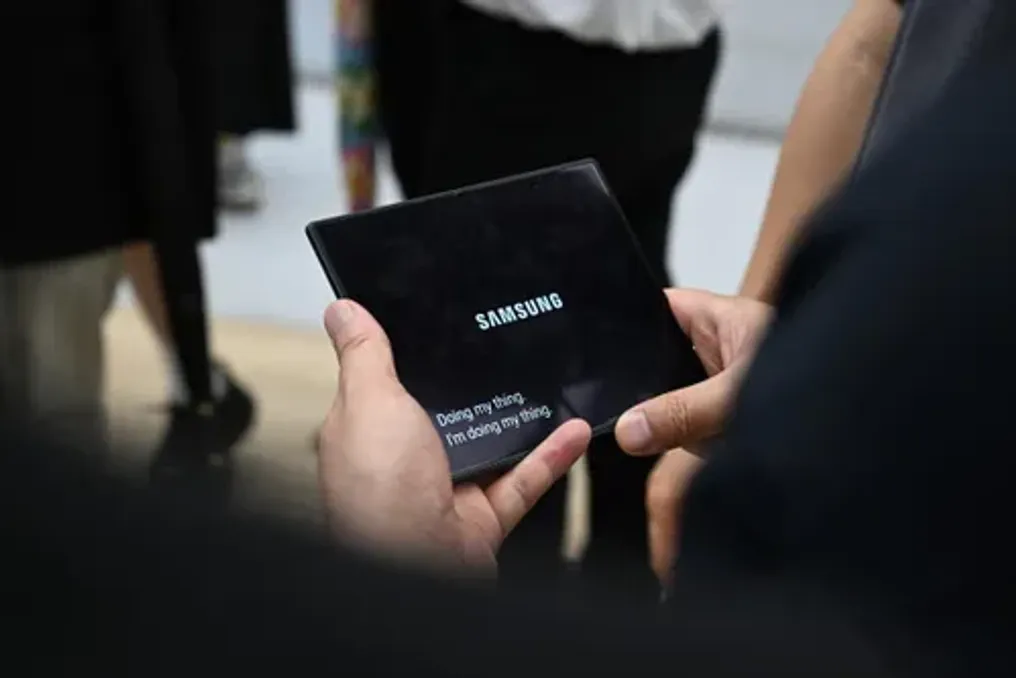
Samsung has presented one of the boldest advertising campaigns targeting Apple following the release of the new iPhone Duo device. The advertisement begins with an image of the device opened about three-quarters, displaying a bright green apple on the screen. When the phone closes, the apple instantly slices into many pieces, leaving only a thick cross-section.
This remaining slice begins to rotate continuously, like a wheel, passing by all generations of Samsung foldable devices—from 2019 to 2026. Eventually, the rotating slice stops next to the new Samsung Galaxy Z Fold 8. Side by side, it becomes obvious that the apple slice is noticeably thicker than the Fold 8 itself. Then, large text appears on the screen: 'Nowhere to hide. 1.6 mm thinner and 53 grams lighter. Galaxy Z Fold 8: Years ahead in foldables.'
The timing of this commercial broadcast proved to be extremely timely. Recently, a serious debate arose surrounding the iPhone Duo, as numerous user reports appeared online detailing cracked displays after just the first week of normal daily use.
This developing situation is reminiscent of Apple's original 2008 MacBook Air presentation—a landmark moment when Steve Jobs unveiled the ultra-thin laptop from an envelope, putting all competitors at a disadvantage regarding thinness.
However, unlike early ultra-thin gadgets of the past, the iPhone Duo does not suffer from performance issues as it is equipped with the powerful A20 processor. Instead, its main vulnerability appears to be its physical hardware. This first wave of screen failures convincingly suggests that Apple may have released its first foldable device to the market before achieving perfection in display durability, leading to a noticeable percentage of defective units.
Nevertheless, it should be noted that the vast majority of iPhone Duo owners use devices that function flawlessly, meaning online complaints do not necessarily reflect the personal experience of every buyer. Nevertheless, the frequency of these screen failures is concerning, especially since Apple has not yet issued an official public statement on the matter.
It is precisely this context that makes Samsung's advertisement, released just a week before these display defects became known, so witty. It serves as a clever, triumphant acknowledgment from Samsung, sending a clear message to the market: 'We know exactly what we are doing with foldables, while Apple is still overcoming the initial stage of development.'