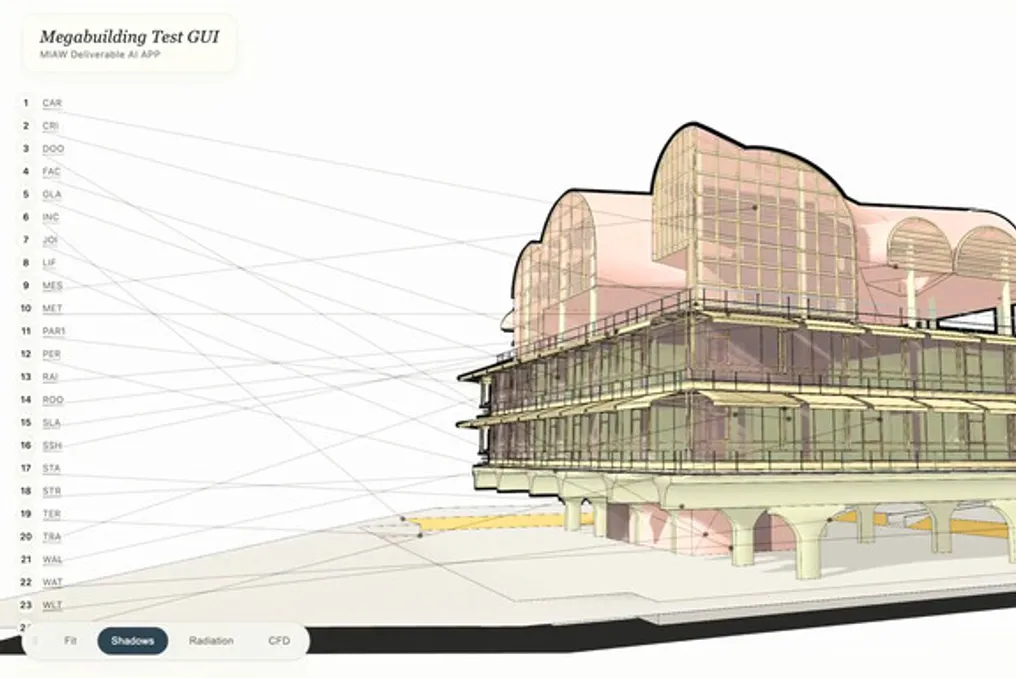
Artificial Intelligence (AI) has rapidly evolved from an academic discipline into a consumer product. The constant appearance of new models and the vast amount of information make critical consumption difficult, requiring architecture to adopt a method-based and critical analysis approach.
Currently, AI is developing spatial intelligence, which is the ability to understand the behavior of physical space. This allows architecture professionals to evaluate projects in relation to their environment even during the conception phase. When used wisely, AI can connect architects to the complexity of nature, elevating the quality of construction practice, as we simulate the world to learn how to inhabit it.
The tool as a designer of humanity
Historically, humanity has undergone major transformations in its lifestyle every few centuries. The Industrial Revolution reduced this frequency to just a few generations. AI has drastically accelerated this cycle of change at an unprecedented pace.
Citing Jean-François Lyotard, it is true that technology was not created by humans, but rather the other way around. In a scenario where tools shape humans faster than ever, the question arises of how to direct our own evolution to achieve a symbiosis between natural and artificial intelligences, and what competencies are necessary for AI to shape us positively.
AI offers a new chance to expand individual possibilities, from the first books that enabled mass education, through unlimited access to information via the internet, to the navigation and creation capabilities provided by AI.
From language to world models
Large Language Models (LLMs) learn about the world through textual descriptions. They operate by predicting text sequences based on statistical patterns, imitating human speech and reasoning using large volumes of data and simple probabilities.
In contrast, world models are systems designed to understand the functioning of an environment—including its physical rules, spatial dynamics, causal states, and functional structures—allowing for the prediction of new behaviors. Fei-Fei Li describes current LLMs as 'word artisans in the dark,' eloquently speaking about a three-dimensional world without ever having physically interacted with it, arguing that spatial intelligence is the next great advance in the field.
For architecture, this distinction is crucial. A text-based model cannot predict how physical and social reality will react to a project, whereas a spatial model allows for simulating scenarios, testing the proposal against factors such as gravity, wind, solar incidence, wear, and human use. Dynamics like thermal diffusion, moisture absorption, pollutant dispersion, and human flow provide feedback that guides project development, rather than simply imposing a form upon them.
Although simulation can inform decisions, it should not assume final responsibility. It is essential that there are professionals with clear criteria and discernment, using AI as a responsible analytical tool, and not merely as a productivity booster. The architect becomes less a creator of forms and more a designer of knowledge systems, being evaluated by the ability to anticipate developments in a complex and often uncertain reality; the human element remains in the process.
Mindhub for Artificial Intelligence Intelligent Worlds
Spatial intelligence demands hybrid professional profiles, capable of integrating design with computational engineering and materials science. The Mindhub for Intelligent Artificial Worlds (MIAWS), located at ETSAM, Polytechnic University of Madrid, functions as a digital center focused on the entire AEC sector, structured around this technological transformation. This hub unites original research with a global network of institutions and experts.
Its Foundations program is offered online in ten modules, guiding participants from AI-assisted modeling and simulation to data visualization and integration. The purpose is to allow participants to keep up with technological advancements while maintaining critical discernment, inviting interested parties to learn about the program and participate in this change.