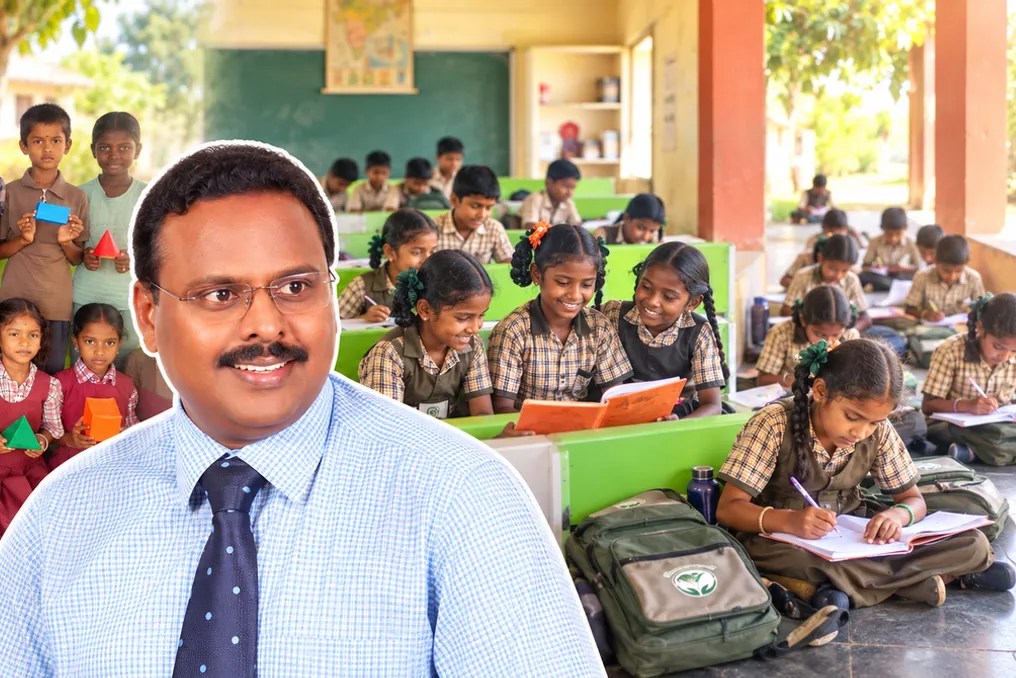
Once, Paturi Namrata Siri, a student from the village of Yernagudem in Andhra Pradesh, faced difficulties in obtaining an education because her family had limited resources and she lacked study materials or after-school support.
Her experience is similar to that of Bethala Vira Swami, who is now 58 years old and grew up in the same village many decades ago. He recalls that his parents were agricultural laborers, and the family's life depended entirely on daily earnings.
Despite the hardships, his parents encouraged his studies. After finishing primary school, he continued his education at college and later enrolled at Osmania University in Hyderabad for mechanical engineering from 1986 to 1990. Since 1991, he started his career working across India and abroad, including Nigeria, Kuwait, and the UAE, and today works as a lead contract engineer in Abu Dhabi.
However, what he saw in Yernagudem stayed with him. He noticed that children his age dropped out of school not due to lack of ability, but because their families could not afford to continue their education. He was struck by the inequality of opportunities, which was related not to intelligence but to access to education.
The Village He Remembers
In 2010, while talking with old friends in Yernagudem, Swami began discussing how they could give back to the community. Their answer was education. They decided to 'gift education' to children, later named V-Kids, starting with their own village. On January 13, 2011, Pragati for Rural Development Association was registered as a society, which later became known as PARD INDIA.
Swami, working abroad, continued his career while he and his friends created this initiative, utilizing their existing jobs, local volunteers, and people from the communities they wished to help. The first program was launched in August 2011 at the special government MPP school in Yernagudem, where Swami himself studied, starting with 50 children from the 4th and 5th grades.
What Happens When the School Day Ends?
For many children in these villages, the main problem was finding someone to help them with their studies after classes. Parents often worked as agricultural laborers or in other jobs with daily pay and returned home late, having no time to help with lessons. Swami and his friends aimed to bridge this gap. Their first initiative, the After School Education Program (ASEP), provided children with the opportunity to continue learning under guidance after regular school hours.
ASEP runs from 3:30 PM to 5:30 PM six days a week, offering children two hours of guided learning. They receive help in mathematics, English, natural sciences, moral education, and computer skills. Time is also dedicated to reading, sports, drawing, debates, competitions, storytelling, guest lectures, and tree planting.
Teachers monitor attendance and contact parents when children start skipping classes. The program is also designed to identify warning signs before a child completely drops out of school. PARD INDIA tracks attendance and collaborates with teachers, parents, and local volunteers during regular absences. Swami notes that the reasons are most often related to circumstances outside the classroom.
He explains that poverty remains the biggest obstacle to education. For families living on daily wages, education can seem like a luxury, and when they have to choose between sending a child to school and meeting urgent financial needs, education is often sacrificed.
However, the financial issue is not the only one. He adds that 'the problem goes beyond finances.' He emphasizes that rural children possess the same intelligence and ambition as their urban peers, but they lack access, mentorship, digital access, and a supportive learning environment.
Bringing Computers and New Opportunities to Villages
The initiative gradually added other forms of support to address various issues that might interrupt a child's education. The Village Knowledge Center Program (VKCP) started in August 2012. At that time, internet access in many villages was limited. Swami personally contributed 8 lakh rupees and helped create a center with 15 computers. Children could learn basic computer skills and use programs such as Word, Excel, and PowerPoint. The center operated for almost eight years.
Over time, the computers became outdated. Now, the team hopes to update and expand the program with the support of Corporate Social Responsibility (CSR) and has sought funding from several organizations. In addition to computer literacy lessons, the program also offers career counseling and personal development sessions. For Swami, the idea was simple: children growing up in villages should have the same chances to learn new skills and explore career opportunities as children elsewhere. He wanted them to feel confident in themselves and know that their circumstances should not limit their ambitions.
Two years later, in July 2014, PARD INDIA launched the V-Kid Scholarship Program (VKSP). This program supports children who might otherwise face difficulties continuing their education due to financial circumstances, focusing particularly on orphans, children of single parents, and economically disadvantaged families. Students apply according to established criteria, after which the organization tries to connect suitable children with local donors. Support can range from the 1st grade through graduation.
The team also runs the V-Kid Knowledge Enhancement Program (VKKB), through which children are selected based on merit-based tests and receive long-term scholarships. In 2017, Vamisetti Ganesh from Mandal Devarapalli participated in such an exam. His parents were daily wage laborers, and it was always difficult to cover all the family's needs. He ranked fifth in the VKKB exam and received an annual scholarship of 800 rupees for six years, covering his education from 6th to 10th grade. The scholarship was supported by Mr. Nageshwar Rao, one of the donors.
Ganesh noted that thanks to the scholarship, the pressure related to family and educational expenses decreased, motivating him to take his studies more seriously and set higher academic goals. Today, he continues his higher education.
For Madhuri from the village of Yadavolu in East Godavari district, the scholarship provided similar continuity. She was also from a daily wage dependent family and received a six-year scholarship through the VKKB program, covering the period from 6th to 10th grade. Today, she is pursuing secondary education in Zangareddigudem and hopes to become an engineer. The difference is not always visible from one exam; sometimes it means the child goes to school next year.
Yangala Uma Maheshwari from Gopalapuram shared that education became especially difficult for her after losing both parents. She had been associated with PARD INDIA since she was six years old and received support under the VKKB scholarship program. When she lost her parents, the organization continued to support her. Her support went beyond the scholarship: 'During that difficult period, the team stood by me and provided me with emotional as well as academic support. Their constant care gave me the strength to move forward.'
From 50 Children to Over 110 Villages
What started with 50 children in Yernagudem has since spread to Andhra Pradesh and Telangana. The non-profit organization now operates in over 110 villages and has impacted more than 550 communities. Its activities have covered places such as Chipurupudem, Dubacherla, Nallajarla, Chinnagudem, Devarapalle, Tiadjamudi, Yadavole, Duddukuru, Gopalapuram, Rajamandri, Kakinada, Vijayawada, Abdullapurmet, Kuntloor in Hyderabad, Jafarguda, Rajivgruha Kalpa, Matuguda, and rural areas around Visakhapatnam.
As of March 2026, the organization reports 116,841 direct beneficiaries, including children and the elderly, and 90,494 V-Kids supported by its programs. Its work has touched 492,567 lives through education, healthcare, nutrition, and community empowerment. Within educational activities alone, ASEP provided 569,419 hours of free education for 3,165 children in 79 villages as of March 31, 2026.
The Village Knowledge Center Program provided 33,999 hours of IT training for 538 children and youth. More than 30 students received annual scholarships through VKSP. These figures cover various programs, each addressing an issue that could affect a child's education. A child should not drop out simply because there is no one at home to help with a difficult lesson, because the family cannot afford education, or because the child has never been shown what is possible outside the village.
Namrata is one of the children still early in this journey. As a 5th-grade student, she says her after-school sessions helped her understand complex lessons and gave her individual attention when she struggled. She notes that teachers encouraged her and reminded her that she could achieve more when she doubted herself. Her confidence has also changed: previously, she would sometimes hesitate when facing difficult subjects or tasks, but now she feels more comfortable tackling them.
Today, she dreams of becoming a revenue collector. She wants to finish her studies and build a successful career, as well as inspire other children to continue their education and never give up on their dreams. For Swami, these very ambitions are the reason the work must continue. He believes that the greatest reward of this 15-year journey has been watching children who once risked dropping out of school now dream of becoming engineers, doctors, teachers, entrepreneurs, civil servants, and community leaders.