In the Iraqi village of Abu Hasaf, near the home of the Khalima Flayh family, stands a small concrete structure. This structure was built by Flayh and her sons by hand to create a place for friends and family gatherings. However, the roof collapsed due to years of harsh weather and neglect.
The ground around this small building has cracked and dried up—a consequence of climate change exacerbated by several government decisions that, according to critics, prioritized oil extraction over the ecological needs of this sensitive region. Nevertheless, the Flayh family refuses to leave the site and plans to turn the empty room into a monument to the past life they knew on the outskirts of the Hawizeh marshes.
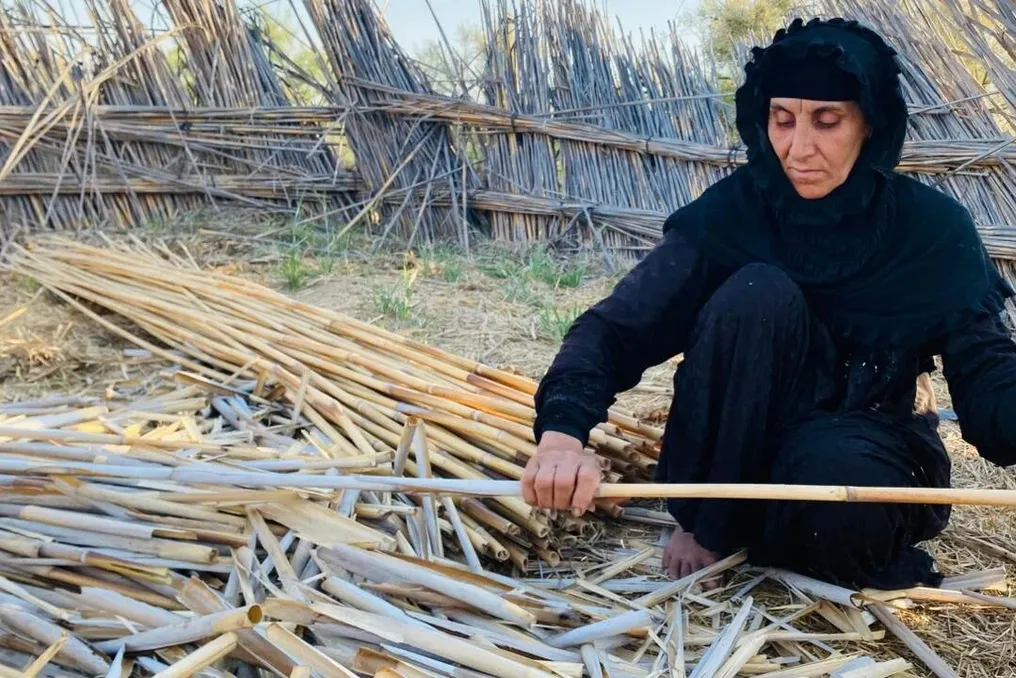
Flayh states that if the water does not return, future visitors and their children must learn how the Maadan people lived in harmony with these wetlands. The planned micro-museum will showcase traditional marsh culture, including Barya carpets woven from wild reeds, cotton-thread fishing nets, and paddles for the mashuf, a narrow boat used by the Maadan people to navigate local waters.
According to Flayh, the goal is not just to preserve the structure erected by the family almost two decades ago, but to create a sustainable archive of a community that is on the brink of disappearance. She emphasizes that this will not just be a collection of artifacts, but the last defense against the complete erasure of Maadan identity.
A Unique Sanctuary
The Hawizeh marshes, stretching approximately 350 kilometers southeast of Baghdad, lie on the border between Iraq and Iran. Ten years ago, these ancient wetlands were inscribed on the UNESCO World Heritage List, recognized as the cradle of human civilization and a unique biodiversity reserve.
For millennia, the marshes survived through delicate symbiotic relationships between the ecosystem and local residents, especially women, whose labor long formed the economic and social backbone of the community. Women provided for their families by milking water buffaloes for kaymar cheese, weaving Barya carpets, and gathering fish to sell in neighboring city markets.
However, this way of life is now under threat. Years of drought have devastated the fragile landscape in the region, where temperatures can reach 50°C in the summer. Intensive development activities, including upstream dams and the expansion of oil extraction sites, have further blocked water flow into these vital marshes. Some residents believe they are being deliberately displaced for heavy industry.
Flayh's son, Mustafa, told the Ministry of Foreign Affairs that earth embankments built by the state to protect their wells and facilities have cut off their access to water, and the operations of these facilities consume water quotas. He added that his family now has to buy drinking water to meet daily needs.
A study published in March this year by the London School of Economics Middle East Centre showed that a massive earth embankment built around the marshes in 2022 as part of a state initiative to combat cross-border drug trafficking significantly restricted water inflow. The consequences were evident: 'Dust replaced water, reeds died, buffalo herds became sick, and entire communities were forced to migrate.'
Researchers noted that in recent years, hundreds of families from four local villages have been displaced, calling it a 'planned catastrophe.' By 2024, one-fifth of the population displaced due to environmental reasons in Iraq originated from Maysan province, where the Hawizeh marshes are located.
Although Iraqi officials publicly deny any link between the oil industry's development and the depletion of the marshes, a recent investigation by Daraj Media found that several oil and gas exploration licenses overlap with Hawizeh and other protected areas in the south of the country. The Chinese company Geo-Jade Petroleum received a contract to develop one such field, HWZ 1, located in the Hawizeh marshes. According to Save the Tigris, a civil rights group advocating for water justice in the Mesopotamian basin, the oil extraction zone overlaps with the UNESCO protected area by 300 square kilometers.
A legal department document from the Ministry of Oil, obtained by the MFA, shows that although Geo-Jade's 20-year investment contract came into force in 2023, the environmental impact assessment was only completed the following year, after fieldwork had already begun, according to local observers. The environmental impact assessment report was not made public.
Water Delivery
Other government documents obtained by the MFA shed light on the intrusion. In March 2025, the state Iraqi oil exploration company sent a letter to the Ministry of Water Resources requesting assistance with exploratory work in the Hawizeh marshes, including the creation of 10-meter wide paths and the drilling of power supply points.
A subsequent letter from the Ministry of Water Resources confirmed that the location of the proposed work overlaps with the core of the UNESCO protected area. The MFA contacted the Iraqi Ministry of Oil and representatives of Geo-Jade for comments on the nature and timing of these works, and requested clarification on measures to mitigate potential damage, but received no response.
Hussein Ali Al-Kinani, director general of the Center for Restoration of Iraqi Marshes and Wetlands under the Ministry of Water Resources, stated that the state actively monitors infrastructure to protect the ecosystem. He explained that a high-level joint committee, including representatives from the Ministries of Water Resources, Oil, and Environment, regularly reviews the spatial overlap between oil concessions and wetland reserves.
Al-Kinani noted: 'If it is proven that any earth embankments or oil installations impede water flow or divert natural paths, directives are issued to cease these actions and rectify the damage,' adding that the water feeding the marshes 'is not used in oil pumping operations.'
Murtada Al-Janubi, an environmental activist, noted that the government provides emergency aid by sending water tankers to meet the daily needs of residents. However, local residents describe a completely different picture. In Abu Hasaf, residents claim that government water tankers are virtually non-existent, and families spend up to 60,000 Iraqi dinars ($45 USD) daily on small private water trucks to sustain themselves and the remaining buffalo herds.
Al-Janubi told the MFA: 'The drought has continued for nine months without a drop of water in the river. Government tankers came maybe once or twice to serve a tiny part of the village, and then disappeared.' Flayh's son, Mustafa, added: 'We have to carry water ourselves on motorized tricycles using plastic jerrycans. We have never received a drop from government tankers. The reality is that they leave us to buy our own survival.'
Devastating Impact
Local activists are increasingly expressing disagreement, warning that oil exploration in the area threatens to damage an ecological treasure. In April, Save the Tigris sent a letter to UNESCO, noting that due to the fragility of the marsh ecosystem, such actions 'will have a devastating impact.' The group also pointed out that the exploration work coincides with the 'almost complete cessation of water flow from the Karheh River in Iran' due to dam construction, urging Iraqi authorities to immediately ban all oil-related activities around the Hawizeh marshes and begin restoration work in areas affected by desiccation and oil projects.
In addition to HWZ-1, Save the Tigris highlighted the impact of oil installations on the neighboring Halfaya field, where pumping stations draw large amounts of fresh water, further drying out the marshes. Satellite images of the Hawizeh marshes, obtained by AFP from Planet Labs last year, revealed visible signs of heavy machinery. One resident told the agency that he saw workers laying cables and drilling holes, while leaked photos and videos geolocated by Guardian showed excavators and pipelines in the heart of the protected area.
Al-Janubi stated: 'The situation on the ground signals a complete catastrophe.' He collected photo and video evidence of heavy machinery operating 'deep inside the Hawizeh oil field' near the core of the protected area, as well as footage of oil spills elsewhere in Maysan province. The Constitution of Iraq guarantees all citizens the right to live in a healthy environment and directly protects the country's biodiversity. However, critics argue that the state risks violating these obligations by allowing oil companies to directly invade the marshes and contributing to air pollution, a byproduct of heavy industry.
According to the Dutch NGO Pax, Maysan province has dozens of pollution sources generating an annual climate effect equivalent to 22 million metric tons of carbon dioxide. The company IQAir, a Swiss air quality technology company, ranked Iraq 11th in the world for air pollution levels in 2025. Methane emissions and gas flaring contribute significantly to emissions in southern Iraq.
Amir Hassoun, spokesperson for the Iraqi Ministry of Environment, told the MFA that the government monitors violations by oil companies and their impact on health, and issues legal warnings for non-compliance. He declined to provide specific data on the number of warnings issued in the last year or whether companies complied with requirements. Hassoun added that protecting the marshes and surrounding communities by adhering to global environmental standards is a priority for the ministry. He did not answer specific questions about the threat posed by oil exploration in the Hawizeh marshes.
Al-Janubi believes that the Iraqi state's response to this issue is insufficient, noting that coordinated efforts to restore water flow to the marshes 'are the only way to save what remains of our biodiversity.' He concluded: 'If the government is truly serious about saving the remnants of the marshes, it must immediately halt all current and future oil extraction expansions and grant the wetlands their legal water quotas.'
Displaced
While the Flayh family fights a tenacious battle to preserve their land, thousands of other people have already been displaced from the southern marshes into a harsh urban environment. According to the International Organization for Migration data for 2024, which began tracking these trends in 2018, more than 140,000 people in central and southern Iraq have been relocated due to climatic and environmental factors. Of the more than 23,000 affected families, about 5,200 originated from Maysan province.
Among them are Abu Kasim and Umm Kasim, who were forced to pack their belongings in 2022 after the death of a herd of buffaloes. Since then, they have settled in a semi-agricultural area on the outskirts of Amara city, exchanging the open horizon of the marshes for a dilapidated house with narrow concrete walls.