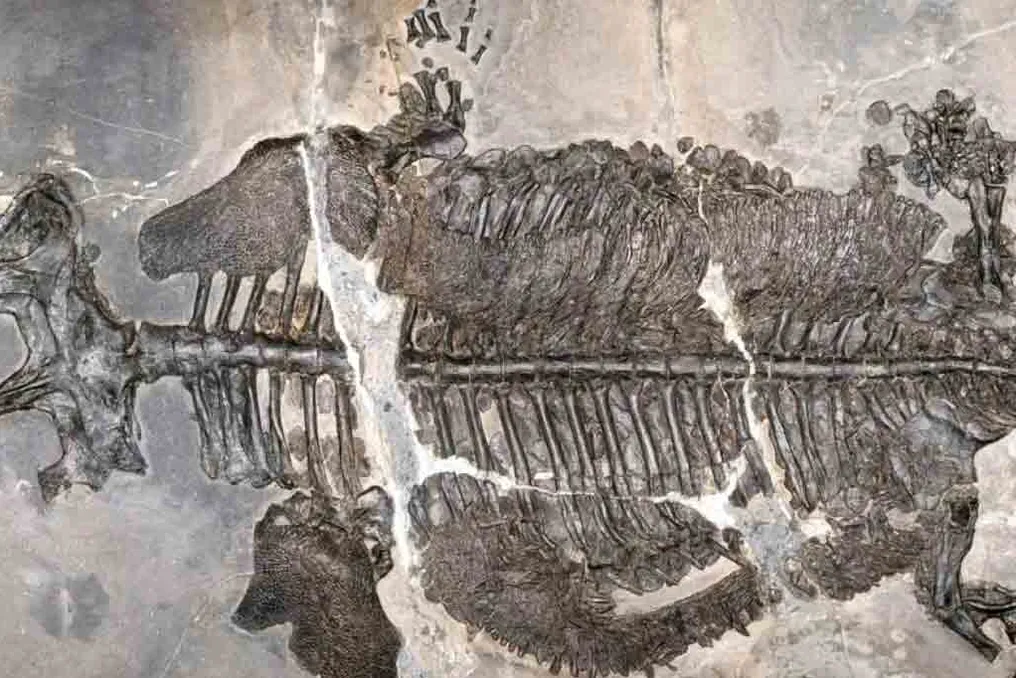
Scientists made a significant discovery by finding fossilized skeletons in the province of Guizhou, China. These fossils indicate the existence of an amphibian that inhabited the saltwater waters of that region approximately 237 million years ago.
This new species, named Gerrothorax maritimus, was about 74 centimeters long and had a flattened body protected by hard scales, resembling armor. For specialists, this finding has revolutionary potential because, if it is confirmed that this Triassic amphibian was entirely marine, it would significantly alter the current understanding of how modern amphibians adapt to terrestrial and freshwater life.
Currently, only 2% of amphibians show tolerance to seawater. Unlike oceanic fish, which have specific glands to expel excess salt, most amphibians have thin and permeable skin, which is essential for breathing and absorbing fresh water. However, this same characteristic makes them vulnerable to rapid dehydration when exposed to saltwater.
Ryosuke Motani, the study's author, explained to Reuters that when a frog swims in saltwater, it loses water through its permeable skin due to osmotic pressure, and it also cannot drink water for the same reason, resulting in weight loss and the need to recover in fresh water. This limitation prevents amphibians from becoming completely marine.
Gerrothorax maritimus managed to survive in saltwater thanks to a unique trait: its bony armor. These protective structures, composed of bone plates, served to defend against predators in freshwater environments but took on a distinct function in the sea. The armor is thought to have prevented salt absorption through the skin, forcing the animal to ingest seawater through its mouth and subsequently filter the salt through its gills. Motani described this process as exaptation, when a biological trait acquires a different function than its original one.
Comparative anatomical analysis indicates that the closest relative to Gerrothorax maritimus is Gerrothorax pulcherrimus, another extinct amphibian from the Triassic period. This relative also had armor and a flattened body but lived exclusively in freshwater. Researchers concluded that the marine lifestyle of Gerrothorax maritimus was an accidental evolutionary event.
Although the hypothesis arose that the skeleton might have been transported to the sea after death, researchers maintained their belief that it was a marine creature. This is due to the fact that its bones were found very far from any landmass of the time, suggesting they were not carried by ocean currents.
Additionally, the team analyzed the animal's isotopes to determine its diet and habitat. This analysis helped date minerals and water in marine samples. The levels found in the bones matched those of Triassic seawater, indicating that these creatures probably 'grew drinking seawater,' as reported in the study published in the journal Nature Ecology & Evolution.